Backlink API: How Modern Agencies Automate Link Tracking at Scale
There’s a point in every growing SEO agency when the spreadsheet breaks. In terms of operations, at least. The tab count multiplies and the Monday morning export ritual extends into the afternoon. A client calls to ask why their rankings dropped. The answer, buried in a CSV from three weeks ago, is that they lost fourteen backlinks to a site redesign. Sadly, nobody caught it.
That’s not a headcount issue. The process that breaks first is almost always backlink tracking.
This guide explains what a backlink API is, why it matters as an agency grows, and how to put one to work inside your agency workflow.
Why Backlink Tracking Breaks As Your Agency Grows
Most agencies don't realize backlink tracking is broken until they're already losing clients over it.
Manual Reporting Is Operationally Expensive
The standard agency backlink workflow is familiar: log in, export a CSV, reconcile it against last month's data, format for the client report. Multiply that across fifty clients and the process takes up dozens of hours and produces data that is already stale on arrival.
Each manual step increases the possibility of human error. Columns get misaligned, filters are applied inconsistently, a trailing slash gets added or dropped and suddenly the historical comparison is meaningless. These small errors add up fast.
Lost Links Don't Wait for Your Monthly Report
Backlinks disappear constantly for mundane reasons like a site redesign, a deleted post, a lapsed domain. And while good links are quietly disappearing, toxic ones from low-quality sources may be building up.
A monthly export schedule means that a link lost on day two of a reporting cycle doesn’t show up until day thirty. In competitive verticals like legal or finance, that's enough time to lose rankings before anyone at the agency notices something is wrong.
Competitor Monitoring Does Not Scale Manually
Manual competitor monitoring at scale is practically not feasible. Checking five competitor domains across fifty clients requires 250 individual data pulls per reporting cycle. Even if each pull takes only a few minutes, the aggregate time investment makes continuous monitoring impossible.
What Is a Backlink API?
A backlink API is one component of a broader SEO API for agencies — the programmatic layer that replaces manual platform use across link tracking, keyword data, and site audits.
Instead of someone logging in and downloading a report, the API requests the data automatically and delivers it wherever your workflow needs it, in the format you specified, on the schedule you set.
Core Data Returned by a Backlink API
A solid backlink API gives you access to:
Referring domains, including domain authority scores and trust metrics
Anchor text distribution
Dofollow and nofollow status for every link
New links acquired and lost links, tracked over configurable time windows
Historical backlink data for trend analysis and velocity calculations
Toxic or low-quality domain flags for link health monitoring
API vs. Traditional SEO Tool Interfaces
Choosing an API over a traditional SEO platform isn't about convenience. It's about who controls the data flow.
Traditional SEO tools are designed for human navigation. You log in, configure a report, wait for it to load, and export or interpret what you see. The data exists inside the platform's interface, on its schedule, in its format.
An API inverts that relationship. Your systems request the data. You control where it goes and how it's structured.
Backlink API Comparison: Which Is Best for Agencies?
Not all SEO APIs for agencies are built with agency operations in mind. What matters most is workflow efficiency, multi-domain scalability, reporting integration, and how quickly you can get value from it.
Here's how the three best backlink API options compare for agencies:
Feature | Ahrefs API | DataForSEO API | Bishopi Backlink API |
Backlink index size | Very large | Very large | Agency-optimized |
Agency workflow design | Limited | Minimal | Core focus |
Reporting integration | Requires dev work | Fully custom build | Built-in |
Setup complexity | High | Very high | Low to medium |
Scalability (50+ clients) | Possible, costly | Possible, complex | Designed for this |
Pricing model | Enterprise tier | Pay-as-you-go | Agency-friendly |
Toxic link detection | Yes | Custom build | Yes |
Ahrefs API
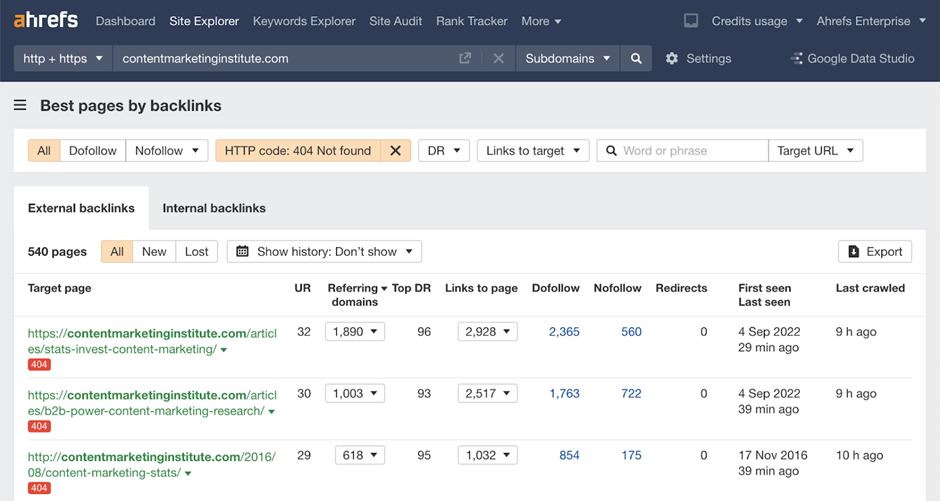
Best for: Enterprise-level backlink data depth
Ahrefs has built one of the most respected backlink indexes in the industry. For agencies that need rich historical data, granular authority metrics, and Site Explorer-level insights delivered via API, it is a strong option.
Ahrefs API is enterprise-priced, which puts it out of reach for many growing agencies. It's well-documented, but building the automation layer most agencies need still requires dedicated development work.
Bishopi Backlink API
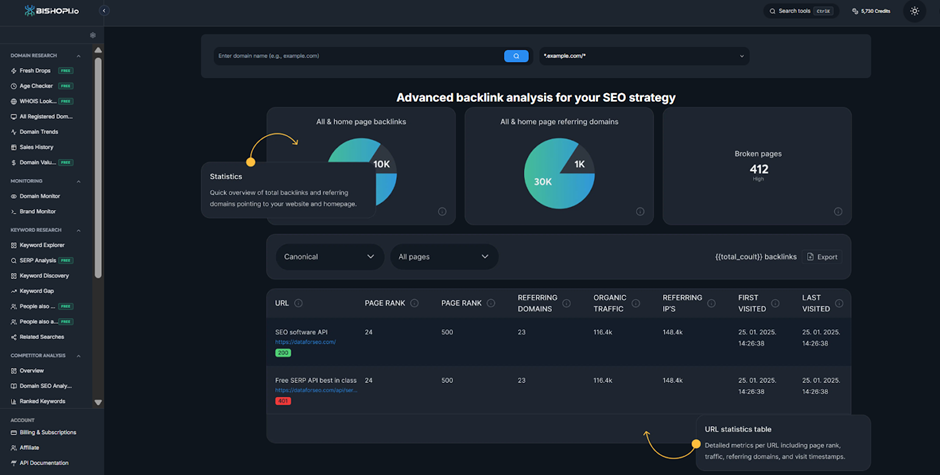
Best for: Agencies automating link tracking at scale
Bishopi is built around agency operations, not data research. It's designed for agencies managing multiple client domains, with backlink data flowing automatically into reporting and monitoring workflows.
Where other APIs provide data access that you then have to operationalize, Bishopi is structured to support automated monitoring workflows from the outset. The design prioritizes scalability across a client portfolio and integration with reporting pipelines.
DataForSEO Backlinks API
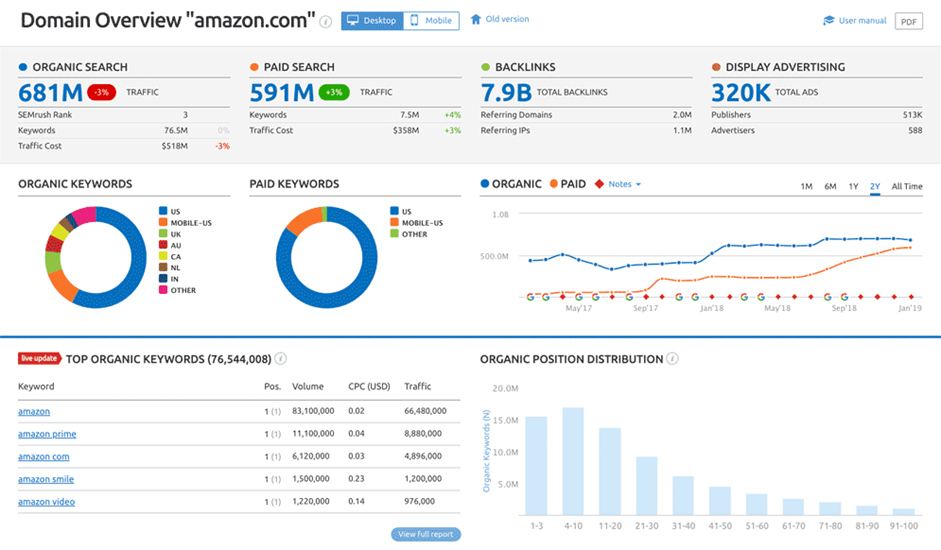
Best for: Developer-centric SEO applications and custom SaaS builds
DataForSEO has one of the largest backlink indexes available via API. For developers building SEO products, the flexibility and data volume are hard to match at the price.
The trade-off is significant for agency use cases. DataForSEO provides data; it does not provide workflows. Every agency-specific function, from client reporting to alert systems to dashboard integration, needs to be custom-built on top of the raw API.
How Agencies Use a Backlink API in Practice
Here's what that looks like in practice for agencies using Bishopi.
Workflow | Trigger | Action | Outcome |
Link Health Monitoring | Daily API pull | Flag lost/toxic links, alert team | Faster response, no silent losses |
Competitor Intelligence | Scheduled crawl | Track new referring domains, feed outreach | Proactive link prospecting |
Client Reporting | Monthly schedule | Auto-populate dashboards, generate PDFs | Zero manual exports |
Workflow 1: Automated Link Health Monitoring
A daily API pull checks each client's backlink profile against the previous day's data. Any link that has disappeared since the last pull is flagged automatically. High-value lost links trigger an automatic alert to the account manager.
A link lost on a Tuesday is visible by Wednesday rather than three weeks later when the monthly report gets assembled. The team can contact the site owner to restore the link before too much time has passed.
Workflow 2: Competitor Backlink Intelligence
For each client, the agency maintains a list of tracked competitor domains. A scheduled API pull runs against those domains daily or weekly, depending on the vertical. The system picks up any new domains linking to competitors that aren't linking to the client yet.
Those domains feed straight into your outreach pipeline as pre-qualified prospects. Instead of manually running competitor analysis before every campaign, the outreach list builds itself continuously. A domain that already links to your client's competitors has already demonstrated interest in the niche. That's a warmer start than most outreach ever gets.
Workflow 3: Automated Client Reporting
Monthly reporting is time consuming. It’s also straightforward to automate once a backlink API is in place.
When backlink data flows automatically into your reporting tools, the monthly report shifts from being a production job and becomes a review.
For a 30-client agency, that's a meaningful chunk of billable time recovered every month.It also means clients hear about their results faster—that's a meaningful chunk of billable time recovered every month.
Best Practices for Using a Backlink API at Scale
Setting up a backlink API is the easy part. Getting real value from it comes down to how you configure and use it.
Set monitoring frequency based on link velocity: Don't just leave the API on whatever monitoring frequency it defaults to. If a client is in a competitive niche where links are won and lost frequently, check more often. If their link profile barely moves, weekly is fine.
Store historical backlink data from day one: Twelve months of history lets you identify patterns, diagnose ranking shifts, and demonstrate cumulative impact.
Track link velocity trends, not just current totals: A sudden spike in lost links may indicate a migration issue. A spike in low-quality incoming links could mean a competitor is deliberately trying to hurt the site's rankings.
Automate alerts for lost or toxic links: Set alerts only for links from high-authority domains. Otherwise every lost link triggers a notification and the alerts become noise.
Combine backlink data with ranking data: When a ranking drops, check whether a link was lost around the same time. Over time, that pattern tells you which links are actually moving the needle.
Monitor anchor text distribution regularly: If too many backlinks use the same keyword-heavy anchor text, Google may flag it as manipulative. Regular monitoring lets you catch that imbalance early.
Benchmark against competitor profiles quarterly: Having 500 backlinks sounds good until you realize your top competitor has 2,000. The number on its own doesn't tell you much; what matters is whether you're ahead or behind the sites ranking above you.
The Future of Programmatic SEO: Why the Backlink API Is the Engine Behind Agency Growth
The agencies that scale well aren't necessarily the biggest ones. They're the ones where the data works in the background so the team doesn't have to. A backlink API is a big part of how that happens.
Manual tracking doesn't scale; and at a certain client volume, it starts costing you more than just time.
Bishopi's Domain Valuation Tools and Backlink API are built specifically for agencies making this transition. Explore Bishopi's API solutionsto start automating your link tracking workflow and build the backlink infrastructure your agency needs to scale.
Frequently Asked Questions
What is a backlink API and how is it different from an SEO tool?
An SEO tool puts data inside a platform that someone has to log into and export manually. A backlink API delivers that same data directly to your systems on an automated schedule. For agencies managing multiple clients, that difference determines whether backlink monitoring is a scalable process or a weekly chore.
How does a backlink API improve client retention for agencies?
A backlink API lets agencies catch lost links, toxic domains, and competitor activity in near real-time rather than at monthly reporting intervals. When an agency spots and fixes a problem before the client notices a rankings drop, the relationship shifts from reactive to proactive. That's a harder thing for clients to walk away from than a cheaper price
What is the best backlink API for agencies?
To find the best backlink API for your agency, look for an API built for multi-domain monitoring, not single-domain deep dives. It should integrate cleanly with your existing reporting tools and include the signals that matter most to agencies: new and lost link tracking, anchor text data, and authority scoring.
Factor in the full cost of integration, not just the subscription price. An API that takes weeks to set up is more expensive than it looks.
Originally published at: bishopi.io
Get updated with all the news, update and upcoming features.