Domain Valuation Tools: Top Estibot Competitors for Accurate Appraisals
Imagine this: You just purchased a promising domain online for $4000, based on Estibot’s estimate. You’re confident it’s a great deal and would yield generous returns. Now that you’re ready to resell, you run the domain through another valuation tool and discover its worth is far less than expected.
This happened to Ron in 2016:

While Estibot is one of the most popular domain appraisal tools, its valuations rely on algorithms that overvalue or undervalue domains. This inconsistency makes its estimates questionable, which is why many expert domainers don’t rely on it.
I spent 48 hours combing the Internet for other reliable Estibot alternatives that offer the best insights into your domain valuation. Whether you’re an expert investor or just looking to sell your domains, these appraisal tools will help you make smarter, data-driven decisions.
But before we get started…
What To Look Out For When Choosing An Estibot Alternative?
When sourcing for Estibot’s alternatives, prioritize comprehensive tools that provide rich insights into why a domain is assigned a particular value and historical sales data of similar domain names so you can compare prices. An appraisal tool that can also show historical sales data for particular domain names (for pre-owned domains) will inform how to value your domain.
Other vitals to look out for are:
i. Accuracy and Reliability
A reliable domain appraisal tool should provide valuations that closely reflect real-world market prices. Estibot and other automated tools rely on basic algorithms, which dilute or inflate a domain's worth. The Domain King complained of this on Twitter:

Instead, you want an alternative that factors recent sales data, industry trends, and market demands to offer more precise valuations.
ii. Integration from other tools:
Next, ensure that your choice tool integrates with your domain software ecosystem, especially if you use multiple tools for domain research, SEO analysis, and marketplace listings. This makes it easy to manage your entire workflow.
iii. Ease of Use:
Another important factor to consider is user-friendliness. The platform should have a clean design, intuitive navigation, and easy-to-understand data presentation.
iv. Data Sources and Valuation Methodology:
The accuracy of a domain valuation tool largely depends on its data sources. As I mentioned earlier, Estibot relies on algorithms and other value indicators, such as the TLD, name length, and keywords.
While this may work in some cases, it’s unreliable as you cannot properly vet the data source; hence, its accuracy is out of your control. This Reddit user, babadoosus, affirmed this for Estibot:

Instead, look for alternatives that provide a detailed, clear overview of the data points, including historical sales data, SEO metrics, and marketplace listings. This clarity helps you make an informed decision when you’re ready to sell or buy.
v. Affordability:
Estibot promises free and instant domain name appraisals, but some users complain of hidden charges:

And poor customer service, too:

Personally, I won’t recommend free domain appraisal tools because you may miss out on advanced analytics for a more accurate valuation.
Also, many free tools use basic algorithms that don’t factor in real-world sales data, which can affect appraisal accuracy in the long run. Instead, go for a paid service that’s also affordable. Bishopi gives you not just a domain valuation tool, but an end-to-end suite of domain and SEO analysis tools you’ll need in your investing journey.
vi. Extra Features:
Want the best value for the buck? Opt for a tool that offers comprehensive domain and SEO features. This way, you can save money and time managing multiple platforms simultaneously.
Quick comparison: 10 domain valuation tools at a glance
Want the short version before we dive in? Here's how the 10 tools stack up:
Tool | Best for | Free tier | API | Pricing |
|---|---|---|---|---|
Bishopi | Investors who need SEO and valuation signals together | Limited | Yes | From $39/mo |
Estibot | Keyword-rich commercial .coms | 3 lookups/day | Paid only | From $9.95/mo |
GoDaddy GoValue | Quick free first-pass estimates | Yes | Paid | Free / paid API tiers |
HumbleWorth | Brandables, .ai, .io domains | Unlimited | Yes (free) | Free |
Flippa | Domains attached to revenue-generating sites | Yes | No | Free tool; marketplace fees on sale |
Sedo | European ccTLDs and human-reviewed appraisals | No | No | From $99 per appraisal |
NameBio | Validating any valuation against real sales | Yes | Paid | Free / Pro tiers |
Dynadot | Bulk portfolio appraisal inside a registrar | Yes | No | Free |
Saw.com | Quick lookups with no account required | Yes | No | Free |
Epik | A second free opinion alongside another tool | Yes | No | Free |
How domain valuation tools actually work
Every algorithmic valuation tool out there, from Estibot to GoDaddy to HumbleWorth, works by combining a handful of underlying signals. Knowing which signals matter most for your domain is the difference between trusting a number blindly and reasoning through it. Six factors do most of the work.
1. The TLD
The .com extension still commands a meaningful premium over almost every alternative. Extensions like .io and .ai have carved out real value in tech and AI contexts, but buyers treat ccTLDs and newer gTLDs as highly variable, and often discount them. How a tool weights the TLD is one of the biggest reasons two tools will give you wildly different numbers for the same name.
2. Keyword value and CPC
This is the core of Estibot's methodology. The logic is simple: if advertisers pay a premium to reach users searching for a keyword, a domain containing that keyword should be worth proportionally more. It works well for keyword-heavy commercial domains in niches like loans, insurance, or software. It breaks for coined brand names, newer TLDs where CPC data is thin, and any name where the value is in memorability rather than advertiser spend.
3. Comparable sales
The most defensible signal in any valuation is what similar names actually sold for. NameBio's database of 500,000+ recorded transactions going back to 2003 is the industry reference. Most tools incorporate sales comps to some degree, but the depth and recency vary wildly. A tool that's pulling from a stale database will systematically misprice domains in fast-moving categories like AI.
4. Domain age and registration history
Older domains with a clean history carry more weight. A domain that's changed hands repeatedly, been penalized, or sat parked for years is worth less even if the name itself is strong. Few free tools surface this, but it shows up in every serious buyer's due diligence.
5. Backlinks and traffic
If a domain has accumulated authority through inbound links, organic traffic, and indexed pages, it's worth more than a freshly registered equivalent. This is the most reliable indicator of accumulated value, and the one most commonly ignored by free valuation tools. It's also where Bishopi's approach differs most from the single-number algorithmic tools.
6. Brandability
Length, pronounceability, memorability, and how cleanly the name reads. This is the hardest factor to quantify and the one where tools diverge most. A short, pronounceable two-syllable .com will often outperform a longer keyword name in actual buyer interest, but you wouldn't know it from CPC-driven tools.
No two tools weight these signals the same way. That's not a flaw. It's exactly why running a domain through two or three tools and reasoning from the spread is more useful than chasing a single "true" number.
Now, let’s go into the fun part:
Top Five (5) Estibot Alternatives for 2025
In this section, I’ll share my top five (5) EstiBot competitors and rank them based on their best use cases. You’ll also learn their strengths, top features, and pricing plans.
i. Bisiopi Domain Valuation Tool - Best for Real-Time, Data-Driven Appraisals
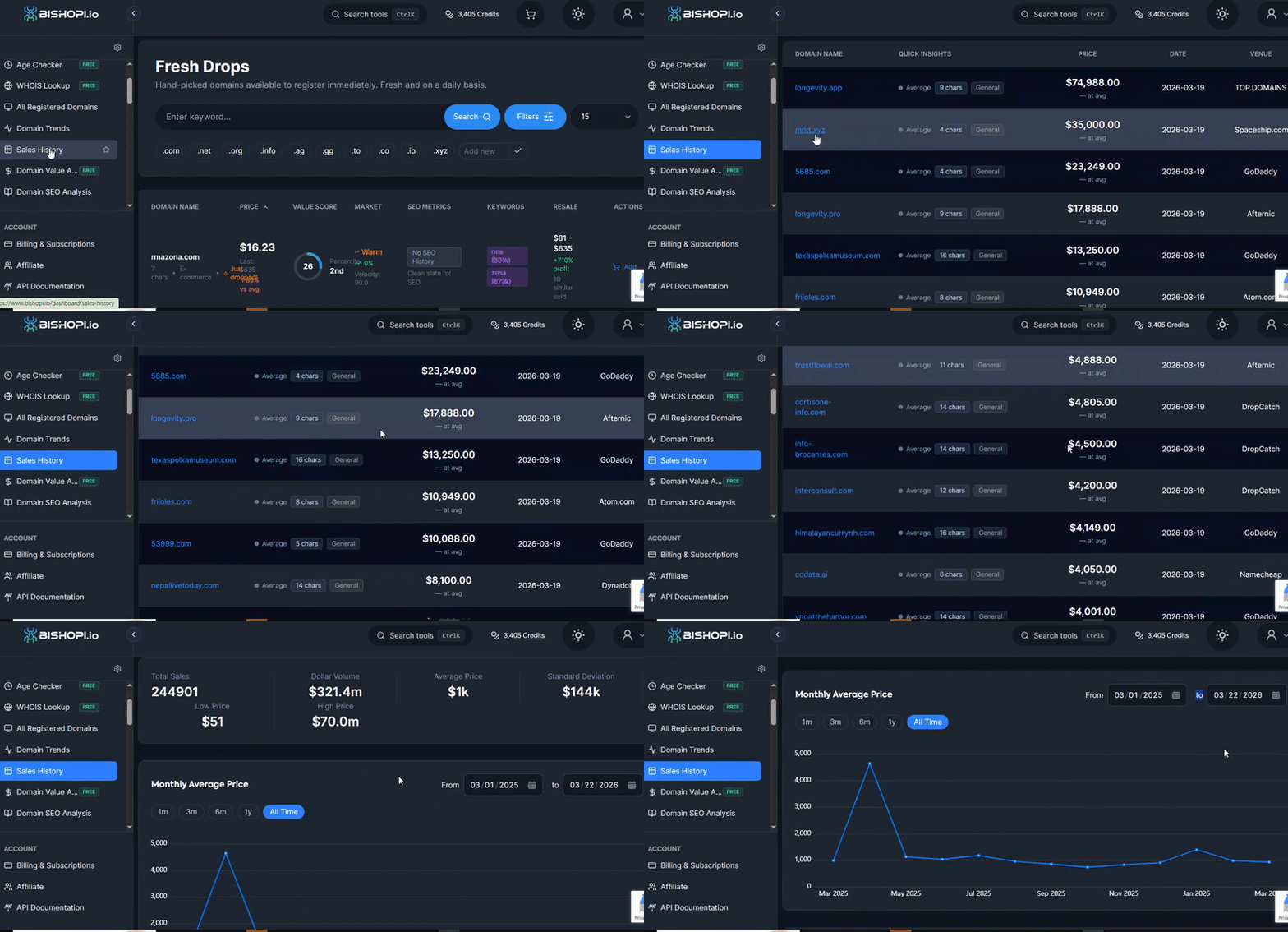
Bishopi domain valuation tool tops my list for many good reasons. This tool provides rich insights into any domain’s past and current sales history to help you estimate its market value.
You’ll love how the process is completely data-backed. Right on the dashboard, you’ll see how often the domain has been sold, real-time market trends, branding appeal, and keyword popularity.
You can also search recent sales of domains that contain particular keywords, so if you have a particular keyword-rich domain, you can tell what the market is willing to pay for it based on similar sales. This helps you gauge prices before buying or selling a domain.
What’s more? Bishopi also offers a full suite of SEO tools you can use to investigate the key metrics - domain authority, search traffic, backlinks, and more - that buyers look out for when buying a used domain.

Who’s it for:
Bishopi is best for domain investors, business owners, SEO professionals, and digital marketers who want to buy or sell a domain name.
Why is Bishopi a great domain appraisal tool?
Unlike tools that rely on basic algorithms, Bishopi appraises domain names based on real-time data sources and market intelligence. This includes the sales history, SEO value, keyword potential, and branding appeal.
What else does it offer?
Bishopi offers other complementary domain and SEO-related features, such as:
WHOIS lookup tool - to understand the domain ownership and history
Domain monitor - Gives you real-time data on specific domain(s)
SEO analysis and metrics tool - to track all your vital SEO metrics, including traffic, domain authority tracker
Domain age checker – displays a domain's age, including the registration dates, registrar, last active date, and other essentials.
Portfolio management tools – A simplified tool to manage all your domain-related activities in one place.
Pricing:
Bishopi has a plan for everyone. If you’re just starting your journey as a domain investor and need a domain tool to show you the ropes, opt for the basic plan, which costs $39/mo. The most advanced plan costs $349/month and works well for expert investors.
ii. GoDaddy Domain Appraisal Tool – Best Free Option:

If you need a quick and free way to estimate a domain’s value, the GoDaddy domain appraisal tool is a solid choice. I picked them for two reasons:
They’re one of the largest domain registrars in the world.
Their algorithm uses machine learning to scrape sales data compiled from their industry-long experience to generate appraisals.
However, their appraisals are not based on real-time data, which can be an issue in the long run.
Who’s it for:
GoDaddy’s domain appraisal tool is best for small business owners, beginners, or casual domain buyers who need a free domain valuation tool.
Why GoDaddy is a great domain appraisal tool:
GoDaddy is a good choice because it offers a quick way to get a rough domain estimate. Its 20+ years of domain experience also provides access to extensive historical sales data.
What else does it offer?
Beyond domain appraisals, GoDaddy offers:
Domain registration and hosting services
WHOIS lookup
Domain name generator
AI website builder
Pricing:
GoDaddy domain name appraisal tool is free. However, advanced features cost $99.99/mo for the basic plan and $499.99/mo for the professional plan.
iii. NameWorth Domain Appraisal Tool - Best for Brandable Domains:

The NameWorth domain appraisal tool is an excellent choice for domain investors and business owners looking to evaluate the brandability of an English domain name. Although it’s a paid tool, you’ll get 5 free domain lookups/day when you sign up.
Who’s it for:
NameWorth is best for beginners who want to learn the ropes of pricing a domain name.
Why NameWorth is a great domain appraisal tool:
NameWorth uses a tiered system to categorize domains based on their marketability. This is a quick way to know the domain’s potential marketability before making any moves.
What else does it offer?
NameWorth is solely a domain appraisal tool.
Pricing:
This tool starts at $9.99/mo for the personal plan and up to $4,999/mo for the enterprise plan.
iv. HumbleWorth: best free AI-based valuation with an API
HumbleWorth launched in 2023 and has quickly become a favorite among working domain investors. What makes it stand out? It returns three separate estimates: auction value, marketplace value, and brokerage value. That's genuinely useful because the same domain is worth different amounts in different sales channels, and most tools pretend that's not true.
You'll also love that HumbleWorth offers a free API, which is rare in this category. If you want to value a portfolio of domains in bulk without paying for a subscription, this is the easiest way to do it.
Who's it for: Domain investors who deal in brandables, .ai, .io, or any name where Estibot's CPC focus comes up short. Also great for anyone who needs API access without the price tag.
Why HumbleWorth is a great Estibot alternative: The three-channel estimate model reflects how the market actually works. It's strong on brandable names where CPC-driven tools struggle, and it's honest about uncertainty rather than projecting false precision.
Where it falls short: Newer training data means it's weaker on pre-2020 historical comps than Estibot. The breakdown of why a number landed where it did is less detailed.
Pricing: Free, including API access.
v. Flippa Domain Valuation Tool - Best for Domains with Traffic & Revenue:

Flippa made it to my list of top Estibot alternatives because of its unique valuation method. Flippa is best known as the place to buy and sell businesses and websites - not just domains.
Flippa factors business model, domain age, business category, and revenue to price domain names compared to other appraisal tools on this list. The valuation largely depends on the information you provide and their backlog of user transactions.
Who’s it for:
Flippa’s domain valuation tool is best for domain investors and business owners who need to appraise a domain based on market potential, traffic, and revenue.
Why is Flippa a great domain appraisal tool?
Flippa stands out because it benchmarks value using real-time business metrics and past transactions from their domain marketplace.
What else does it offer?
On Flippa, people can buy and sell whole websites and businesses.
Pricing:
Flippa's domain valuation tool is free.
vi. Sedo Domain Valuation Tool

Sedo is a domain marketplace, but its scientific approach to domain valuation makes it one of the best Estibot competitors. To appraise domains, this tool factors in vitals such as domain TLD, length, language complexity, scalability, SEO, and historical sales data. You can also use it for bulk appraisals.
The only downside is that each appraisal takes at least five days to generate. This can be a turn-off if you need valuations more quickly.
Who’s it for:
Sedo’s domain valuation tool is best for resellers, domainers, and business owners who must appraise multiple domains simultaneously.
Why is Sedo a great domain appraisal?
The Sedo appraisal tool is integrated with its marketplace platform, which is a huge plus if you’re a buyer or seller there. They also offer human appraisal services for a more accurate valuation.
What else does it offer?
Domain marketplace
Brokerage services
Parking & monetization services
Pricing:
It costs $99 to appraise one domain on Sedo.
vii. NameBio: best comparable-sales database
NameBio is often miscategorized as a valuation tool. It isn't. It's the largest public database of actual completed domain sales, with more than 500,000 transactions going back to 2003. You don't get a "this domain is worth $X" answer. Instead, you search for comparable sold names and reason from real evidence.
Why does this matter? Because every serious domain investor uses NameBio to validate the numbers that come out of the other tools on this list. If Estibot says $8,000 and three structurally similar domains sold for $1,500 in the last 12 months, the Estibot number is the one that needs explaining.
Who's it for: Every domain investor. Not as your first stop, but as the final sanity check before you commit to a number.
Why NameBio is essential: It's the most credible single source of historical sales data in the industry. Every other tool's number is just a model output until you've cross-referenced it against real comparable sales.
Where it falls short: It doesn't give you a single-number output, which means it's not a substitute for an estimator. You also need a working knowledge of the market to interpret what you're seeing.
Pricing: Free basic access. A Pro tier with advanced filters and API access is also available.
viii. Dynadot appraisal: best for bulk portfolio work inside a registrar
Dynadot's built-in appraisal has quietly become one of the more capable free options in the market. Its real strength is portfolio bulk work. If you already have dozens of domains in a Dynadot account, you can value the entire portfolio with a single click.
The tool evaluates length, memorability, keyword relevance, TLD strength, registration history, and comparable sales, which gives it a broader signal base than most free alternatives.
Who's it for: Existing Dynadot customers who want one-click portfolio appraisals, plus anyone who wants a free second opinion alongside GoDaddy or HumbleWorth.
Why Dynadot is a great Estibot alternative: The free comparable-sales integration is a genuine differentiator at the free tier, since most tools don't surface this at all. It's also strong on mainstream domains.
Where it falls short: There's no public API for programmatic access. It's also less accurate on a single high-value domain than Estibot or a Sedo human review, with limited transparency on factor weights.
Pricing: Free.
ix. Saw.com: best for quick lookups with no account required
Saw.com offers free domain valuations without asking for an email, account, or sign-up. That sounds like a small thing until you've been email-funneled by every other tool on this list. It's a clean utility, not a deep analytical tool, but for a quick gut check it does the job.
Who's it for: Anyone who wants a quick anonymous second opinion without handing over personal info.
Why Saw.com is worth using: It's fast, no friction, and useful as a quick cross-check alongside another tool. The lack of account requirement is genuinely refreshing.
Where it falls short: Less methodological transparency than the bigger tools. It's not a portfolio tool, and it's not where you should base a serious investment decision.
Pricing: Free.
x. Epik: best as a second free opinion
Epik's free appraisal returns a dollar estimate along with a mix of standard and less common stats. It's not the most accurate tool on this list, but it's a useful second free opinion when you want to triangulate before committing to a paid Sedo appraisal or a serious buy.
Who's it for: Anyone who wants to sanity-check a number from another tool before acting on it.
Why Epik is worth a look: It's free, fast, and surfaces some less common data points like broker interest and parking estimates. Useful for triangulation when two other tools disagree.
Where it falls short: Less reliable than the bigger algorithmic tools. Best treated as a sanity check rather than a primary source.
Pricing: Free for the standard appraisal. A professional human appraisal is available for around $399.
Get Accurate Domain Valuation With the Best Estibot Alternatives
As a domain investor or business owner, you’ve likely felt the sting of uncertainty—overpaying for a domain that flops or missing out on a gem because the valuation didn’t add up.
While Estibot is one of the most popular domain appraisal tools, it's not always accurate. And this can be costly in the long-run. Castello Brothers was almost a victim of this:

Reliable and accurate domain appraisal tools like Bishopi offer transparent valuation methods, as you can track real-time data used to evaluate the domain. This includes historical sales data, current market trends, and other vital metrics.
It also doubles as an SEO analysis tool, helping you determine the domain's search potential before taking the next steps.
FAQs
What is the best free tool for domain valuation?
For most domains, GoDaddy GoValue is the best free quick-check, since it's trained on the largest aftermarket sales dataset in the industry. For brandable names, .ai, or .io domains, HumbleWorth's free tool tends to be more accurate because GoDaddy's model is heavily weighted toward .com sales. Use both for any name you're serious about. The two will often disagree, and the disagreement itself tells you something useful about the domain.
Why do Estibot and GoDaddy give different valuations for the same domain?
Because they're measuring different things. Estibot's algorithm is heavily weighted toward CPC and keyword search volume. It's essentially asking, "how much would an advertiser pay for traffic on this term?" GoDaddy's model is weighted toward comparable sales in its own aftermarket. It's asking, "what have similar names sold for recently?" Both are legitimate methodologies. They just answer different questions. When they disagree significantly, cross-reference against NameBio sales data to see which question better matches your domain's category.
How accurate are free domain valuation tools?
Free tools are accurate enough for triage but rarely accurate enough for high-stakes decisions on their own. They tend to be weakest on the factors that move prices the most, like backlink profile, traffic data, and the specific brandability of a name. The realistic use case is to combine a free tool for the initial estimate with a more comprehensive source (Bishopi for SEO signals, NameBio for comparable sales) before committing to a number that involves real money.
Is there a truly free Estibot alternative?
Yes, several. HumbleWorth is free and includes API access, which makes it the closest functional replacement for Estibot's paid features. GoDaddy GoValue is free for single-domain appraisals. Dynadot's appraisal is free if you have an account. None of these will replace Estibot perfectly for keyword commercial .coms, but for everything else they're at least as good and often better.
How often should I revalue my domain portfolio?
Twice a year is enough for most portfolios. Quarterly is reasonable if you're actively trading or holding domains in fast-moving categories like AI-adjacent .com or .ai names, where values have moved 20 to 40 percent in single quarters over the last 18 months. Tools like Bishopi's portfolio monitoring or Dynadot's bulk appraisal make this a one-click job rather than a project.
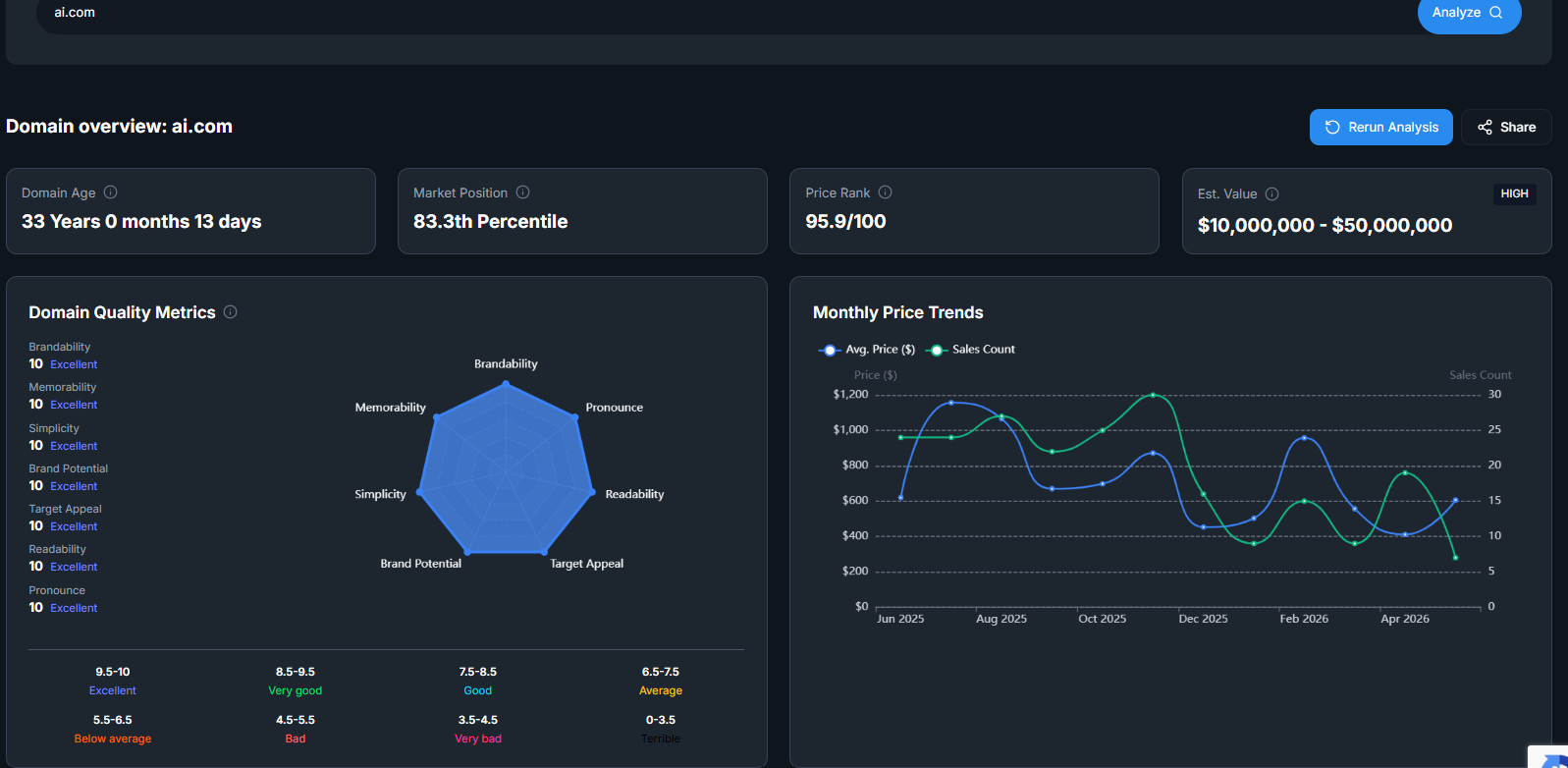
Domain SEO analysis tools like Bishopi also give you a snapshot of a domain's authority score, rank, and difficulty:

How to daily value a domain?
Follow these steps to get an accurate value of your domain:
Go to the bishop.io domain history tool
Sign up and choose a plan that suits your use case
Log back into the Bishopi dashboard and click “Pro Tools >> Domain Sales Lookup.”
Enter the domain URL in the space provided and click search
That’s it! You’ll get a rich, detailed overview of the domain’s sales history, market trends, keyword value, monthly sales data, and SEO overview.
Originally published at: www.bishopi.io
Stay up to date
Get updated with all the news, update and upcoming features.