DataForSEO Alternative: Which API Fits Your Use Case? (2026)
Every few weeks, a thread like this surfaces on Reddit: a developer hitting a wall with DataForSEO - not because the API is bad, but because the architecture doesn’t fit their build.
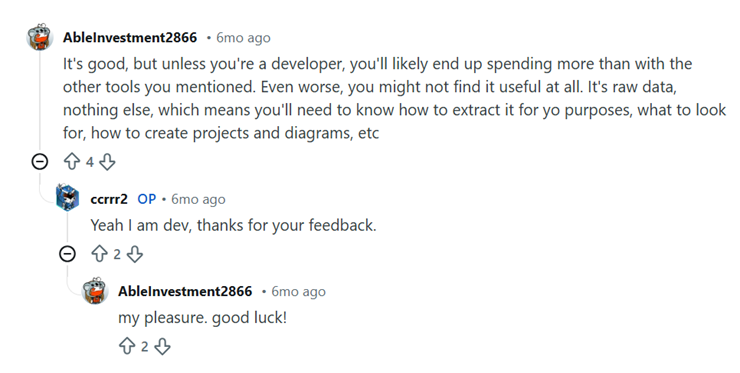
[Screenshot via Reddit]
The friction shows up in a few predictable places. Once you see the pattern, it becomes easier to map the best SERP APIs for competitor analysis or other use cases.
Why Do Developers Leave DataForSEO?
It usually starts small.
A feature takes longer to ship, and a workflow feels heavier than it should. Then the same constraints keep showing up as the system grows.
Async architecture overhead - Submit, poll, fetch. If you need to ship fast or want synchronous responses, this adds integration complexity that your timeline can't absorb.
Live mode cost at volume - DataForSEO's live endpoint runs $2.00/1K requests. Past 50K queries/month, that starts hurting the margin fast.
No enriched data in one call - Need backlinks or domain intelligence alongside SERP results? That's a separate endpoint, a separate API call, sometimes a second provider.
Limited engine coverage - If your product needs Bing, YouTube, or Amazon data, DataForSEO doesn't get you there.
If these reasons sound familiar, this DataForSEO alternatives guide is for you.
Especially if you’ve already chosen APIs over platforms - if not, start with SEO API vs SEO tools to make sure you’re solving the right problem.
The Pricing Reality: What Each DataForSEO Alternative Actually Costs at Volume?
Before getting into which tool fits which build, the numbers matter. At 100K queries a month, a difference of $50 versus $200 changes the decision entirely.
Here's what each alternative actually costs at three realistic volume tiers:
Pricing at Volume (Based on Actual Plans)
Tool | Pricing Model | 10K/mo | 100K/mo | 1M/mo | Delivery | Notes |
Bishopi | Subscription | $49 (10K) | $349 (150K) | Custom | Live + async | Includes domain data |
Serper.dev | Pay-as-you-go | $10 (10K) | $75 (100K) | $300–$500 (tiered plans) | Live | Credits never expire |
SerpAPI | Subscription | $40–$80 (10K) | $250 (100K) | $2,000+ (scale plans) | Live | Multi-engine support |
Bright Data | Usage-based | $10 (10K) | $100 (100K) | $1,000 (1M) | Live | Enterprise infra, proxy layer |
*PricingNote: Figures are mapped to the nearest available pricing tier for each provider as of April 2026. Subscription-based tools use fixed plan buckets, while usage-based APIs scale per request. Where an exact volume tier isn’t offered, the closest plan is shown instead of interpolated values.
Which DataForSEO Alternative Is Right for Your Build?
The final decision isn’t about cost alone, though. You’re choosing the one alternative that breaks least under your specific constraints.
Scenario 1: You Need Real-Time Data
You're building a live dashboard or user-triggered search feature - async doesn't work for your use case.
Every extra second of latency is visible to the end user, so DataForSEO's task-based architecture is a non-starter.
The live endpoint solves the latency problem but creates a cost one: at $2.00/1K requests, you're looking at $200/month at 100K queries before you've spent a dollar on anything else.
⮕ The answer here is Serper.dev.
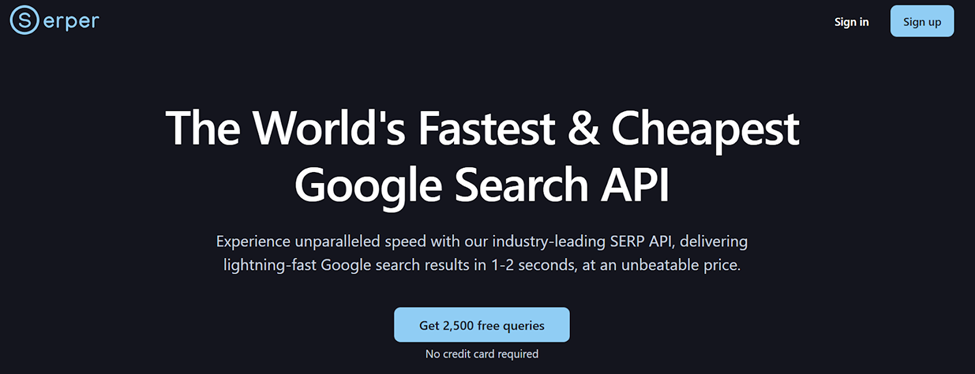
Screenshot via Serper
It returns clean JSON in under two seconds, runs on pay-as-you-go credits that never expire, and at 100K queries/month is a lot more affordable than what DataForSEO's live mode costs at the same volume.
Pricing Details
Starter Plan - $50
50K credits ($1.00 per 1K)
50 queries per second
Standard Plan - $375
500K credits ($0.75 per 1K)
100 queries per second
Scale Plan - $1,250
2.5M credits ($0.50 per 1K)
200 queries per second
Ultimate Plan - $3,750
12.5M credits ($0.30 per 1K)
300 queries per second
For pure real-time Google organic results at scale, nothing on this list beats it on cost per query.
That said, Serper.dev is Google organic only.
If your build needs anything beyond that - backlink data, domain-level signals, or results from engines other than Google - it won't cover you, and you're looking at scenario two or three.
Scenario 2: You want Data Depth with Domain Intelligence
You're building a rank tracker or SEO platform that needs more than raw SERP results.
You need domain-level signals alongside them - backlinks, traffic estimates, domain authority - and you don't want to stitch two API providers together to get there.
With DataForSEO, that's exactly what you're doing: a separate endpoint, a separate integration, a separate bill.
⮕ This is the scenario the Bishopi SERP API is built for.
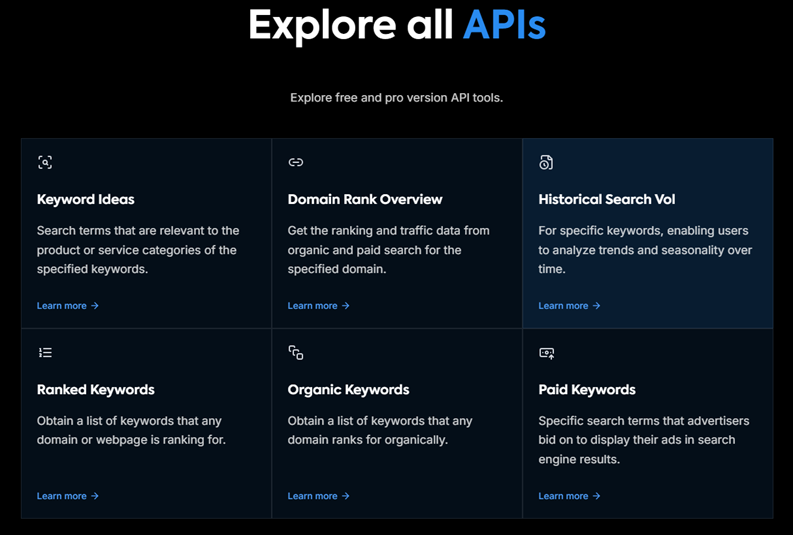
Screenshot via Bishopi
It combines SERP data and domain intelligence into a single ecosystem, so you make one API call instead of two and manage one provider instead of two.
It runs both live and async endpoints, operates on pay-as-you-go credits, and offers a 7-day free trial with no credit card required - which means you can test it against your actual query patterns before committing.
Pricing Details
Individual Plan: $49/month
10,000 API credits per month
Start-Up Plan: $149/month
50,000 API credits per month
Business Plan: $349/month
150,000 API credits per month
Scenario 3: You Need Data From Engines Beyond Google
Your product isn't Google-only. You're pulling data from multiple search environments - Bing for a different market segment, YouTube for video ranking signals, Amazon for product search - and Google organic is one endpoint among several, not the primary one.
⮕ SerpAPI is the right answer for this build.
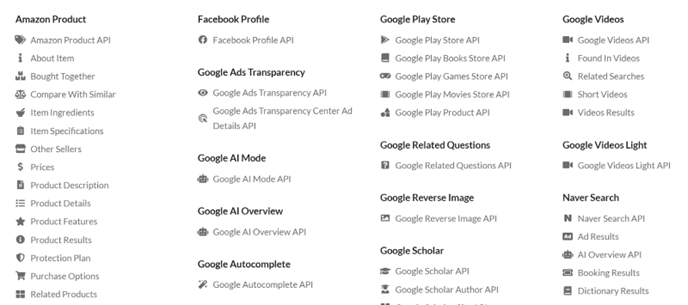
Screenshot via SerpAPI
It covers 100+ engines with synchronous responses and has been a stable, production-grade platform since 2016.
The breadth of engine coverage is genuinely hard to match, and for a multi-engine product, that matters more than per-query cost savings on a single source.
The trade-off is cost.
Pricing Details
Standard Speed
Developer Plan - $40/month
$4 per 1K · 10K searchesProduction Plan - $100/month
$3 per 1K · 35K searchesBigData Plan - $250/month
$2.5 per 1K · 100K searchesScale Plan - $500/month
$2 per 1K · 250K searches
Enhanced Speed
Developer - $80/month
$8 per 1K · 10K searchesProduction - $200/month
$6 per 1K · 35K searchesBigData - $500/month
$5 per 1K · 100K searchesScale - $1,000/month
$4 per 1K · 250K searches
They also offer high-volume plans ranging from $900 to $10,000 for larger workloads.
While it offers multiple pricing options, it is comparatively an expensive option on this list for developers who only need Google organic.
If that's your situation, you're paying a significant premium for engine coverage you'll never touch - go back to scenario one or two.
Scenario 4: You Have Enterprise Compliance Requirements
This scenario is different in kind, not just degree.
You're not choosing between API pricing tiers; you're dealing with organisational data compliance requirements.
That means you're operating at a scale where IP rotation, CAPTCHA handling, and geo-targeting are infrastructure-level concerns that a standard API call can't abstract away.
⮕ Bright Data is the answer, but it's worth being precise about what it is.
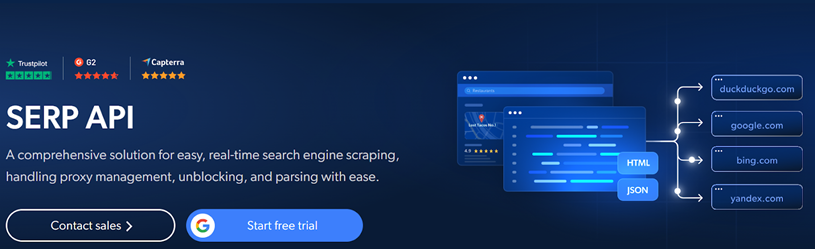
Screenshot via Bright Data
It's not a direct DataForSEO replacement in the way the other three tools are - it's an enterprise web data platform that happens to have a SERP API on top.
The reason it's on this list is that for compliance-heavy enterprise builds, it's the only option that actually solves the problem.
Web Access APIs pricing:
Unlocker API: $1 / 1k requests
Crawl API: $1 / 1k requests
SERP API: $1 / 1k requests
Browser API: $5 / GB
If you're building an SEO product at a startup or mid-market scale, it almost certainly isn’t for you. It is overbuilt and under-optimized, so you end up paying for enterprise-grade infrastructure before you actually need it.
DataForSEO Alternatives: Side-by-Side Comparison Table
Think of these tools as sitting on two axes: data richness vs. simplicity, and cost efficiency vs. engine breadth.
DataForSEO sits at the high-richness, high-complexity end. Serper.dev sits at the opposite corner - minimal, fast, cheap.
The others sit somewhere in between, each optimised for a different trade-off.
The table below maps that out clearly.
The column that matters most depends entirely on your build - a rank tracker cares about enriched SEO data, a price comparison tool cares about multi-engine coverage, and a real-time dashboard cares about delivery mode.
Tool | Primary Use Case | Pricing model | Engine coverage | Enriched SEO data | Free trial | Async support |
DataForSEO | High-volume async SERP data | Pay-as-you-go | Google + limited | No (separate endpoints) | No | Yes |
Bishopi | SERP + domain intelligence in one call | Pay-as-you-go | Yes | Yes - 7 days | Yes | |
Serper.dev | Real-time Google organic at a low cost | Pay-as-you-go | Google only | No | Yes - 2,500 free searches | No |
SerpAPI | Multi-engine coverage | Subscription | 100+ engines | No | Yes - 100 free searches | No |
Bright Data | Enterprise proxy + compliance infrastructure | Usage-based | Multi-engine | No | No | Yes |
A few things worth calling out from the table that aren't immediately obvious.
Enriched SEO data is a binary, not a spectrum.
Either a tool bundles domain intelligence alongside SERP results in the same call, or it doesn't. If it doesn't, you're writing a second integration, and that's not just a cost question; it's an architectural one.
Every additional provider is another failure point, another rate limit to manage, another API contract to keep up with.
Async support matters more than most developers expect upfront.
If you're building a user-facing feature where someone clicks a button and waits for a result, async is a liability.
But if you're running nightly crawls or batch processing at scale - think refreshing rankings for 10,000 domains every 24 hours - async is an asset. DataForSEO's queue architecture is genuinely well-engineered for that pattern.
The tools that don't support async aren't worse; they're just optimised for a different access pattern.
The free trial column is more useful than it looks.
Serper.dev's 2,500 free searches test whether the response format fits your parser.
Bishopi's 7-day trial tests whether the enriched data covers your use case. SerpAPI's 100 free searches are enough to validate engine coverage.
Use the trials to test against your actual query patterns - not synthetic ones - before you commit to a pricing tier.
What changes isn’t the data you get back. It’s the amount of system you have to build around it.
That’s usually where the decision becomes obvious.
DataForSEO Alternatives: Quick Decision Mapping Based on Use Cases
Here’s the quick orientation:
Tool | Where it fits |
DataForSEO | Batch-heavy pipelines with async processing |
Bishopi | Workflows that need SERP + domain data together |
Serper.dev | Cheap, fast, real-time lookups |
SerpAPI | Multi-engine access |
Bright Data | Proxy + scraping infrastructure |
Choose Based on What You’re Actually Building
DataForSEO is a genuinely powerful API. This article is for the four specific situations where its architecture creates more friction than your build can absorb.
Real-time Google data at volume → Serper.dev
SERP + domain intelligence without two providers → Bishopi
Multi-engine coverage beyond Google → SerpAPI
Enterprise compliance and proxy infrastructure → Bright Data
If scenario two is yours, Bishopi's SERP API covers it - enriched data, clean integration, live and async endpoints.
No credit card required for the 7-day trial. Start there, run it against your actual query patterns, and you'll know how smoothly it works for you.
For a more detailed comparison, check out our post on “7 Best DataForSEO Alternatives Tested.”
FAQs
1. What is the best DataForSEO alternative?
It depends on how you’re using it. For real-time queries, Serper.dev is often the simplest option. For workflows that combine SERP data with domain insights, Bishopi changes how the system is structured. For multi-engine use cases, SerpAPI is a better fit.
2. Is there a free alternative?
Serper.dev offers a generous free tier for real-time usage. Bishopi provides a shorter trial, but it’s more useful if you need to test enriched datasets.
3. Does Bishopi replace DataForSEO?
If you’re combining SERP data with other SEO metrics, it can replace both the SERP provider and the enrichment layer. In purely async pipelines, DataForSEO still fits well.
4. Which option is cheapest?
That depends entirely on how you use it. Real-time and batch workloads behave differently from a cost perspective, so the cheapest option changes with the system.
Originally published at: bishopi.io
Get updated with all the news, update and upcoming features.