Most SEO teams aren't short on data. But they lack clarity. The average platform hands you dashboards full of keyword rankings, backlink profiles, and traffic estimates. Then, they leave you to work out what actually matters.
The right competitor analysis tool bridges that gap. We've compared seven of the best SEO tools for competitor analysis in 2026. We’ve looked at data depth, usability, strategic value, and price.
Whether you're running an agency, working in-house, or building a SaaS product, this guide will help you pick the right one.
What to Look for in SEO Tools for Competitor Analysis
It's worth knowing which capabilities actually move the needle in competitive research:
Organic keyword research: Which keywords drive a competitor's traffic and what positions they hold.
Keyword gap analysis: Keywords your competitors rank for that you don't. This is where most quick wins hide.
Backlink comparison: Quality signals, anchor text patterns, and link source context matter more than raw counts.
Traffic estimation: Helps you prioritize which competitor pages are worth studying.
Content gap analysis: Looks beyond keywords to identify content formats and structural patterns competitors use.
Historical ranking data: Know where a competitor ranks today, and how they got there.
Strategic insight: Data is only useful if it tells you what to do next.
Competitor SEO analysis tools: Quick Comparison
In 2026, the best SEO tools for competitor analysis give you clear keyword gaps, backlink details, and competitor traffic analysis to stay ahead of rivals.
Tool | Best For | Key Strength | Starting Price | Ideal User |
Semrush | All-in-one SEO competition | Broadest database + PPC overlap | ~$140/mo | Agencies, full-stack teams |
Bishopi | Strategic competitive insights | Turning data into actionable strategy | Custom | SaaS, agencies, growth teams |
Ahrefs | Backlinks + content gaps | Industry-leading backlink index | ~$129/mo | Content teams, link builders |
SE Ranking | Budget-friendly SEO suite | Solid core features at low cost | ~$65/mo | SMBs, freelancers |
Similarweb | Traffic & market intelligence | Multi-channel competitive view | ~$125/mo | Brands, multi-channel marketers |
SpyFu | SEO + PPC overlap | Deep competitor history | ~$39/mo | Hybrid organic/paid teams |
BuzzSumo | Content-based research | Content performance + social signals | ~$159/mo | Content marketers, PR teams |
Best SEO tools 2026
1. Semrush: Best All-in-One SEO Competitor Suite
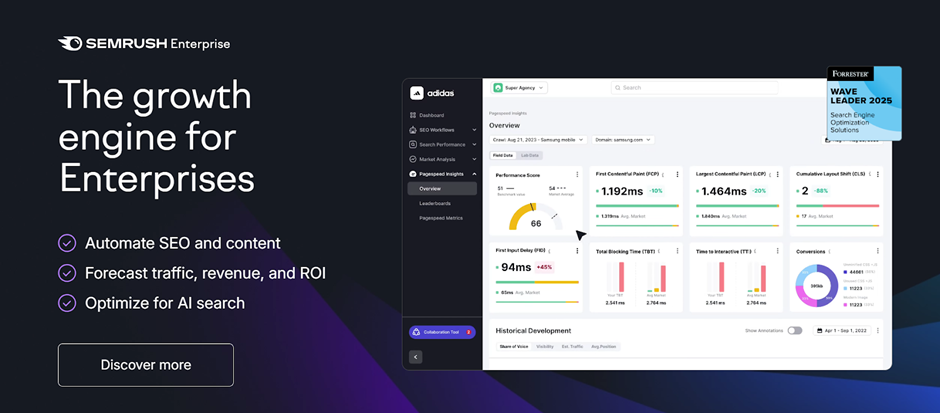
Semrush is built for teams that need comprehensive competitor data without stitching together multiple tools.
The Keyword Gap Tool lets you enter your domain with up to four competitors, and it highlights rankings you're missing and keywords where competitors outrank you.
Backlink Analytics goes beyond link counts, showing anchor text distribution, referring domain authority, and link velocity over time.
The Competitive Positioning Map visualizes how competitors cluster by traffic and keyword volume, so you can spot gaps in the market.
Strengths: Unmatched data breadth; strong PPC and social overlap for multi-channel teams.
Limitations: Genuinely complex. Smaller teams often pay for capabilities they rarely use.
Best for: Agencies and full-stack SEO teams that need one platform to cover everything.
2. Bishopi: Best for Strategic SEO Competitive Insights
Most SEO tools give you data. Bishopi is built around the premise that what teams actually need is clarity on what the data means and what to do next.
Bishopi strategically interprets competitive data. Its insights help you understand the patterns that drive competitor rankings. Learn how they cluster around topics, where their strategies overlap, and where there are genuine vulnerabilities.
Instead of a flat list of keyword gaps, Bishopi groups related opportunities into clusters and maps them against difficulty and search intent. This means, you know exactly where to focus first.
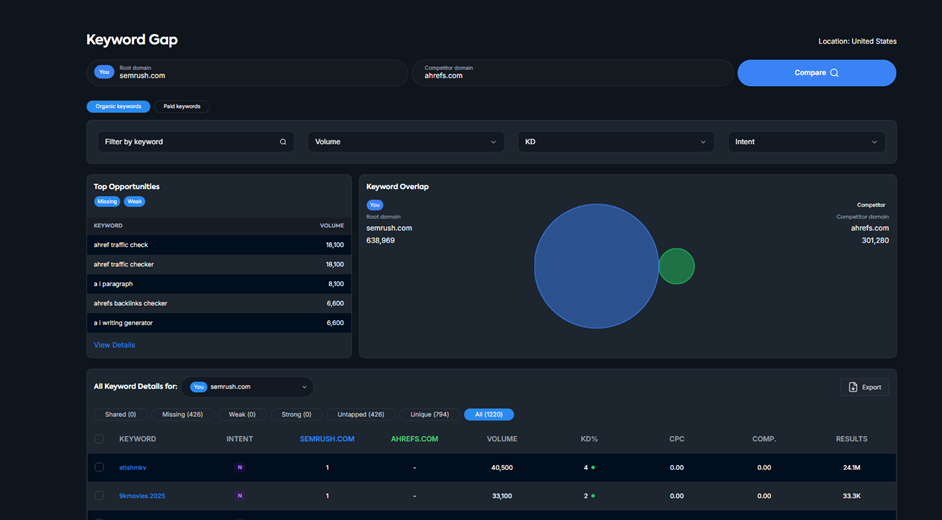
This matters most for agencies and growth teams operating in fast-moving markets. Because the bottleneck is rarely data; you need to know what to do with it.
Strengths: Makes competitor data actionable, reducing the gap between data collection and decision-making.
Limitations: Not a replacement for raw data tools in workflows that need bulk exports or API access for reporting.
Best for: SaaS founders, agencies, and growth teams that want higher-level strategic intelligence.
Explore Bishopi's competitive analysis features →
3. Ahrefs: Best for Backlink & Content Gap Analysis
Ahrefs built its reputation on backlink data, and that foundation still shows. Its crawl coverage is widely regarded as the most accurate among commercial SEO tools.
Site Explorer gives you a granular breakdown of any competitor's top pages by traffic and the backlink profile supporting them. The Content Gap tool surfaces keywords where competitors rank but you don't, filtered by position so you can focus on realistic targets.
Link Intersect shows which domains link to multiple competitors simultaneously, which is a practical starting point for outreach.
Strengths: Strongest backlink index available; excellent content opportunity discovery with less noise than alternatives.
Limitations: Limited PPC intelligence; all plans are single-user, which creates friction for teams.
Best for: SEO teams and link builders focused on content and backlinks
4. SE Ranking: Best Budget-Friendly SEO Suite
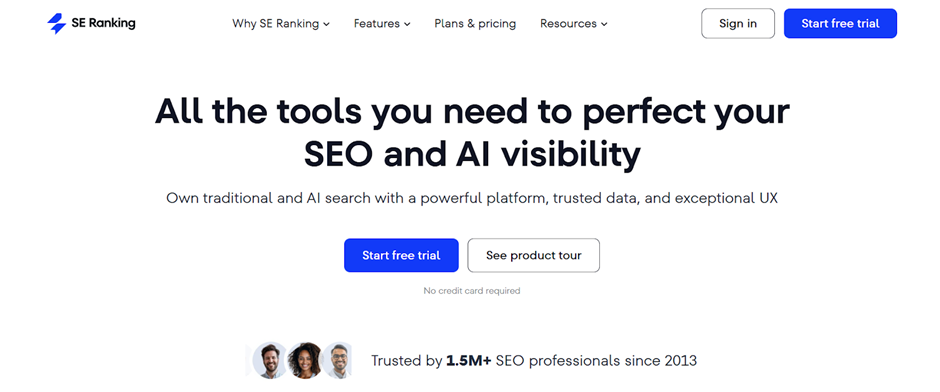
SE Ranking gets the job done at a price small businesses and freelancers can justify.
Its Competitor Research module provides a domain-level overview of organic and paid keywords, estimated traffic, and top-performing pages.
Rank tracking includes daily updates and location-level data, which makes it practical for local SEO. The platform has also expanded its traffic research capabilities and now includes basic AI Overviews tracking, which is increasingly relevant as AI-generated results reshape click behavior.
Strengths: Clean interface and solid features at a fraction of the cost of larger platforms.
Limitations: Less keyword coverage and shallower historical data than top-tier tools
Best for: SMBs, freelancers, and early-stage teams that need reliable core SEO data without enterprise pricing.
5. Similarweb: Best for Traffic & Market Intelligence
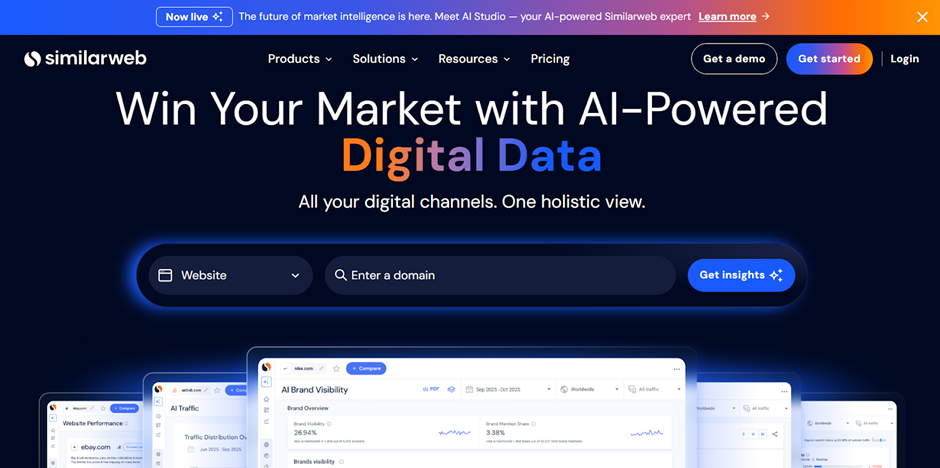
Similarweb looks beyond organic search. It shows how any site competes across all digital channels.
Its traffic source analysis breaks down how any competitor acquires visitors, across direct, referral, social, paid, and organic. The market share view shows how competitors stack up across a full category. This is useful for positioning work and client reporting. Audience breakdowns show engagement metrics so you understand competitor content quality.
Strengths: Excellent multi-channel competitive intelligence; good for understanding market size and share.
Limitations: SEO-specific keyword analysis is less granular than dedicated SEO tools.
Best for: Brands and marketing directors who need a complete picture of competitive traffic across all channels.
6. SpyFu: Best for Combined SEO and PPC Intelligence
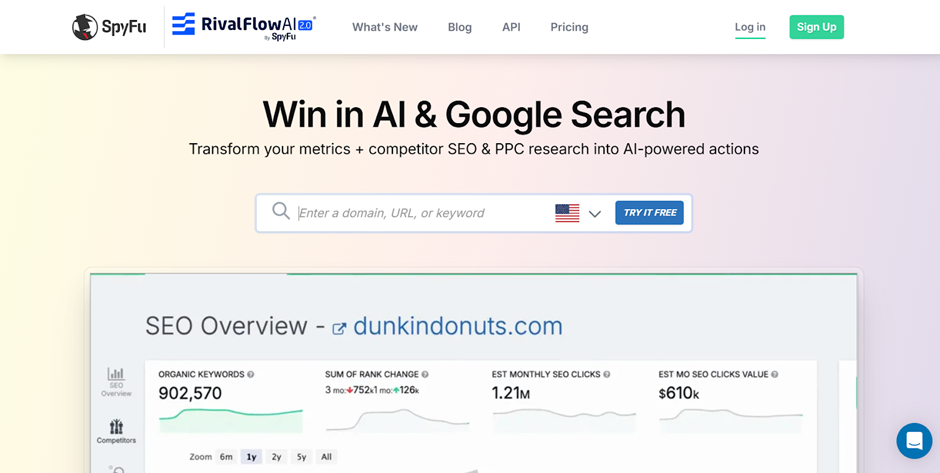
SpyFu's historical depth sets it apart. You can see which keywords a rival has owned for years versus ones they've recently started chasing.
The Competitor Keyword History feature is particularly useful to distinguish between terms a rival is serious about versus ones they rank for incidentally. The Ad Intelligence module covers PPC alongside organic, surfacing competitor keywords, ad copy variations, and estimated spend in one view.
Strengths: Exceptional historical data; combined organic and paid intelligence at accessible pricing.
Limitations: Interface feels dated compared to modern platforms; data accuracy on lower-volume keywords can be inconsistent.
Best for: Marketers who combine organic and paid search and want more than a current-state snapshot.
7. BuzzSumo: Best for Content-Based Competitor Research
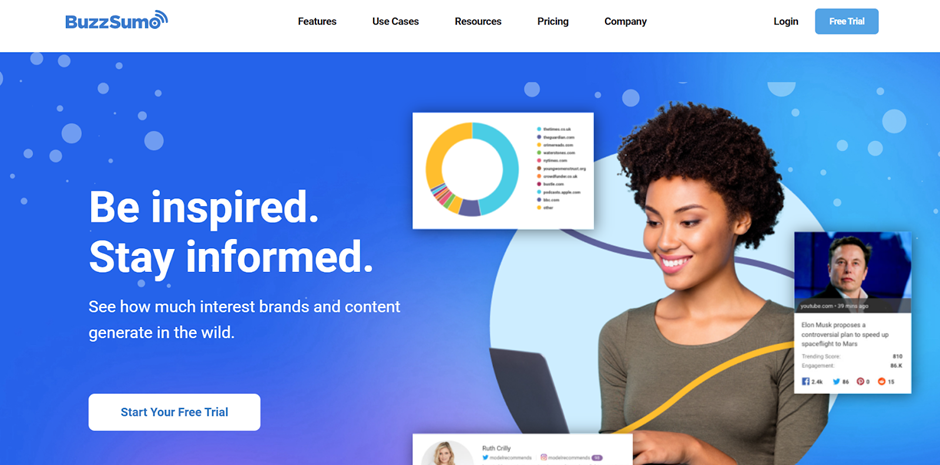
BuzzSumo focuses on one problem: understanding which competitor content actually resonates with audiences, and why.
The Content Performance Tracker shows which competitor articles have attracted the most shares and engagement, broken down by platform. Topic Research identifies trending questions and content formats in your space. This is useful to plan content before you start writing.
Strengths: Best-in-class for content performance intelligence and social signal tracking.
Limitations: Not a full SEO analytics suite; requires a dedicated SEO tool alongside it.
Best for: Content marketers and PR teams focused on competitor content strategy rather than keyword rankings.
How to Perform SEO Competitor Research
Having the right tool matters, but also knowing how to use it. Here's a framework you can use:
Identify your true organic competitors: Beyond direct business rivals, your real competitors are the sites ranking for the same keywords you want. Enter your domain into any tool above to see consistent SERP overlap.
Run a keyword gap analysis: Focus on keywords where competitors rank in positions 1–10 and you rank outside the top 20. Filter by intent to zero in on the terms that matter most to your business.
Analyze backlink overlaps: Find domains that link to multiple competitors but not to you. They've proven they're open to linking in your niche.
Study their top-performing pages: What's the format: guide, comparison, data study? What intent does it satisfy?
Prioritize by difficulty and intent. Quick wins, like low-difficulty keywords where competitors have thin content, should come first. Being strategic compounds over time.
SEO Software Comparison: Frequently Asked Questions
Still have questions about picking the right tool? Here are your answers.
What is the best SEO tool for competitor analysis?
The right tool depends on your needs. Bishopi fills a gap other tools leave open: helping teams decide what to act on, not just what's happening. Semrush is a good all-in-one option, Ahrefs leads for backlink and content gap work, while SE Ranking is the best value for smaller budgets.
How do you analyze competitor SEO strategies?
Start by identifying your true organic competitors. Look at their top pages, keywords bringing in traffic, and what's linking to them. Look for patterns across multiple competitors rather than fixating on any single site.
Are free competitor analysis tools accurate?
Free tools are a useful starting point, but they offer limited accuracy and depth. Traffic estimates are rarely precise, and keyword coverage thins out quickly in niche industries.If you're spending serious money, choose paid tools for higher accuracy.
Originally published at: www.bishopi.io
Stay up to date
Get updated with all the news, update and upcoming features.