Free Google APIs are powerful tools for building SEO workflows. They provide trusted, first-party data directly from the source, making them a strong foundation for analysis. However, as your needs grow, you may find yourself needing additional solutions to support larger-scale operations.
For instance, the Google Search Console API enforces quotas. It caps usage limits to 1,200 calls per minute per site and 30 million calls per day per project for search analytics.
What’s more? Free Google APIs do not provide comprehensive competitor data, backlink analytics, or large-scale, real-time raw SERP data for any query.
These limitations become operational pain points as your SEO operations scale. That’s where paid SEO APIs become useful.
Built for volume, reliability, and SEO automation, these APIs are designed to support modern pipelines at scale.
This article breaks down when free Google APIs are enough. You will discover where they fall short and why paid SEO APIs increasingly define scalable SEO infrastructure in 2026.
What are Free Google APIs?
Free Google APIs are application programming interfaces provided by Google for use at no cost within specific usage limits.
These APIs provide growth marketers, SaaS founders, and other SEO professionals with first-party data for performance tracking, technical monitoring, and basic reporting workflows. They include Google Analytics Data API, Search Console API, and PageSpeed Insights API.
What Google APIs Offer?
Free Google SEO APIs give teams direct access to performance data from Google’s own ecosystem. They form the backbone of foundational reporting and SEO automation.
Key capabilities include:
Search visibility and performance data for verified sites.
Page speed and Core Web Vitals insights.
Organic traffic and engagement metrics from Google’s ecosystem
These APIs are ideal when you need verified site performance data, but they do not cover all SEO needs, especially beyond your own properties.
Where They Work Well — and Where They Don’t
While powerful within their intended scope, free Google APIs are not designed for every SEO use case.
These APIs work well for:
Site-level performance tracking.
Lightweight dashboards and internal SEO reporting
Health monitoring and diagnostics
However, they struggle when teams need:
Large-scale automation
Competitive or market-wide data
Production guarantees—they lack business-ready SLAs and dedicated support.
What are Paid SEO APIs?
Paid SEO APIs are subscription-based application programming interfaces that provide access to search engine optimization data such as keywords, backlinks, rankings, traffic estimates, and site audits.
What They Provide Access to
Paid SEO APIs are purpose-built for professional SEO use cases that extend beyond your own website.
At a high level, these APIs allow you to access the following insights:
Full SERP data, including organic results, ads, and SERP features
Keyword discovery, trends, and visibility insights
Competitive and market-level analysis
Multi-location and multi-device search data
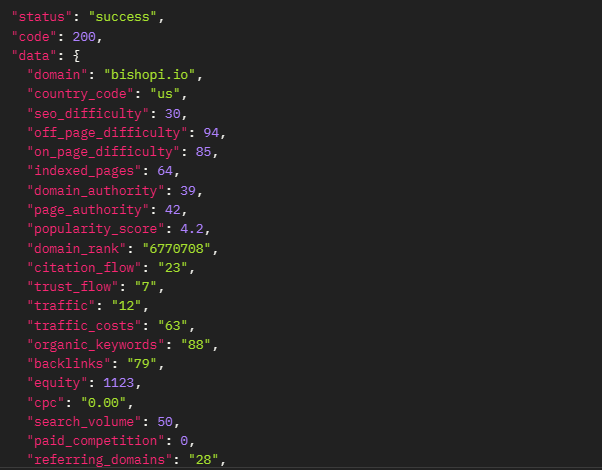
For instance, modern platforms, such as Bishopi’s SEO API, are built to deliver structured search data beyond what free, site-restricted APIs expose. The API supports large-scale SEO strategies by providing comprehensive metrics and SERP data at scale.
You can evaluate domain authority, page authority, trust flow, traffic analytics, and costs, as well as search trends in real time.
How SEO APIs Help You Scale SEO Efforts
At their core, paid SEO APIs are built to scale as your SEO operations and team grow. These APIs are engineered to support continuous data flows, not occasional queries, which makes them suitable for production environments.
Here is how they support SEO workflows at scale:
They offer higher request volumes and predictable quotas
They deliver fresh, automation-data designed for automation and dashboards
They provide consistent performance guarantees for agencies, SaaS platforms, and in-house tools
What “Scaling SEO” Actually Means in 2026
Scaling SEO goes far beyond tracking a handful of keywords or pages. In 2026, scaling SEO means:
Moving from dozens to millions of monthly data requests
Expanding coverage across countries, languages, and devices
Supporting real-time or near-real-time decision-making
Powering multiple teams, clients, or products from the same data stack
Integrating SEO pipelines into BI tools and dashboards used by multiple stakeholders.
Free Google APIs vs Paid SEO APIs — A Real-World Comparison
While free Google APIs provide accurate, first-party performance data directly from Google, paid SEO APIs focus on expanding visibility beyond your owned properties.
Here is how the APIs differ:
Feature | Free Google APIs | Paid SEO APIs |
Reporting and visibility tracking | Accurate first-party data for your own site (impressions, clicks, user behavior) | Complementary insights showing performance vs competitors and broader SERP landscape |
SERP monitoring | Limited. For instance, Google Custom Search JSON API offers 100 free queries per day and returns a maximum of 10 results per request. | Full search results across locations, devices, and search types, consistently |
Competitive analysis | Not available; only your own site data | Tracks competitors’ rankings, keywords, backlinks, and domain metrics |
International SEO | Limited to properties you control; scaling across markets is inefficient | Built-in geo-targeting, language options, and device emulation for global SEO insights |
Case example: To gain broader search visibility insights from Google’s first-party data, you can use SEO APIs like Bishopi. These APIs can unlock large-scale SERP monitoring, competitive benchmarking, and cross-market insights that Google data alone can’t provide.
The Real SEO API Cost Question (It’s Not Just Pricing)
The true cost for free Google APIs vs paid SEO APIs is not just pricing, but operational. Here is the cost you will incur when relying on free APIs as you scale your workflows:
Engineering time spent managing quotas, retries, and workarounds instead of building features.
Data gaps that limit automation, forcing manual analysis or incomplete insights.
Performance bottlenecks where reporting slows as usage approaches quota limits.
Rebuilding pipelines later, which is far more expensive than designing for scale upfront
Ultimately, teams adopt paid SEO APIs not for more data, but for predictability and efficiency as SEO becomes infrastructure.
What Actually Scales in 2026
As SEO stacks mature in 2026, the real question isn’t free versus paid. It’s what actually scales. Free Google APIs anchor trusted, first-party insights, while paid SEO APIs unlock the automation, competitive depth, and global reach modern teams need.
In a nutshell, here is what scales:
Free Google APIs remain essential for foundational, first-party SEO performance insights
Paid SEO APIs enable growth, automation, and advanced analysis
The most scalable setups are designed around long-term data needs, not short-term cost savings
Practically, you can combine Google Search Console data with platforms like Bishopi APIs to build richer dashboards, automate reporting, and support multiple stakeholders, without replacing your existing stack.
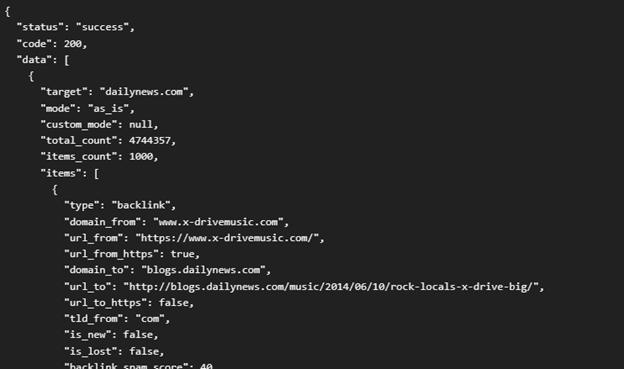
For instance, a backlinks analysis API can add off-page SEO signals that GSC doesn’t show. It can reveal why certain pages rank better by correlating impressions/clicks with backlink growth, referring domains, and link quality.
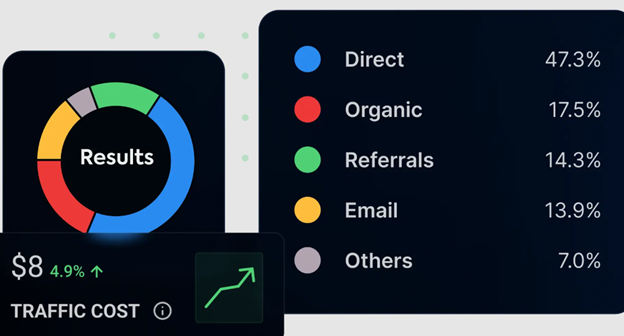
The traffic analysis API can add market-level visibility. You can compare Google Search Console click data with estimated total traffic, competitor traffic share, and channel overlap to show how much opportunity you’re missing.
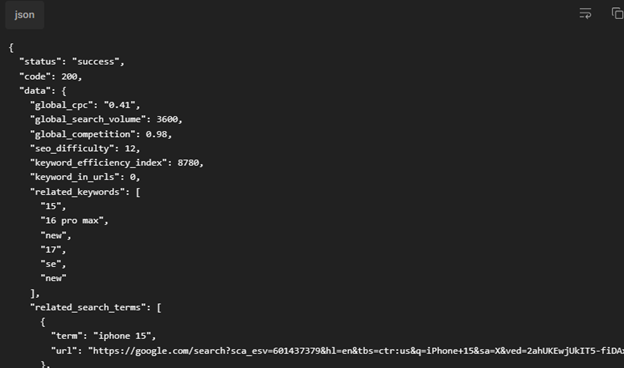
Meanwhile, a keyword research API can extend query coverage beyond GSC limits. You can expand Google Search Console queries into related, long-tail, and missing keywords.
You can also add global search volume, keyword difficulty scores and variations, CPC metrics, and intent for content planning.
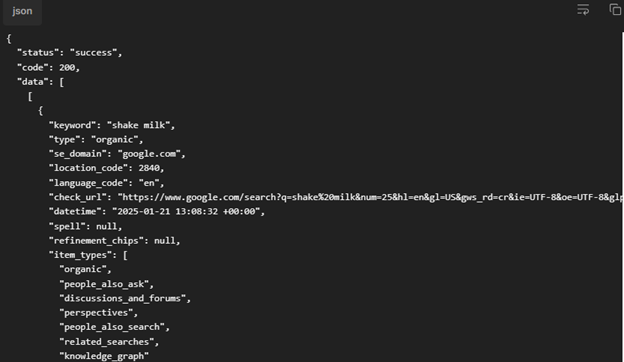
What’s more, a SERP API can pair GSC average position with real-time SERP features (ads, snippets, PAA, local packs) to explain CTR drops or gains.
Scale Faster and Smarter With Modern SEO APIs
As SEO workflows continue to mature in 2026, the real differentiator is how well your data infrastructure can scale.
While free Google APIs are useful for trusted, first-party performance data, they are not designed to support competitive analysis, global coverage, or high-volume automation on their own.
Paid SEO APIs fill that gap. They provide the breadth, reliability, and predictability required as your team grows from simple reporting to complex, multi-market SEO systems.
For effective setups, you can use Google’s data as a foundation, then augment it with scalable SEO APIs to unlock broader visibility and operational efficiency.
If you're building SEO dashboards, internal tools, or automated reporting systems, you can use scalable SEO tools like Bishopi's SEO API. The API is designed to support scalable, reliable access to search and SERP data as your needs grow.
Explore how Bishopi SEO API can give your team scalable, reliable access to search and SERP data here.
Originally published at: www.bishopi.io
Stay up to date
Get updated with all the news, update and upcoming features.