Checking a domain's worth often begins with a comparison. You assess similar domains, current listings, or past sales to get a rough estimate of domain value. This seems reasonable on the surface.
However, surface-level comparisons rarely account for key signals.
Domains may look similar, but their prices behave very differently once exposed to buyers. Without clarity on what drives buyer interest, those variations are easy to misinterpret.
In this guide, we break down how domain valuation works in practice. We also provide a clearer way to interpret a domain's market value.
What Does “Domain Value” Actually Mean?
When you ask, “how much is my domain worth?” you’re probably thinking of a specific amount.
But, domain value is not a fixed price. It is a market-based assessment of what an individual is willing to pay for a domain at a specific point in time.
Domain name valuation mirrors the branding, commercial, and strategic adequacy of a domain name.
Domain value also shifts based on context:
For domain investors: Domain value is tied to resale potential and liquidity. Can the domain realistically be sold, and to whom?
For startups and businesses: Value is about credibility, branding strength, and sustainable strategic use.
For SEO professionals: Value may encompass existing authority, backlinks, and traffic.
Since these use cases differ, the same domain can appear "undervalued" or "overvalued". It all depends on who is valuing it.
To accurately value a domain, you need to understand the market demand, buyer intent, and comparable sales; not just surface-level metrics.
Key Factors That Determine a Domain’s Worth
Precise domain valuation comes from evaluating multiple signals, not just a single estimate or metric.
Here are the factors to rely on when pricing your domain:
Domain Length and Memorability
Domain length and memorability affect how easily a domain can be recalled, typed, or reused.
A buyer evaluating multiple options will most likely favor a name that feels simple and familiar.
Shorter names are more attractive because they:
Are easier to recall after a single exposure. Think of Uber.com or Google.com
Lower the chance of spelling or typos
Adapt more easily to branding and marketing
For example, a domain like UrbanGardens.com is easier to recall, communicate, and adapt than UrbanGardeningSolutions.com.
Keywords and Search Demand
Keywords influence domain value when they point to a clear business use case.
According to Search Engine Land, exact-match domains still carry value when they support a strong brand identity.
Does the domain immediately signal the problem it can solve? What market does it serve?
Keywords that add value tend to:
Reflect commercial or transactional intent
Map directly to a product or service
Be commonly used by businesses, not just researched by users
A domain like OnlineAccounting.com is more usable than an abstract alternative, even if the abstract one could be branded over time.
Caveat: High search volume alone does not guarantee value. Informational keywords usually attract traffic, but may not attract buyers.
Domain Extension (TLD)
According to a 2025 Statista analysis, 44% of all global websites used the .com TLD.
This makes .com TLD the undeniable internet leader. .org comes second and .de third.
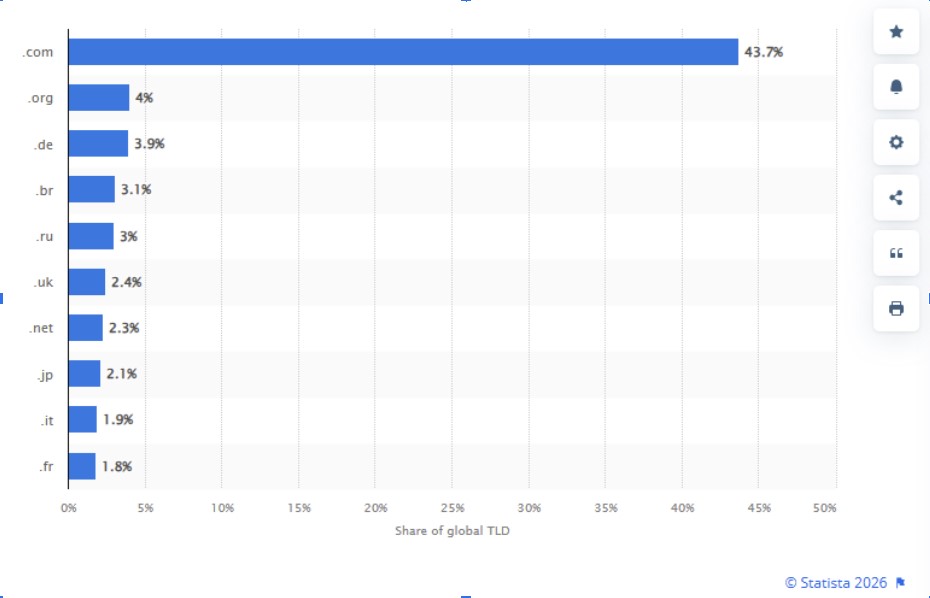
The .com TLD has also long been the benchmark for premium domain value. It is widely trusted and easier to justify in high-stakes acquisitions.
Here are some of the notable high-value domain sales in 2026 for the .com extension:
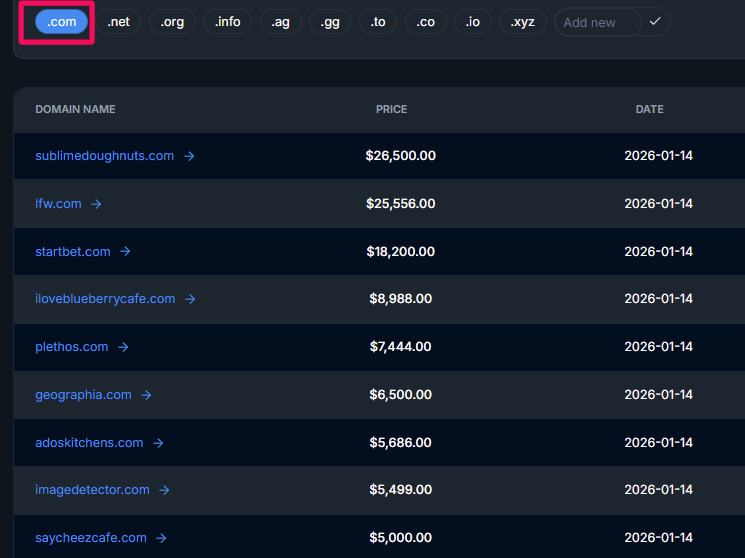
This does not mean other extensions have no value.
Niche market TLDs like .ai and .io have also recently been sold for premium prices.
For example, in 2025, Wisdom.ai was sold for $750,000, and mb.io for $220,000.
Comparable Domain Sales
Comparable sales show what buyers have actually paid for similar names, not what sellers are asking.
For domain valuation, the most reliable comparables are:
Closed transactions
Recent sales, typically within 12-24 months
Domains purchased for similar reasons
This helps you anchor pricing decisions and minimizes the risk of under- or over-valuing your domain.
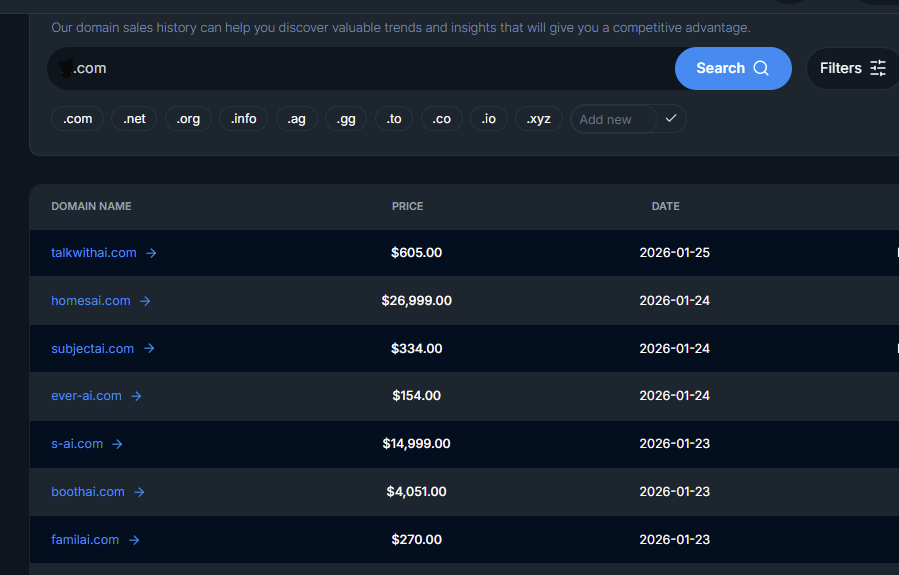
Bishopi’s Domain Name Sales History tool allows you to view past sales and investigate potential investments. By tracking current domain pricing data, you can better understand market value.
SEO Metrics and Existing Authority
SEO metrics can influence domain value, but only when they are relevant and transferable.
Here are the metrics that matter:
Existing organic traffic
Indexed history
Backlink quality and relevance
Domain authority
A domain with a clean history and relevant links reduces time to traction.
In contrast, buyers may discount or avoid a domain with spam signals and low-quality links.
Age, History, and Past Usage
Domain age can influence its value. However, age alone does not determine value.
Buyers examine if a domain has a clean, legitimate history, not just how long it has existed. Domains previously used for legitimate business or stable content are easier to redeploy.
When examining past usage, buyers often look at:
Previous content and purpose
Ownership changes
Signs of penalties or misuse
Note: A new domain with a clean slate can be valued higher than an older one with unresolved issues.
This free Domain Age Checker can help you check a domain's age, including its registration date, IP address, last-seen status, and historical archives.
Market Trends and Buyer Demand
Market demand impacts domain value. It influences how many buyers are competing for similar names at a given time.
When demand increases, buyers are generally willing to:
Accept higher prices
Move faster on acquisitions
Compete for fewer high-quality domains
This shift explains why domains tied to emerging industries like AI are seeing an upward valuation pressure.
An example is the ai.com domain that sold for $11 million.
Bottom line: Market trends influence timing, competition, and achievable price.
Why Many Domain Appraisal Tools Are Inaccurate
Automated domain name tools help you perform quick domain valuation checks. However, most rely on limited datasets or simplified formulas that do not fully capture buyer behaviour.
Here are their common limitations:
Overemphasis on one signal while ignoring context
Outdated or incomplete data
Lacks buyer-intent modeling
Lacks risk assessment
This means you get numbers that look accurate but lack grounding.
To accurately value your domain, you need a domain name valuation calculator and appraisal tool that combines multiple signals, cross-checks recent comparable sales, and adjusts for risk and demand.
How Experienced Domain Investors Value Domains
Experienced domain investors do not just depend on a single estimate or score.
They combine multiple signals and test each against real market behavior. The investor’s main question is “what would a qualified buyer pay today?”
Here are the metrics they typically evaluate:
Market fit: Identifying who would realistically buy the domain and why
Comparable sales: Basing expectations on recent, relevant sales
Name quality: Evaluating length, clarity, memorability, and extension together
Demand and timing: Analyzing the current competitiveness of the buyer pool
Risk review: Scrutinizing domain history, past usage, and other domain valuation factors that can limit reuse
Note: Experienced domain investors cross-check data. If a valuation signal is not supported by demand, comparables, and buyer intent, it is often discounted or ignored.
How Bishopi Helps You Determine Your Domain’s Real Market Value
Bishopi analyzes over 10 domain quality factors to show how different domain elements influence domain price and buyer interest.
Here’s what Bishopi delivers:
Instant domain appraisal: Assesses historical trends, market positioning, and growth potential
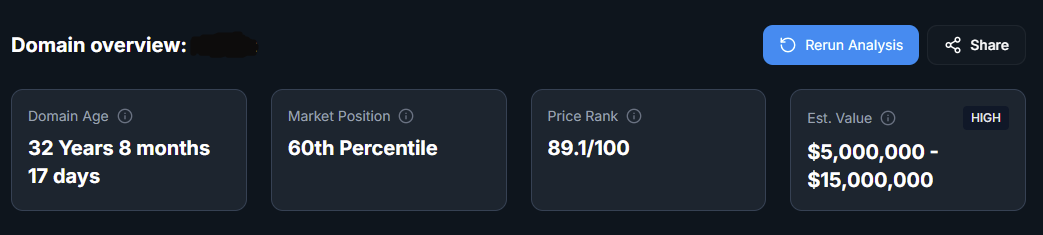
Predictive pricing models: Apply models on keyword seasonality and sales growth analytics
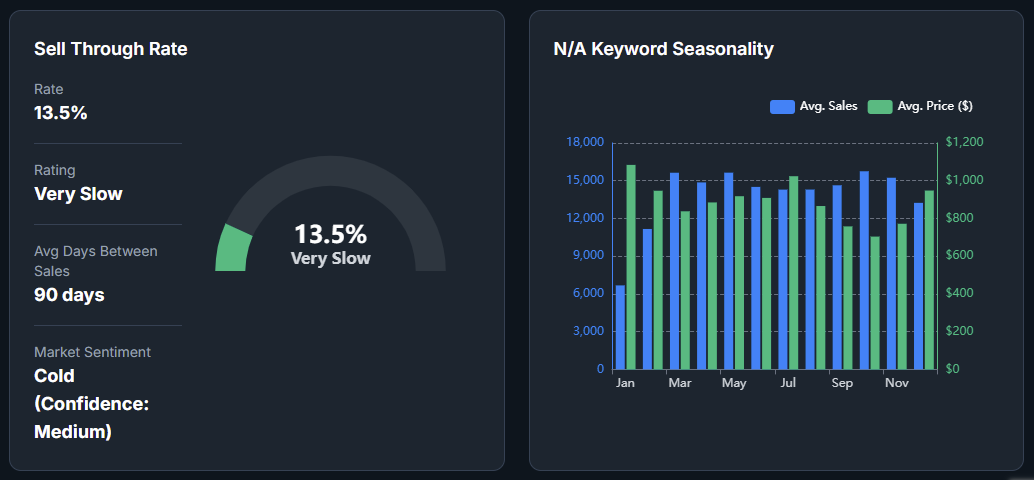
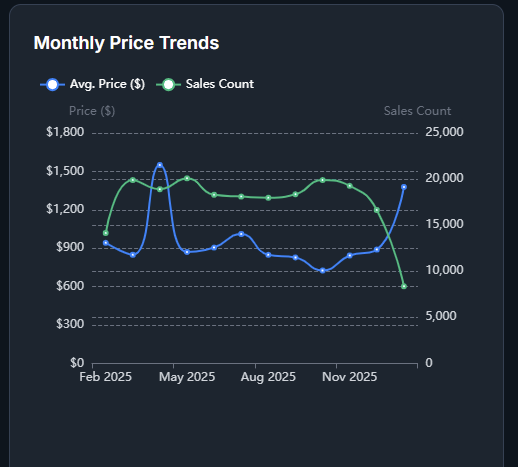
Real-time market intelligence: Tracks sales volume, monthly price movements, and TLD trends
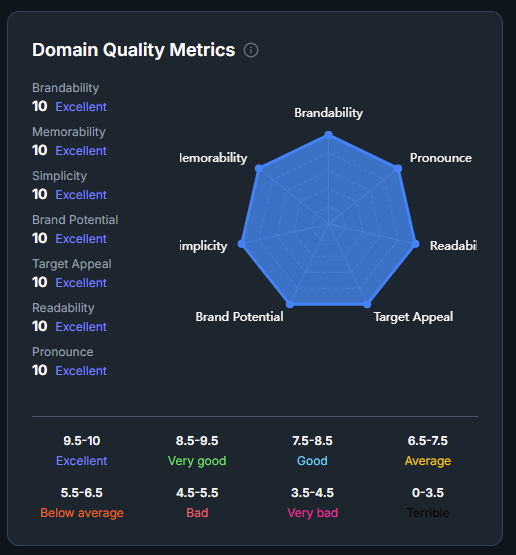
Over 10 quality factors: Uses brandability, search demand, historical sales data, and structural characteristics to evaluate domains
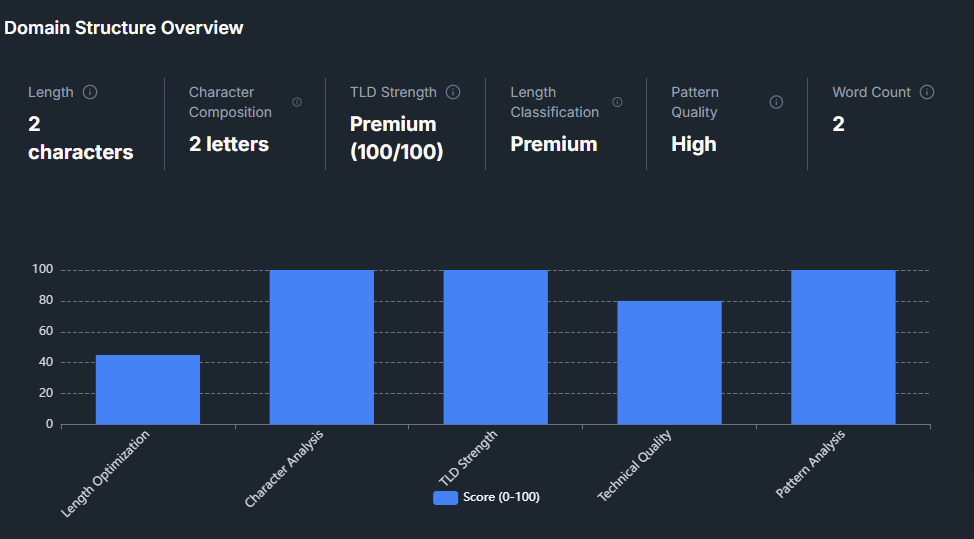
Domain structure overview: Evaluates domain length, character composition, TLD strength, and pattern quality to assess valuation impact.
If your question is “how much is my domain worth,” Bishopi has the answer. It is one of the best domain value checkers around, offering valuation backed by live market intelligence.
What to Do After You Know Your Domain’s Value
How to auction the domain valuation data depends on your goals, timing, and market conditions.
Here are three considerations:
If your domain value is higher than expected:
Consider selling while demand is active, particularly if comparable sales show recent buyer interest
Use the valuation as a reference point when negotiating, not a fixed price
Reexamine whether holding the domain adds more value than reallocating capital elsewhere
If your domain value is lower than expected:
Assess which factors are limiting value, such as structure, length, or demand
Determine whether it makes sense to improve positioning or wait for market shifts
Avoid overpricing. It often leads to long sales cycles or no offers
If you are holding multiple domains:
Use the valuation data to prioritize renewals and prune underperforming digital assets
Establish domains with rising demand signals versus those losing relevance
Channel your resources on domains with clear resale or deployment potential
Common Domain Valuation Mistakes to Avoid
Even with optimal data, valuation can go wrong if a few common mistakes slip in.
Watch out for these domain valuation mistakes to keep price realistic and decision aligned with the market:
Overpricing based on ownership bias: Sunk costs or emotional attachments can lead you to price domains beyond what buyers are willing to pay.
Relying on a single appraisal number: Automated price estimates without context disregard risk, buyer intent, and market comparables.
Confusing SEO metrics with market value: Traffic or backlinks only boost domain value when they are relevant, clean, and transferable.
Market-Backed Domain Valuation With Bishopi
Domain valuation boils down to how buyers evaluate and price domains in actual transactions. Factors like demand, timing, and comparable sales influence the price they are willing to pay. These signals do not work in isolation.
So, the answer to the question “How much is my domain worth?” depends on how these signals align in the current market. A valuation that does not factor them in is incomplete and often misleading.
Bishopi consolidates these signals into one view.
Its comprehensive domain valuation tools combine buyer demand signals, domain quality metrics, live market data, and recent comparables to surface domain name value, market positioning, and growth potential.
Originally published at: www.bishopi.io
Stay up to date
Get updated with all the news, update and upcoming features.