Enterprise keyword research spans thousands of keywords across brands, regions, and product lines.
As the scope grows, strategically organizing keywords, aligning on intent, and avoiding content overlap become more difficult.
Most traditional keyword tools are built for single-site optimization and rely on UI workflows and manual tagging. These approaches do not scale well across teams and markets.
As a result, 85.7% of organizations are already investing in AI and LLM optimization, and 61.2% expect to increase SEO budgets.
This shift is accelerating the adoption of API-based, data-first platforms like Bishopi that treat enterprise keyword discovery as shared infrastructure rather than a standalone task.
In this article, we break down why data infrastructure matters more than tools in enterprise SEO research. You’ll learn how large keyword datasets are turned into usable enterprise search intelligence and how search insights connect to business outcomes.
Why Data Infrastructure Matters More Than Tools In Enterprise SEO Research
At enterprise scale, keyword research is more about how data moves.
Most SEO teams use multiple tools simultaneously. One for keyword discovery. Another for rankings. Another for analytics.
Each holds its own version of the truth. The work then shifts to exporting, cleaning, and stitching data together. That effort grows with scale.
This is where data infrastructure matters.
It focuses on how keyword data is stored, accessed, and reused. Instead of treating large-scale keyword research as a task inside a dashboard, it treats it as a shared data layer that the whole organization can query.
Here are the three capabilities that make the difference:
Unified Keyword Datasets
You need one consistent keyword source across brands and regions. This is because centralized datasets keep volume, trends, and difficulty aligned.
Programmatic access replaces scraping and CSV exports. Your data stays structured and ready for analysis.
Real-Time Integration
Large keyword pulls happen in bulk, not one query at a time.
As such, data flows directly into BI tools, internal dashboards, and planning systems. No waiting. No manual refreshes.
A McKinsey survey shows that nearly 88% of organizations now use AI in at least one business function.
This reflects a broad shift toward automation and data-oriented workflows at scale. The goal is speed and consistency, not more reports.
Scalable Processing
As keyword sets reach the hundreds of thousands, processing becomes the constraint.
Infrastructure built for scale supports clustering, trend analysis, and prioritization without hitting limits. You stop working around tools and start working with the data itself.
This is why enterprise SEO is moving away from tool-led workflows. Systems designed around APIs and data pipelines support growth without adding friction.
Although enterprise SEO tools still matter, infrastructure decides how far they can go
How AI Turns Enterprise SEO Data into Intelligence
Once keyword data is centralized, the focus shifts to understanding it at scale.
This is where pattern recognition and consistency become more important than individual keywords.
This happens through:
Intent-Based Classification
Large keyword sets are hard to organize manually, as small differences in labeling quickly add up.
Language models help group keywords based on meaning rather than exact wording.
This makes it easier to separate informational, commercial, and transactional searches across large datasets.
The outcome?
Clearer intent alignment
Overlap is easier to spot
Content targets stay cleaner across pages and regions
Predictive Keyword Insights
Keyword data becomes more useful when it shows direction, not just history.
Trends in rising or declining interest become visible earlier
Seasonal patterns are easier to plan around
Content calendars can be built with better timing and less guesswork
Shifts in competitive focus also become apparent sooner, guiding your adjustments before performance changes appear in reports.
Competitive Intelligence at Scale
Reviewing competitors one keyword at a time does not scale.
Set-level comparisons make gaps easier to see. You can identify topics that competitors cover that you do not, and see where demand is strong and competition manageable.
This view also helps balance effort with impact, so your time and resources stay focused on high-value opportunities.
Consistency Across the Dataset
Consistency is the real advantage. This is because you apply the same approach across the full keyword set every time. It reduces duplicate intent groupings, conflicting labels, and overlapping content targets.
As such, less time goes into rechecking classifications or reconciling differences. More time is spent deciding on next steps.
Enterprise Analytics: Connecting Keywords to Revenue
Keyword data becomes more valuable when it is evaluated in a business context.
Enterprise SEO research performance needs to be understood alongside customer behavior and revenue outcomes.
That requires keyword data to connect with systems beyond SEO tooling through:
Multi-Source Data Integration
Connecting keywords to value starts with integration. Keyword and ranking data need to sit alongside:
Google Search Console for impressions and visibility
GA4 for on-site behavior and journeys
CRM systems for leads, pipeline, and customers
Internal revenue and lifetime value data
When these signals are aligned, keyword performance can be evaluated across the full funnel, not just at the click level.
Revenue and Conversion Pattern Analysis
Search volume alone does not explain impact.
Some keywords bring traffic that rarely converts. Others attract fewer users but generate revenue more consistently.
Analyzing keyword clusters against conversion and revenue data makes these differences visible.
You can identify which topics:
Influence high-value customers
Support early discovery
Have limited downstream impact
This supports clearer prioritization across content, optimization, and investment.
Proving Organic Search Impact at Scale
When keyword performance is connected to revenue signals:
Organic search becomes easier to defend and plan around
Performance discussions move from isolated rankings toward contribution
SEO can be evaluated by its impact on the pipeline, revenue support, and customer value over time
That shift strengthens organic search as a measurable growth channel, especially at enterprise scale.
The Future of Enterprise Keyword Research (2026 and Beyond)
Enterprise keyword research is shifting from periodic analysis to continuous decision-making.
The days of quarterly reviews and static keyword lists are fading. What matters now is how quickly you can see change and respond to it.
Here are the emerging trends shaping the next generation of enterprise SEO:
Agent-Led SEO Workflows
Keyword research at scale is now running in the background. Instead of waiting for audits or scheduled reviews, systems surface gaps and changes in real time.
These workflows can:
Flag opportunities
Assess impact
Outline next steps
Final decisions still rest with you, but much of the discovery work is automated. This shortens the time between insight and action.
Privacy-First Search Analytics
As third-party tracking continues to decline, keyword analysis depends more on first-party data.
Enterprise search data, site behavior, and conversion signals need to live inside your systems.
When those signals are connected, analysis becomes more stable and less affected by changes in external tracking.
Search Results Are Becoming More Interpretive
Search engines now summarize information instead of listing links. 80% of users rely on these AI summaries at least 40% of the time.
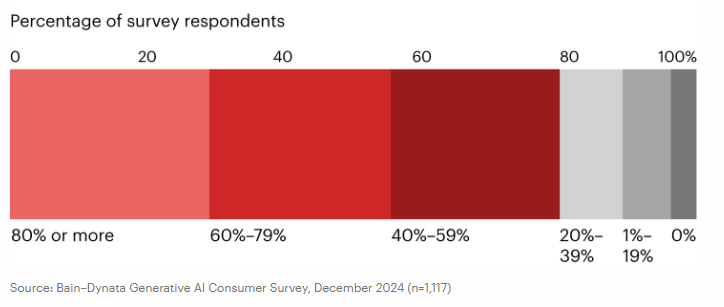
Survey showing the percentage of respondents who rely on AI summaries
This shifts keyword research toward topic coverage and intent satisfaction.
Individual keywords still matter, but understanding how queries relate to each other matters more. Brand presence, context, and relevance across a topic become stronger signals.
Faster Decisions, Smaller Adjustments
When data updates continuously, your enterprise SEO strategy becomes more flexible.
This means:
Changes in demand or competition can be addressed sooner
Adjustments are smaller and more frequent
Keyword strategy aligns with the market rather than reacting weeks later through reports
What This Means for Your Organization
The shift changes how keyword research fits into your everyday decision-making.
The focus moves from managing lists to building systems that scale with your search data.
Here’s how to adapt:
Invest in Data Infrastructure First
Start with a unified data foundation.
Keyword data should be easy to query, update, and reuse across teams. APIs and real-time access matter more than adding another dashboard.
Treat AI as a Productivity Multiplier, Not a Replacement
Use automation to handle scale. That includes
Organizing large keyword sets
Tracking changes
Surfacing opportunities
Tools like keyword explorer give you direct access to high-potential keyword data.
This ensures automation fits into your existing enterprise SEO workflows rather than forcing you to work through a UI.
Make Security and Compliance Non-Negotiable
Define access, permissions, and data handling rules early.
Keyword data often connects to internal performance and revenue signals, so controls need to be in place from the start.
Measure What Drives Business Impact
Evaluate keywords alongside conversions, revenue, and customer value.
Rankings and traffic provide context, but impact should guide your prioritization.
The Future of Enterprise Keyword Research
Enterprise SEO research is moving toward data-first systems that support scale, speed, and consistency.
As keyword discovery becomes part of your core infrastructure, you gain clearer insight and stronger alignment with your business goals.
FAQS
Why do I need data infrastructure for enterprise SEO research?
As keyword sets grow, data often ends up scattered across tools and spreadsheets. A shared data foundation makes it easier to:
Keep intent consistent
Reduce duplication
Connect keyword insights with analytics and business systems
How can I scale keyword research without losing accuracy?
Treat keyword data as shared infrastructure rather than isolated lists.
API-based platforms like Bishopi help keep keyword exploration consistent across teams while supporting scale and reuse.
How does data infrastructure differ from traditional keyword research tools?
Data infrastructure treats keyword data as a shared, queryable resource rather than a set of exports inside a tool.
This makes it easier to:
Organize large keyword sets
Maintain consistent intent
Reuse data across analytics, reporting, and planning workflows
Originally published at: www.bishopi.io
Stay up to date
Get updated with all the news, update and upcoming features.