The Most Important SEO Metrics in 2026 And What Most Teams Are Ignoring
Most SEO dashboards surface 20+ metrics, yet fewer than seven SEO KPIs reliably indicate whether your site is gaining visibility, traffic, or competitive ground. AI Overviews now reduce organic clicks by approximately 58% on queries where they appear (Ahrefs, February 2026). If your framework doesn't account for it, that’s a blind spot.
Bounce rate, pages per session, and time on site are deliberately excluded. Knowing how people behave once they arrive is not the same as knowing whether SEO is working.
In this guide, we review the seven most important SEO metrics that matter, and how to measure SEO performance without paying enterprise-tool prices.
1. Organic Traffic
Organic traffic is the number that tells you whether everything else is working. But the raw number matters less than the trend. A site with 10,000 monthly visits growing 15% MoM is in a healthier position than a site with 80,000 visits declining 8% MoM. The raw volume looks better on the second site, but the trajectory says the opposite.
One critical caveat for 2026: a flat or declining organic traffic trend doesn't automatically mean your SEO is failing. AI Overviews are compressing click volume on a growing share of queries. Before blaming your SEO, check if AI Overviews are answering your target queries before anyone clicks through.
What to watch:
MoM growth rate rather than absolute volume
Traffic broken down by landing page: surface, which pages are gaining or losing
Organic vs. direct split, to catch misattributed traffic
Track it with Bishopi's Website Traffic Checker for domain-level trend monitoring and competitor benchmarking. Dev teams building internal reporting pipelines can pull this programmatically via Bishopi’s Website Traffic Analytics API
2. Keyword Rankings: One of the Most Important SEO Metrics to Get Right
Keyword rankings are your visibility signal. They determine how many users even have the option to click on your page. And the gap between positions matters enormously: moving from position #9 to #3 for the same keyword can increase clicks by 3–5×, with no change in search volume whatsoever (Backlinko / Advanced Web Ranking CTR study).
A keyword pulling 500 monthly searches at position #9 gets you roughly 8–10 clicks. The same keyword at position #3 gets you 30–40. Same query, same content, no additional work; just a ranking shift.
Most clicks never make it past position #3. Everything below that is fighting for scraps.
What to watch:
Week-on-week position changes across your target keyword groups
Share of page-1 rankings across your target term set
Priority terms are tracked daily or weekly
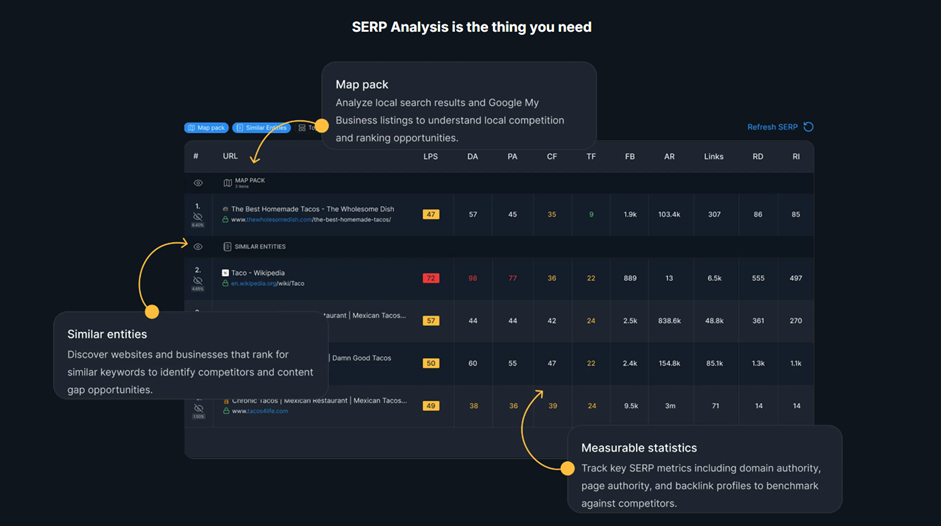
Bishopi's Keyword Analysis shows which keywords a domain ranks for and at what positions, so you can see ranking shifts across your entire keyword set, not just the terms you're manually watching. Teams building custom rank tracking dashboards can access this via the SERP API
3. Backlink Profile and Referring Domain Trajectory
Domain authority and domain rating are useful shorthand for client conversations, but they're communication tools, not measurement targets. Optimising for DA is like painting over damp walls — the surface reading improves, the underlying problem doesn't.
The real measure of SEO health is the trajectory of your referring domains over time, and the quality of the sites linking to you. DR tells you where a domain has been while referring domain growth tells you where it's heading.
What to watch:
Referring domain count over time: is the trend up, flat, or eroding?
Domain rating trajectory as a directional signal rather than an end goal
Toxic or spammy link patterns that could trigger a manual action
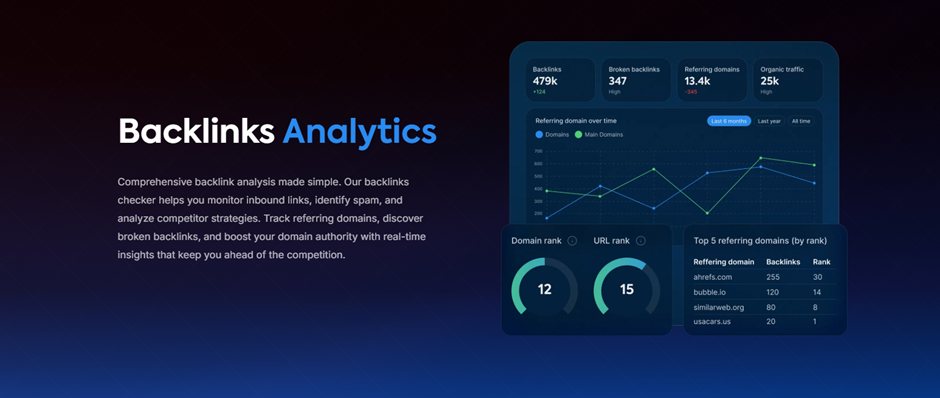
Bishopi's Backlinks Analysis gives you a full backlink profile, referring domain breakdown, and link gap data versus competitors. The Backlink Analysis API makes this available programmatically for teams building automated link monitoring.
4. Click-Through Rate (CTR)
A weak title tag at position #2 will lose clicks to a stronger snippet at position #3. CTR is where rankings convert into actual traffic, and it's routinely underleveraged.
The benchmark: position #1 averages approximately 27.6% CTR across all devices (Advanced Web Ranking, 2025). If your top-ranking pages are pulling significantly less than 27.6% CTR, the page isn't the problem; the snippet is.
Open Google Search Console, filter by page, and sort by average position. Any page in positions 1–5 with a CTR below 10% is underperforming on its snippet. Common fixes include rewriting the title tag to match search intent more directly, adding a specific number or year, or making the meta description answer the query rather than describe the page.
What to watch:
CTR by page and by keyword cluster in Google Search Console
Pages where average position is high but CTR is disproportionately low — these are your optimisation targets
Title tag and meta description patterns on pages that are outperforming expected CTR
Google Search Console is the primary source for this data. Pair it with Bishopi's Domain SEO Analysis to audit competitor title and meta patterns for the same queries.
5. Competitor Visibility: An Underrated SEO KPI
Tracking your own seo metrics in isolation gives you half the picture. The other half is knowing exactly how three to five competing domains are moving relative to you. Because SEO is inherently a share-of-SERP competition, and not an absolute score.
The top three organic results capture roughly 68 to 75% of all clicks on a given SERP. Knowing whether you're in that group, or who is, drives better content and link strategy than any internal metric can on its own.
Here's what it looks like in practice: identify a keyword cluster a competitor ranks for in positions 1–3 that you don't appear in at all, then build one well-targeted piece of content to close that gap.
What to watch:
Keyword overlap between your domain and your top competitors
Which competitor pages are ranking above you for your target terms
Their referring domain growth rate relative to yours. This is often the leading indicator of future ranking shifts
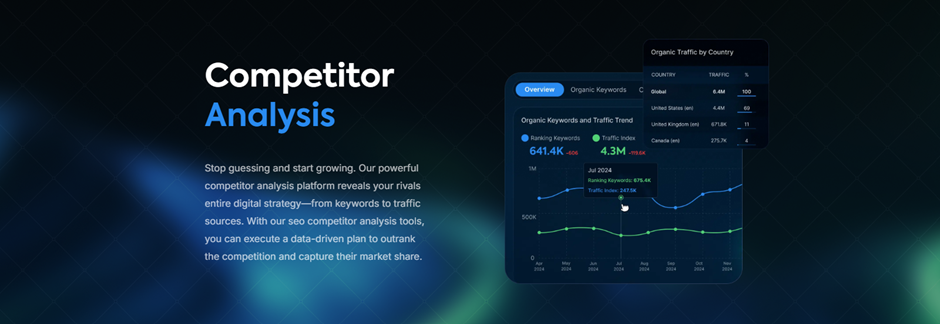
Bishopi's Competitor Analysis compares keyword footprints, surfaces ranking gaps, and turns the data into a content and link acquisition strategy.
6. Crawlability and Technical Health
None of the above metrics matter if Google can't access or render your pages cleanly. Technical health is a hygiene metric; it doesn't generate wins, but poor technical health prevents all the other work from paying off.
Core Web Vitals, specifically LCP (Largest Contentful Paint), INP (Interaction to Next Paint), and CLS (Cumulative Layout Shift), are confirmed Google ranking factors. Treat them as non-negotiable on any technical audit, alongside crawlability.
What to watch:
Indexed page count and any unexpected drops in the Index Coverage report
Crawl errors, redirect chains, and orphan pages that bleed crawl budget
Core Web Vitals performance, particularly LCP and INP, on high-traffic landing pages
The Google Search Console Index Coverage report is your starting point. Combine it with Bishopi's Domain SEO Analysis for site-level audit data. Dev teams can automate site health checks via the SEO API.
7. AI Visibility: The SEO Performance Metric Most Teams Are Ignoring
AI visibility, or how your brand and content appear in AI-generated answers from ChatGPT, Perplexity, Gemini, and Google's own AI Overviews, is now a meaningful traffic and awareness channel that sits above traditional organic results. Most teams are not tracking it at all.
AI Overviews reduce organic clicks by ~58% on queries where they appear (Ahrefs, February 2026). If your target queries are increasingly answered by an AI summary, traffic will decline even as rankings hold. The counter move is to become a cited source within those answers.
In practice, that means three things: content that answers questions directly rather than building to an answer, clear sourcing and authorship that signal expertise, and structured pages that make it easy for a language model to extract a clean response. None of that requires a separate workflow; it's simply good content practice that now has an additional payoff.
To be clear, this is still an emerging metric. Standardised tracking doesn't exist yet across mainstream tools. But teams not thinking about it yet are measuring a version of SEO that no longer exists.
What to watch:
Brand and domain mentions in AI-generated answers for your core queries
Share of AI Overview citations on target informational terms
'People Also Ask' appearances: a reasonable proxy for the question-and-answer signal that LLMs are trained to surface
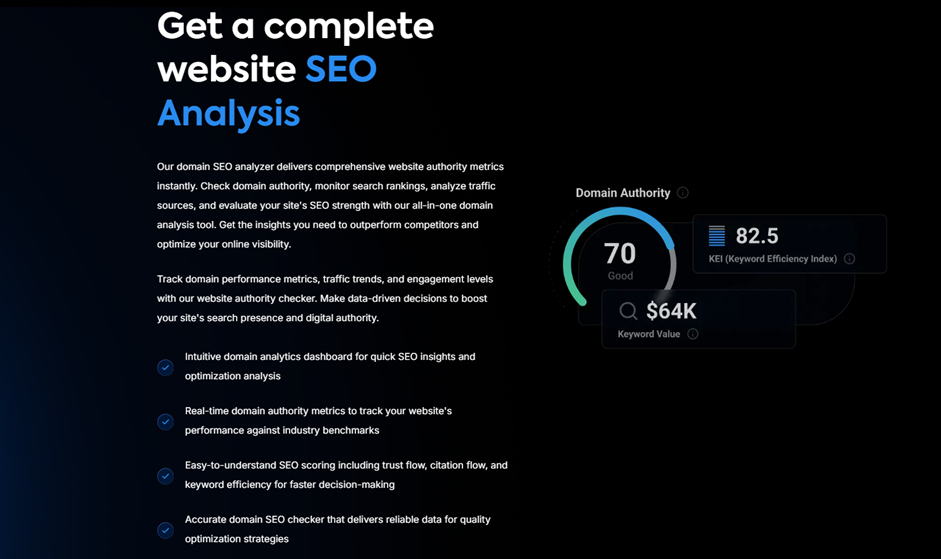
Most mainstream seo tracking metrics tools don't surface AI Overviews citation data yet, which makes this a real competitive gap. Bishopi's Domain SEO Analysis can identify the content patterns and authority signals that correlate with AI citation at Manual spot-checks in ChatGPT, Perplexity, and Google AI Overview remain a valid starting point.
Your 2026 SEO KPI Metrics Shortlist
Traffic, rankings, backlink trajectory, CTR, competitive visibility, technical health, and AI visibility together cover every layer of how SEO actually performs in 2026. And AI visibility is what most teams are still treating as someone else's problem.
That's going to get harder to ignore. AI Overviews are expanding across more query types, and LLM-generated answers are increasingly the first thing a user sees. Before organic results, before ads, or anything you've optimised for.
The teams building content and authority signals that get them cited in those answers now will have a compounding advantage over the next 12–18 months. Waiting will have you playing catch-up on a gap that keeps widening.
Manual spot-checks will tell you where you stand. Tracking it consistently, alongside rankings, backlinks, and competitive movement, is where you need a proper system. Bishopi's Competitor Analysis, Domain SEO Analysis, and Backlinks Analysis are built for practitioners who want this data without the bloat of enterprise platforms.
Originally published at: www.bishopi.io
Stay up to date
Get updated with all the news, update and upcoming features.