How Accurate Are Free Domain Appraisal Tools? A Real-World Comparison
Most domain owners rely on a single free tool to set their asking price. The problem is that the number can be off by thousands of dollars, sometimes even tens of thousands, and you'd have no way of knowing.
VacationRentals.com sold for $35 million. Voice.com went for $30 million. At those price points, a flawed appraisal isn't a minor inconvenience; it's a catastrophic misjudgment.
Whether you're buying a domain as a strategic investment, pricing one for sale, or sizing up an unsolicited offer, the valuation you work with is the foundation of your decision. The difference between a good deal and a bad one is often just the starting number.
Here’s an honest look at the most-used free tools, and what accurate domain valuation actually requires.
What Factors Determine a Domain's Value?
Before evaluating any domain value estimator tools, it helps to understand what drives domain value in the first place. Because a tool is only as good as what it measures.
TLD: .com still commands a meaningful premium over almost every alternative. Extensions like .io and .ai have carved out real value in tech contexts, but buyers treat ccTLDs and newer TLDs as highly variable, and often discount them.
Domain age and registration history: Older domains with a clean history carry more weight. A domain that’s changed hands repeatedly, been penalized, or sat parked for years is worth less, even if the name itself is strong.
Keyword value: Domains built around keywords with high search volume and strong commercial intent ("loans", "insurance", "software") can use CPC in that niche as a reliable indicator of what buyers are willing to pay.
Backlink profile: The quality and quantity of inbound links is one of the most reliable indicators of a domain's accumulated authority. It's also one of the most commonly ignored factors in free tools.
Organic traffic and ranking signals: A domain that already attracts search traffic has a demonstrable head start.
Brandability: Short, memorable, easy-to-spell domains hold value independent of keywords. Single-word .coms and coined terms with strong recall often command premiums that keyword-based models can't explain.
Comparable sales: What have similar domains actually sold for? NameBio maintains the most comprehensive historical database of domain sales and is the closest thing the industry has to a reliable comps benchmark.
Free tools rarely account for all of these factors, and the gaps add up.
The Top Free Domain Valuation Tools: Reviewed
Not all free domain valuation tools are built the same way. Here's how the most popular ones work, what they get right, and where they fall short.
Dynadot
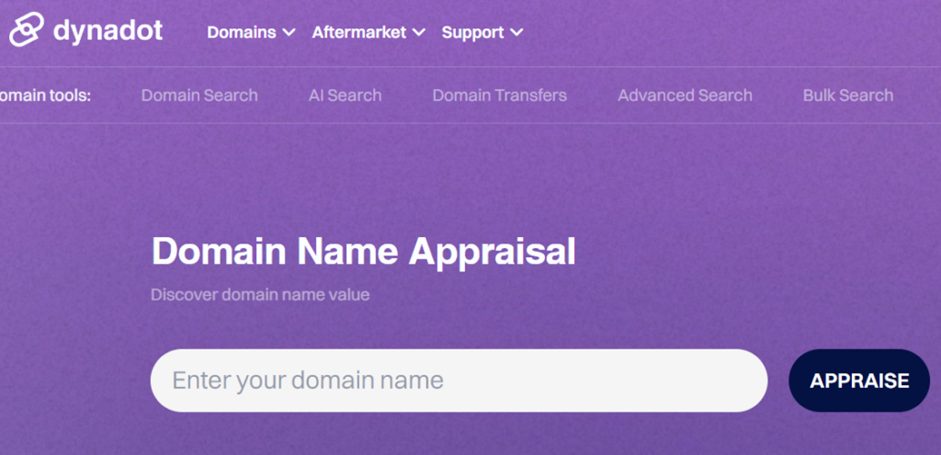
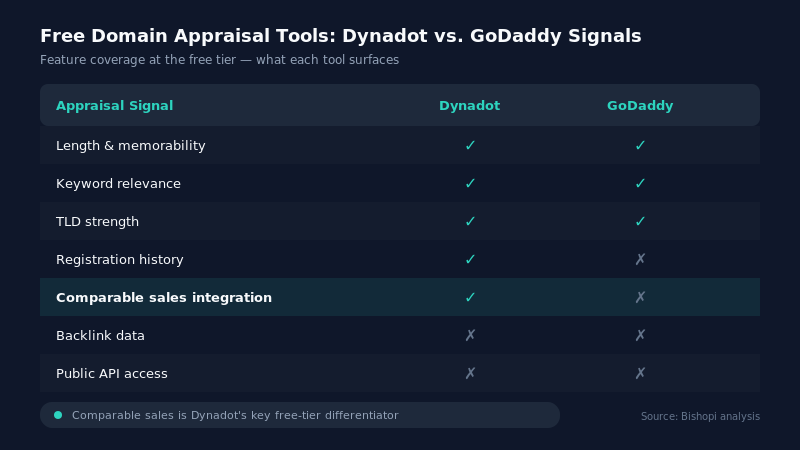
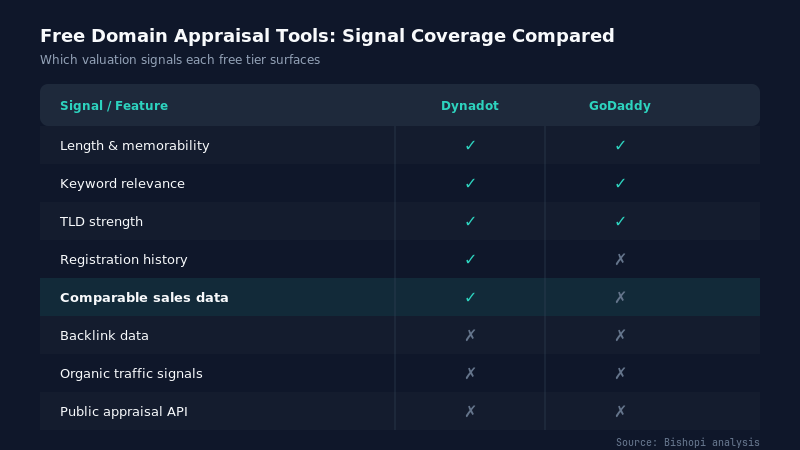
Dynadot's appraisal tool has become one of the more capable free options in the market. Its position at the top of search results for "domain appraisal" reflects how widely it's being used. The tool evaluates length, memorability, keyword relevance, TLD strength, registration history, and comparable sales. This gives it a broader signal base than most free alternatives.
In practice, it performs reasonably well for mainstream domains where those signals are meaningful. The comparable sales integration is a genuine differentiator at the free tier; most tools don't surface this at all.
Where it falls short is predictable: no backlink data, no organic traffic signals, and limited transparency on how the model weighs each factor against the others.
For developers: Dynadot does not currently offer a public API for programmatic appraisal access.
GoDaddy Appraisals
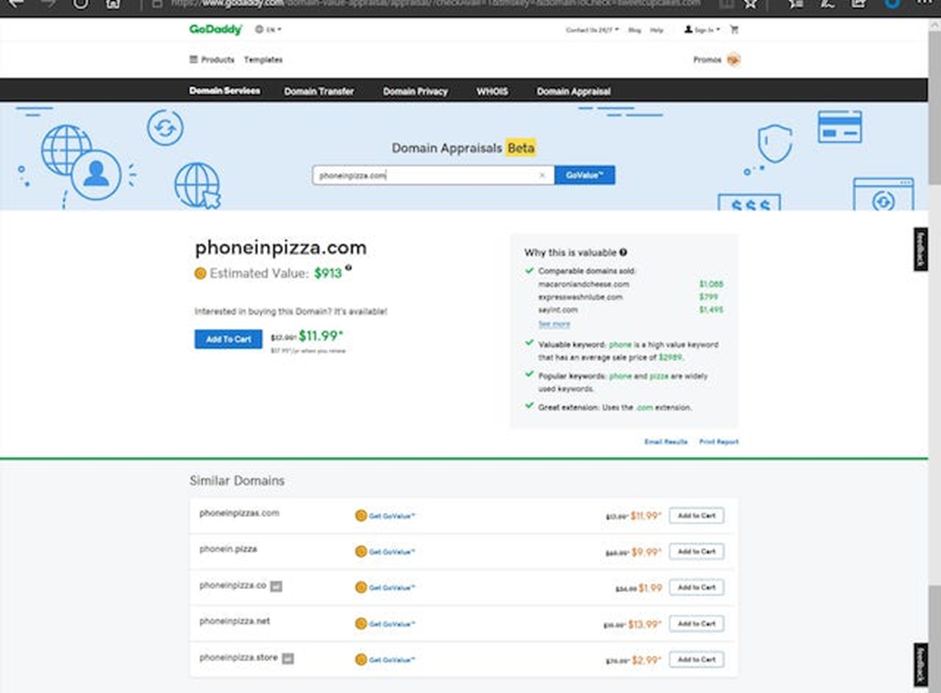
GoDaddy is the most recognised name in domain appraisal, which means its numbers carry more weight than they often deserve. The tool uses a machine learning model trained primarily on keyword value and TLD. It's fast, it outputs a dollar figure instantly, and for straightforward .com domains with commercial keywords, it produces estimates that fall within a defensible range.
However, the problems show up quickly once you move outside that narrow category. GoDaddy rarely tells you a domain is worth nothing. Even weak, unmarketable names tend to get generous estimates. More critically, it ignores backlink profiles and organic traffic entirely. A domain with 2,000 high-quality inbound links and established rankings looks identical to a freshly registered domain with the same keywords. That's a significant structural flaw for anyone using it as a serious appraisal tool.
For developers: GoDaddy does offer API access, but it sits behind a paid tier. There's no free programmatic access, which rules it out for most developer use cases.
The bottom line on GoDaddy domain appraisal accuracy: useful as a rough first reference for .com keyword domains, but not reliable enough to base your asking price on.
Estibot
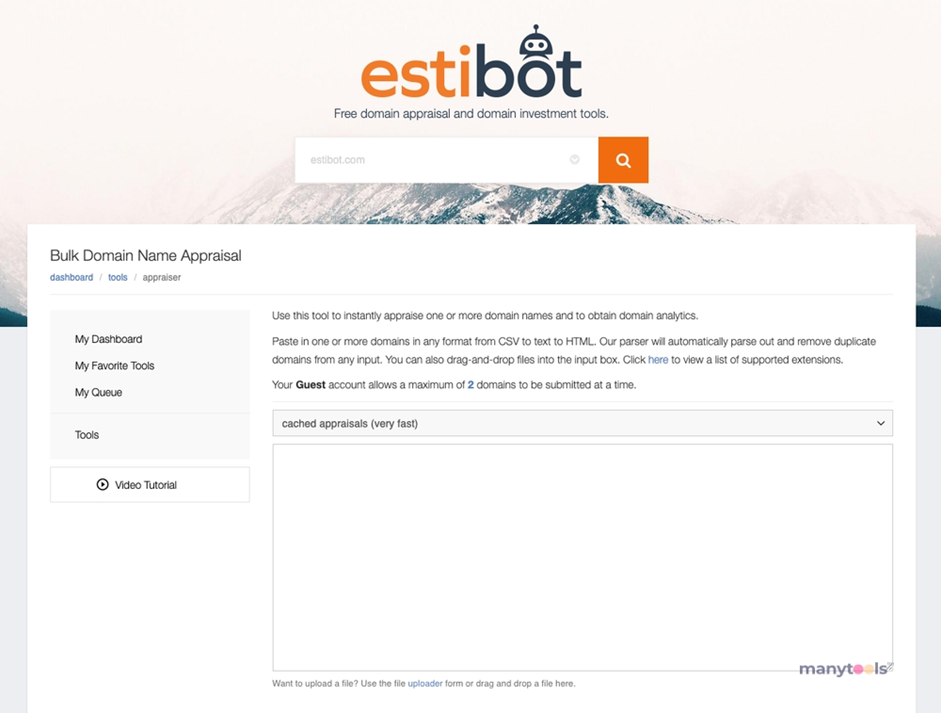
Estibot's valuation is built primarily around CPC data. The logic is simple: if advertisers pay a premium to reach users searching for a keyword, a domain containing that keyword should be worth proportionally more. For keyword-rich commercial domains, that logic holds reasonably well.
Where Estibot falls short is with brandable domains, newer TLDs, and sales comparables that don't always reflect current market prices. For domains that don't map onto a commercial keyword, the estimates are hard to rely on. That includes coined brand names, newer TLDs like .ai, and any niche where CPC data is thin.
Estibot does have an API, though it's gated behind a paid Expert account. Free tier users are limited to web interface lookups only.
HumbleWorth
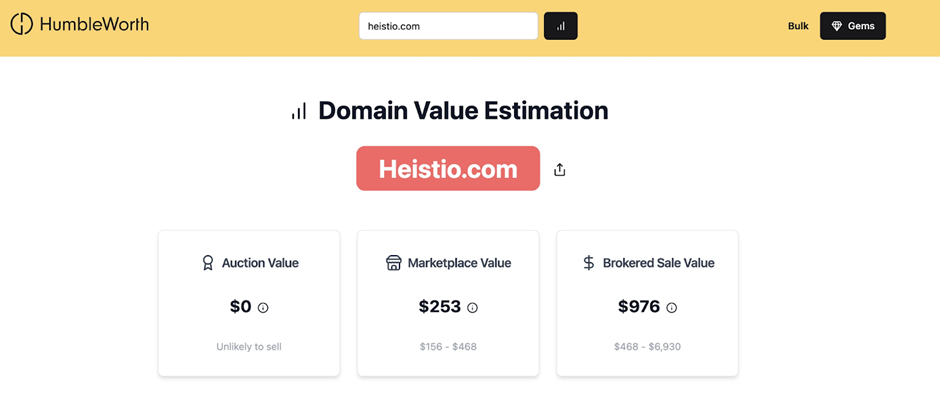
HumbleWorth is the most lightweight of the tools reviewed here. It looks at the domain name and extension, spits out a number quickly, and doesn't make you work for it.
The honest assessment is that HumbleWorth's methodology is thin. There's limited transparency on what the model is actually doing, and the outputs reflect that. Think of the output as a rough guess, rather than a real appraisal.
No API access is available, though HumbleWorth does support free bulk uploads of up to 2,000 domains, which partially offsets that limitation for investors managing larger portfolios.
Why Free Tools Often Get It Wrong
What looks like an individual tool weakness is actually a category problem — free domain appraisal tools are structurally limited by design.
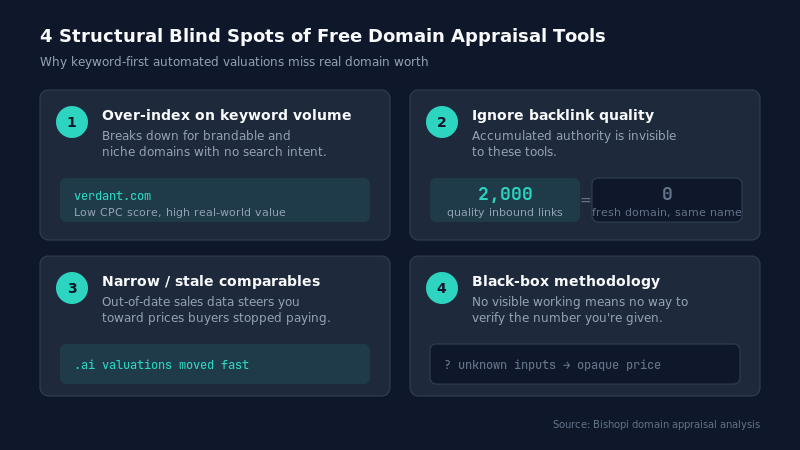
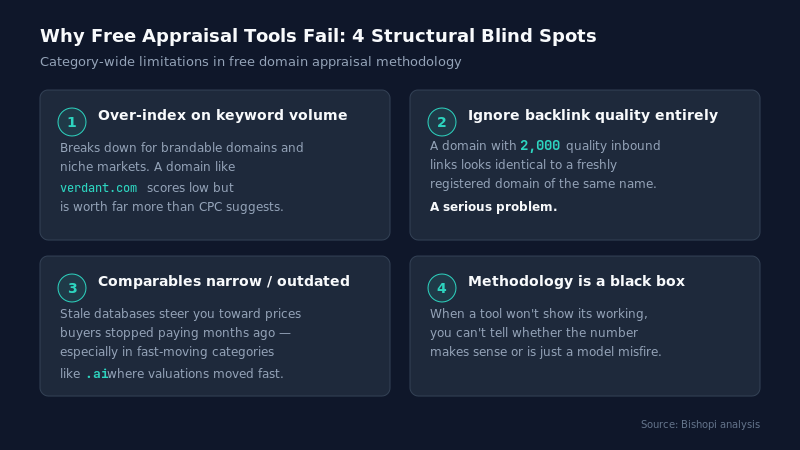
They over-index on keyword search volume
Keyword data works as a starting point. It falls apart for brandable domains, niche markets, and domains where buyer intent doesn't show up in search volume. A domain like "verdant.com" doesn't score well on keyword metrics, but in the right buyer's hands, it's worth far more than its CPC data suggests.
They ignore backlink quality entirely
Backlinks are one of the most reliable signals of a domain's accumulated authority and practical SEO value. A domain with 2,000 quality inbound links and a freshly registered domain with the same name look identical to these tools. That's a serious problem.
Their comparables data is narrow or out of date
Markets shift, and a comparables database that isn't kept current will steer you toward prices that buyers stopped paying months ago. Particularly in categories like .ai where valuations have moved fast.
Their methodology is a black box
When a tool won't show its working, you have no way to know whether the number makes sense or is just a model misfire.
They can't account for context
Brandability, industry fit, and buyer intent all affect real-world sale prices, and none of them are things an automated, keyword-first model can reliably capture.
High-value domains are where free tools fail most visibly. A tool that's off by 20% on a $1,000 domain is an inconvenience; the same error rate on a $50,000 domain is a $10,000 mistake.
If Your Domain Decision Involves Real Money, a Single Free Tool Isn't Enough
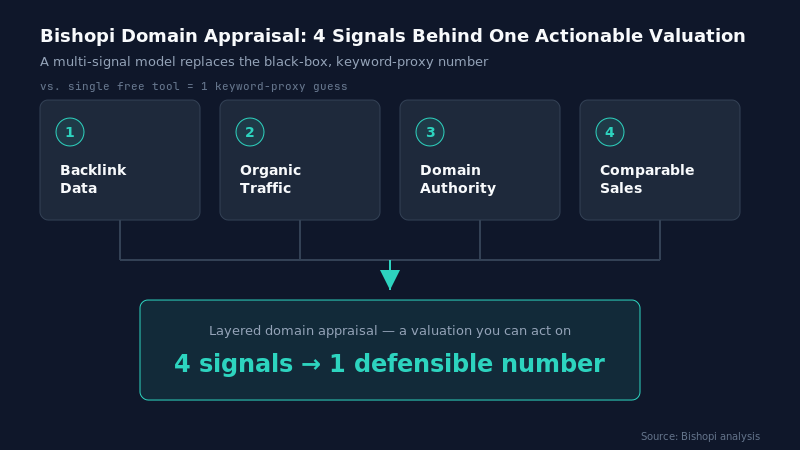
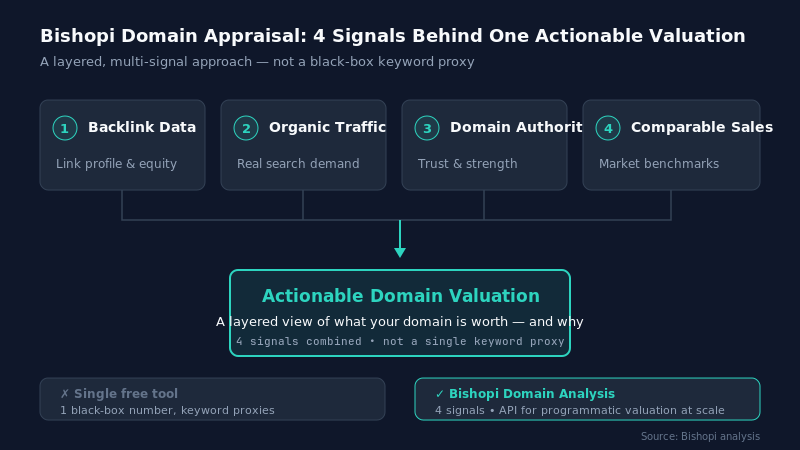
Bishopi Domain Analysis takes a multi-signal approach, combining backlink data, organic traffic, domain authority, and comparable sales to give you a valuation you can act on. Instead of a black-box number based on keyword proxies, you get a layered view of what your domain is worth and why.
Try Bishopi Domain Analysis
For developers: Explore the Bishopi API for programmatic domain valuation at scale
Free Tool vs. Dedicated Platform: Quick Decision Guide
Use Case | Free Tool OK? | Recommended Option |
Quick sanity check on a single domain | Yes | GoDaddy or HumbleWorth for context |
Pricing a domain before listing for sale | Partially | Bishopi + NameBio comparables |
Due diligence before a significant purchase | No | Bishopi Domain Analysis (backlinks + traffic + authority) |
Bulk valuation of a domain portfolio | No | Bishopi Domain Analysis API |
Developer building a valuation feature | No | Bishopi API |
The simplest way to decide is to ask what a bad number would cost you. If the answer involves real money, you need a valuation built on more signals than any free tool is actually pulling.
The Bottom Line on Free Domain Appraisal Tools
Free domain valuation tools are useful, but they're simply not reliable enough to make real money decisions around.
A valuation is only useful if it reflects what a real buyer would actually pay. That means backlinks, organic traffic, domain authority, and comparable sales all need to be in the picture. No free tool pulls all of them. The number you get back from a free tool isn't wrong so much as it's incomplete, and incomplete valuations have a way of showing up as expensive mistakes at the negotiating table.
Explore the Bishopi API for programmatic valuation at scale
Frequently Asked Questions
Domain valuation throws up the same questions again and again, usually right before someone makes a significant decision. Here are the most common ones, answered for you.
How accurate is GoDaddy's domain appraisal?
GoDaddy's appraisal tool is reasonably accurate for generic .com domains with commercial keywords, but it tends to overvalue weak domains by assigning inflated floor estimates. It doesn't factor in backlinks or organic traffic, which makes it unreliable for domains where those signals are meaningful.
What is the most accurate free domain valuation tool?
No single free tool is consistently accurate across domain types. Of the tools reviewed here, Dynadot takes the broadest signal approach. It combines length, memorability, keyword relevance, TLD strength, registration history, and comparable sales. That said, no free tool accounts for backlink and traffic data, which are the two signals that most meaningfully affect real-world value.
How do I determine the value of a domain name?
A reliable domain name appraisal weighs TLD, domain age, keyword value, backlink profile, organic traffic, brandability, and comparable sales together. Looking at recent sales of similar domains on NameBio alongside a multi-signal appraisal tool gives you the most defensible estimate.
What factors affect domain name value?
The primary domain value factors are TLD, keyword search volume, CPC, domain age and history, backlink quality, organic traffic, brandability, and comparable sales. To put that in perspective: Insurance.com sold for $35.6 million in 2010, a figure that reflects near-perfect scores across almost every one of those factors simultaneously. But, domain investors know that this was not a pure domain-only sale.QuinStreet acquired the full website, content, established traffic, and media assets alongside the domain name.
Is Estibot accurate for domain valuation?
Estibot performs reasonably well for keyword-heavy commercial domains where CPC data is meaningful. It's less reliable for brandable domains, newer TLDs, and niches where advertiser spend doesn't reflect actual buyer intent. Its comparables database can also be slow to reflect current market conditions.
What does Bishopi Domain Analysis look at that free tools don't?
Bishopi pulls together the signals that matter most: backlink data, organic traffic, domain authority, and comparable sales. Free tools rarely cover more than one or two of these. When you're making a decision that involves real money, having all of them in the picture is the difference between a defensible valuation and an educated guess.
Originally published at: www.bishopi.io
Stay up to date
Get updated with all the news, update and upcoming features.