How to Find High-Value Domains with Bishopi’s Domain Analysis Tools
Last week, AI.com made headlines with a reported $70 million sale.
Originally registered for just $100 in 1993, it’s the kind of appreciation every domain investor dreams about.

The question for anyone holding a premium domain name is: how do you determine the domain value and the right price?
One word: data.
Domain transactions at that level are built on verifiable data: historical sales, keyword demand, extension comparables, and commercial search intent.
These measurable signals can help you arrive at a defensible number before ANY negotiation begins.
And understanding how to read those domain value signals is what gives you a reliable foundation for every decision they make.
This guide covers the tools and methods used to value a domain accurately, and how to apply them to any name you are researching.
Why Domain Valuation Is Often Misunderstood
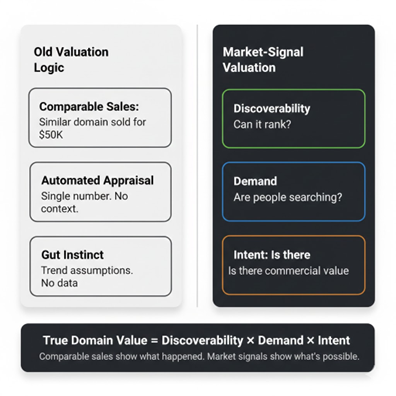
Traditional domain valuation relies on 3 comparative approaches, and all of them fall short:
Comparable Sales: TechStartup.com sold for $50K – does that make YourTechStartup.com worth the same? Not necessarily. Differences in search volume and trends can make structurally similar domains behave very differently.
Automated Appraisals: Many domain appraisal tools often output differing values due to differing algorithms weighting factors like keywords, length, and sales data unevenly.
Gut Instinct: Intuition can’t predict spikes in demand. For example, AI resume tools saw search interest surge over 100% in recent years amid booming adoption.
Takeaway: Comps, numbers, or guesses alone aren’t enough.
If you value a domain at $10,000 based purely on comparable sales, you're missing critical market signals.
[Infographic created via Google NanoBanana]
What if search demand for that keyword dropped 60% last year? What if advertiser competition (measured by CPC) fell from $15 to $3, signaling businesses are abandoning that space?
Here's the missing piece: domain discoverability, demand, and intent.
This is where Bishopi’s Domain Valuation Analysis Tool changes the game.
It tells you why a domain has value, how it ranks in search, and whether the traffic it attracts is actionable.
The Data-Backed Way to Determine Your Domain Name’s Value
Before we get into the specifics, let’s consider two consider:
Scenario #1: You’ve already got a domain name in mind
Scenario #2: You’re only sure about a niche, but don’t have a domain name in mind
Based on your situation, scroll down to see how to come up with right domain valuation.
Scenario #1: You’ve Finalized a Domain Name
If you’ve locked in one or a few names, the work gets easier.
Head straight to Bishopi's domain valuation tool and you'll have a clear, data-backed picture to aid your valuation strategy.
Here's all it covers:
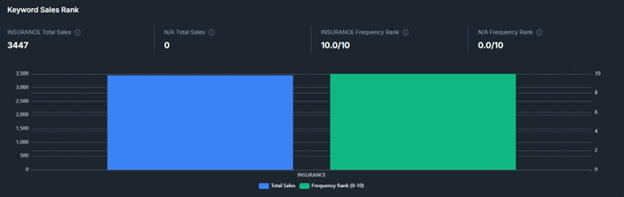
You'll Know If the Domain Name Has Real Commercial Pull
At a glance, you’ll see the total sales for your specific keyword.
This matters because domains anchored to strong keywords consistently command higher resale prices. So, you'll know upfront whether the domain name has commercial weight behind it.
You'll Know Whether the Name Is Built to Sell
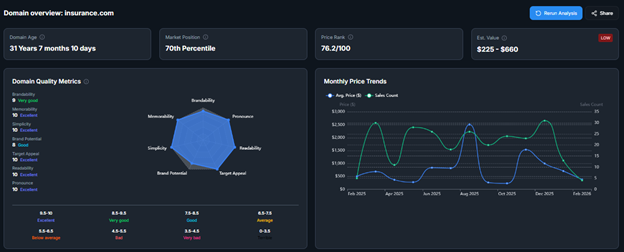
At its heart, a domain's value comes down to marketability.
How memorable is the name? How clearly does it communicate its purpose? How well does it connect with the buyers who will act on it?
The domain overview section answers those questions so you know you’re buying a valuable domain.
You'll Know What Buyers Are Paying Right Now
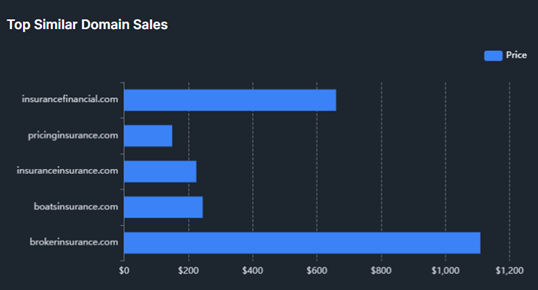
You also get insights into what similar domains are being sold for. It gives you a ballpark range of what the ceiling and floor look like for your domain.
You'll Know the Odds of Getting Offers
Next, the sell-through rate gives you an idea of the realistic timeline for a sale. Because the opportunity cost is visible, you can pick domains that match your investment horizon.
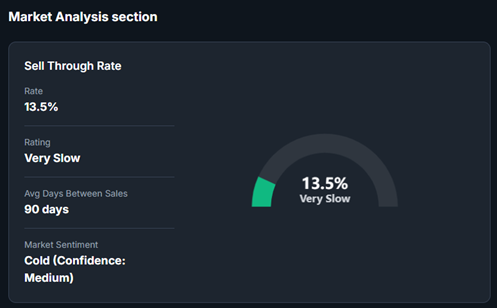
The full report is just like a domain investment brief. Whether you’re buying or selling, it equips you with data points that aid in better decision making.
But what if you haven't locked in a specific name yet? Bishopi can still help.
Scenario #2: If You Don’t Have a Specific Domain Name in Mind
If you’ve only got a niche or keyword in mind and are open to different domains, your research should focus more on understanding the search landscape, competition, and the monetization potential.
Here’s a quick primer on what you can look at
Step 1: Check Search Demand & Keyword Alignment
The first step is to figure out how popular is the keyword that you want to target.
Is this keyword searched 1,000 times a month or 100,000? More importantly: is demand trending up or fading?
Let’s say, you’re interested in the insurance niche.
A quick overview in Bishopi's Keyword Explorer shows good demand but also 100% keyword difficulty with mostly navigational intent.
Takeaway: Lots of interested folks, but few looking to buy, compare, or convert.
In this scenario, if you were hoping to win in the SERPs and get people to “buy” insurance, you’d have to go deeper.
This is where short-tail vs. long-tail analysis comes in.
Short-tail keywords like “insurance” have huge volume but are intensely competitive.
On the other hand, all the long-tail version keywords show lower KD. So, they’re easier to rank for and can give your domain a foothold in search results even if the volume is smaller.
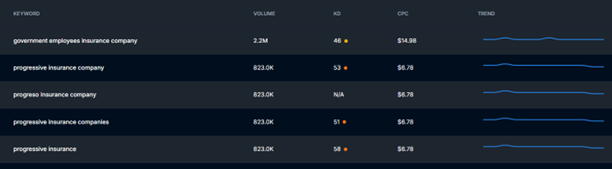
2. SERP Landscape & Competition Analysis
Once you’ve validated search demand, it’s time to check who ranks in the SERPs? That determines whether you can break in the top results easily.
For "insurance," the top results are exactly what you'd expect: government sites and high-authority sites.
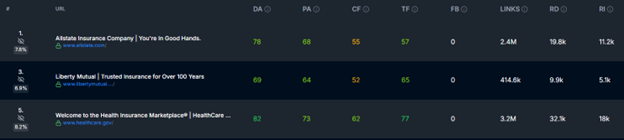
That means it’s difficult to break in. Either you need a dominant brand or a very specific niche angle to get ahead.
But if your goal is to monetize via ads, the section on bids and ad competition will be more relevant.
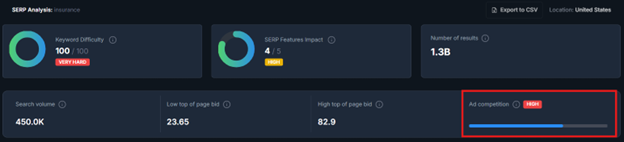
Overall, it gives you a realistic picture of whether your domain can rank in search results and how well it might perform if you run ads.
3. Intent & Commercial Viability Signals
The last part of the validation is to look at intent.
Even if your long-tail keyword has high traffic, it’s important to check again if it has commercial potential.
HealthInsuranceTips.com may get lots of readers, but most are just browsing. ShortTermHealthInsurance.com attracts people ready to act, making it far more valuable.
When you evaluate a domain, focus on whether the audience has intent to generate revenue. If yes, that’s the domain name that’ll get you a higher valuation.
How to Use Domain Valuation Tools to Increase Your ROI
Getting the intelligence is step one. Here's how it compounds into better decisions across the full domain investment lifecycle:
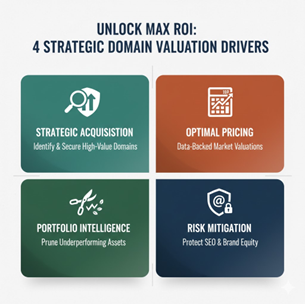
1. Validating Your Domain’s Value
Before you bid on a domain name, it’s a good idea to validate if it’s worth the asking price. Check the keyword data, commercial intent, and SERP competition to make sure it’s a winner.
This simple validation step can save you thousands of dollars in bad acquisitions.
2. Back Your Asking Price With Data
It’s common for domain buyers to negotiate before they make a purchase.
But if you justify your asking price with data - exact search volume, CPC data, and competition scores - the conversation tilts in your favor.
You're not asking them to trust your valuation, you're showing them the market data that supports it.
3. Prune Underperforming Assets From Your Domain Portfolio
If your portfolio starts to get worse with underperforming assets, you can turn to domain valuation to identify which one is a renewal trap. When your pruning exercise is backed by data, you can improve your ROI.
4. Assess the True Risk of Rebranding
If you're helping a client evaluate a domain change, Bishopi quantifies the search equity at stake – so the decision isn't made on instinct or aesthetics, but on what the data says about discoverable value.
What a Domain Valuation Tool Can and Can’t Do
Being clear about this matters, because no tool should be used as a substitute for judgment.
What Bishopi Does | What It Doesn't Do |
Surfaces real search demand and keyword trends | Guarantee a sale price |
Analyzes SERP competition and market dynamics | Inflate value to make a domain look better |
Scores commercial intent and monetization potential | Replace negotiation or human judgment |
Guides acquisition, pricing, and portfolio decisions | Predict exact future revenue |
The tool gives you informed judgment. What you do with it is still up to you.
Find Out What Your Domain Is Actually Worth
If you're evaluating an acquisition, reviewing your portfolio, or choosing a name for a new venture, the questions you need answered are always the same:
Is anyone searching for this – and is that demand growing or shrinking?
Can you compete in this SERP, or is it a closed market?
Does this traffic convert, or does it just browse?
What would a motivated buyer actually pay for this?
Bishopi answers all four. In one tool, in under a minute.
Try the Bishopi Domain Valuation Tool →
FAQs
Is Bishopi only for investors?
No. Founders, startups, and marketing teams use it to pick discoverable domains, assess rebrand risk, and plan SEO strategy.
How is Bishopi data different from traditional appraisals?
Bishopi uses live search demand, SERP competition, and commercial intent to give you a comprehensive idea of the market and value.
Can Bishopi tell me how much traffic a domain will generate?
Yes, it estimates potential visibility and monetizable traffic based on keyword volume, trend trajectory, and intent scoring.
Originally published at: www.bishopi.io
Stay up to date
Get updated with all the news, update and upcoming features.