How to Find Low Competition High Traffic Keywords Fast
If you’ve been doing keyword research, publishing content, and still not seeing rankings, you’re not alone.
You follow the usual process. You open a keyword tool, filter by low difficulty, pick topics with decent search volume, and write solid content. Then you hit publish, but nothing happens.
The frustrating part is that it feels like you’re doing everything right. But the reality is that most keyword research workflows lead everyone to the same keywords, the same topics, and the same crowded search results.
In this guide, you’ll learn how to find low-competition, high-traffic keywords that you can realistically rank for, not just keywords that look good in a spreadsheet. You’ll also discover how to identify weak SERPs, uncover search intent gaps, and use APIs for SEO to surface keyword opportunities at scale.
By the end, you’ll have a repeatable framework for finding keywords that can start ranking in weeks, not years.
Why Low Competition Keywords Matter More in 2026
The SEO landscape has changed significantly in the past few years. Currently about 60% of Google searchers get their answers directly on the result page without clicking to an external website.
Low-competition keywords often take the form of specific, question-based long-tail queries, which makes them ideal for targeting these searchers.
Here is why you should target low competition keywords:
AI content saturation has made broad, high-competition keywords a crowded race.
Search engines like Google reward niche topical authority built through specific keywords
People search with more specific, high-intent queries that favor long-tail keywords.
SERP features and ads reduce organic visibility, making low-competition terms easier to win
Low-competition keywords are easier to rank for and offer higher conversion rates for newer or smaller websites
The 3 Signals That Actually Matter
When researching keywords, difficulty scores and search volumes are crucial metrics to consider.
But here is the catch: while those numbers can be helpful, they describe the surface of competition.
Here are the three key signals you should evaluate to find keywords you can actually win:
Weak authority among pages ranking in SERPs
Gaps in search intent coverage
Proven traffic potential beyond the keyword itself
Here's how these signals compare against the typical keyword research approach:
Metric | What most SEOs check | What you should check |
|---|---|---|
Keyword difficulty score | Raw KD number from a tool | Domain authority of actual ranking pages, plus content quality and depth |
Search volume | Monthly search numbers | Total traffic potential of the topic |
Competition level | Number of indexed pages | Analyze click-through rate potential, plus SERP feature competition |
Search intent | Rarely checked | Whether top results match the query's real intent |
Content quality | Ignored entirely | Thin answers, missing subtopics, poor formatting in top results |
How to Spot Low-Competition, High-Impact Keywords
The standard playbook, using Google’s autocomplete, type a seed keyword into a tool, filter by KD under 30, pick the highest-volume result works until everyone is running the same playbook.
Here are practical tactics that go a layer deeper and draw on signals most keyword research workflows overlook entirely.
1. Start With Micro-Niche Expansion (Not Broad Keywords)
Broad keywords are tempting because the volume numbers look impressive.
But when you begin with a broad keyword or topic, you usually end up competing with major websites with established content libraries. You won’t win there.
Instead, start with a very specific subtopic where existing content is thin, mismatched or outdated, then expand from there as you build authority.
Here is how to find low-competition high traffic keywords by starting your keyword research narrow:
Use Seed Keywords from Forums and Communities
To get authentic keyword ideas, you need to analyze real conversations happening on forums and communities. Because the way your target audience describes their problems in a Reddit thread or a Quora discussion is often exactly how they search and it's rarely what shows up in when you use a keyword research tool.
Here are specific places to mine seed keywords:
Reddit threads: Search your topic on Reddit and look at upvoted questions, comment threads, and recurring pain points. The titles of popular posts often map directly to real search queries.
Quora discussions: Quora surfaces niche, question-based queries phrased the way someone would actually search them. Filter by topic and sort by recent activity to spot emerging questions with few good answers.
Product reviews on Amazon, G2, or Capterra: Look for reviews that mention specific use cases, limitations, or comparisons. These often map to high-intent, low-competition long-tail keywords.
Customer support questions: If you have access to support tickets, live chat logs, or public forums for your product category, the questions users ask repeatedly are almost always underserved search queries.
When mining keywords on these forums and communities, focus on the underlying search intent not just copying the phrasing. Here is an example of a frustrated user on Reddit:
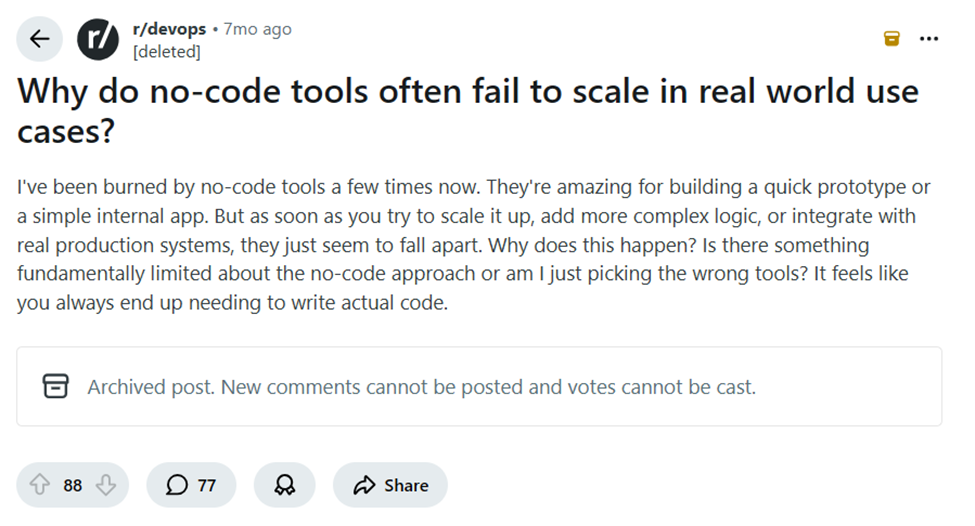
From the above thread, you can come up with keywords that match the user’s frustration such as:
Limitations of no-code platforms
Real-world limitations of no-code tools
Why do no-code tools not scale well
Scaling no-code applications
No code vs low code scalability
When to migrate from no-code to code
Expand Using Keyword Research Tools
Once you have a list of seed keyword ideas from these sources, use keyword research tools to validate demand and discover related variations you might have missed.
There are many keyword research tools out there that you can use to generate hundreds of long-tail variations around your seed keywords.
However, most of them aren’t built for bulk keyword research. If you’re processing dozens of seed keywords or topics, you might take hours to complete your keyword research process.
API-based SEO tools can pull large keyword datasets and expand seed terms at scale.
For instance, platforms like Bishopi provide SERP API that can:
Retrieve Google autocomplete keyword suggestions across multiple keywords
Pull related search queries in bulk in just a single API call
Extract People also ask questions from multiple SERPs in batch
Generate thousands of long-tail variations automatically
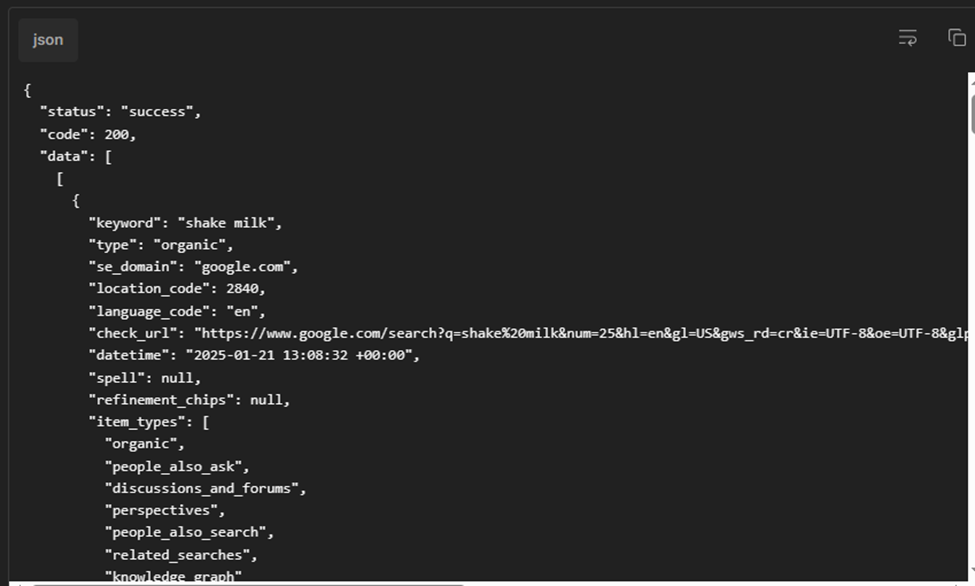
The API can turn an hour-long keyword research process into a minutes API call.
2. Find Under-Optimized SERPs (The Easiest Win)
Some of the easiest keyword opportunities are hidden in SERPs that look competitive at first glance but contain weak content.
For example, a large website might rank for keywords it didn’t target. Its content may appear on the first page because of domain authority, not because the page is optimized for a particular keyword.
Here is how to analyze under-optimized SERPs:
Look for These 5 Weak SERP Signals
When manually scanning SERPs for a target keyword, observe these specific patterns. Any one of them represents a gap you can build around:
Poor search intent match: The top results for a keyword answer a different question than the one users are actually asking
Shallow featured snippet: A paragraph snippet that gives a surface-level answer
Poor formatting and readability: Content with no headers, dense blocks of text, or missing tables and visuals for queries where those elements would help
Outdated content: Pages citing stats from 5 years ago or referencing tools that no longer exist
Use Data to Validate at Scale
Manual SERP analysis works well for a handful of keywords. But when you’re evaluating hundreds or thousands of queries, it becomes time-consuming, especially if you’re managing large keyword portfolios.
To efficiently evaluate hundreds of potential targets, you need a way to pull structured SERP data including domain authority of ranking pages, content length patterns, backlink profiles without spending hours in a browser.
Using specialized APIs designed for SEO can simplify and enhance the process for you.
Using these APIs, you can:
Pull top 10 results for thousands of keywords in seconds
Analyze domain authority trends
Identify SERPs with unusually weak authority with a single API call
Detect ranking volatility and instability
3. Use Search Intent Misalignment to Beat Strong Domains
Even highly authoritative sites or domains can rank with content that partially answers a query rather than fully satisfying it. When that happens, creating a more focused article can outrank them even if your site is smaller.
Take a look at the example below:
When you search for the keyword “how to get rid of pimples fast” you want an immediate remedy or quick treatment for your pimples. Cleveland Clinic, even though a strong domain, appears at the top of the search results but doesn’t answer the question satifactorily.
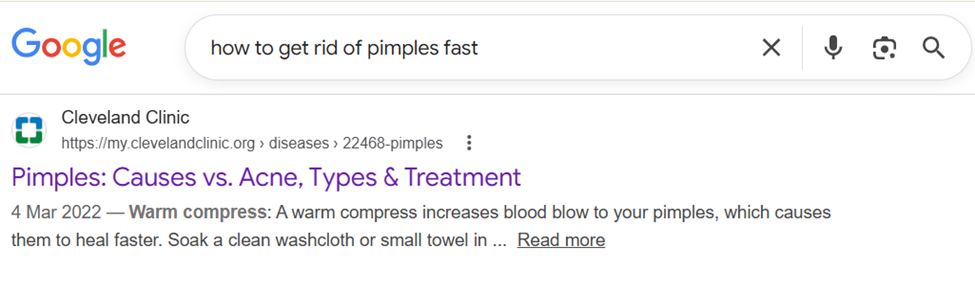
Instead of answering the searcher’s intent directly, the page mainly explains what pimples are, their types, causes, and general treatments, rather than giving quick, actionable steps to remove them fast.
It focuses on educational background (e.g., symptoms, diagnosis, and prevention) instead of directly addressing the search intent of “how to get rid of pimples fast.”
That’s a search intent misalignment from a strong domain.
To beat this page, create content that directly answers the query in the first section with clear, quick solutions (e.g., overnight treatments, dermatologist-recommended quick fixes, and timelines). Structure it with step-by-step instructions, “fast results” tips, and FAQs optimized for the keyword so users immediately get the exact solution they searched for.
4. Leverage Competitor Keyword Gaps (The Right Way)
Competitor keyword research can reveal valuable opportunities but only if you approach it strategically.
Most people execute it wrong. They import a competitor's top keywords and try to replicate their rankings without analyzing whether those keywords represent real opportunities.
Here is how to do competitor keyword gap analysis:
Identify Competitor Pages Getting Traffic But Not Optimized for Certain Terms
Start by analyzing competitor pages that receive organic traffic. Then examine whether those pages truly target all the keywords they rank for.
Often you’ll discover that a single page ranks for dozens of related queries that were never intentionally optimized.
These are high-value targets: the SERP already accepts content from this niche, but the existing piece leaves the user's question partially unanswered.
Use content analysis to find pages with broad keyword footprints but shallow coverage on specific subtopics.
Reverse-engineer the ranking URL. Look at what the page actually covers versus what queries it ranks for. Any gap between those two is a keyword you can target with a more focused piece.
Find 'Almost Ranking' Keywords
Another useful tactic to find low-competition high traffic keywords is to identify keywords where competitors rank just outside the first page.
These keywords indicate that Google already considers the topic relevant but the existing content isn’t strong enough to rank higher.
Look for keywords where:
Competitors rank in positions 11–20
The competing pages have low or moderate authority
The keyword shows reasonable traffic potential
Using a competitor analysis tool, you can analyze competitors’ organic keywords, compare rankings, filter results by keyword difficulty <25 and ranking positions 2.
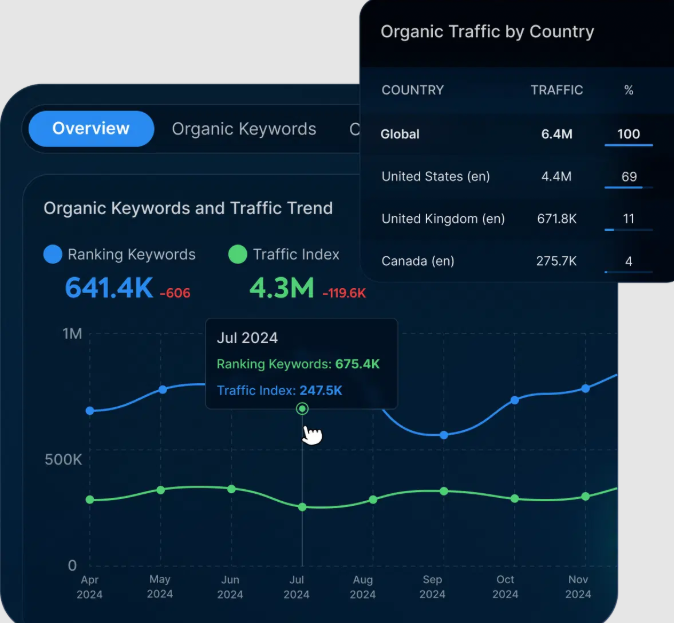
You can quickly surface keywords where competitors rank between positions 11–20 and assess traffic potential, page metrics, and authority. By highlighting keyword gaps and ranking opportunities, the tool helps you prioritize “almost ranking” keywords and create stronger content that can realistically break into page one.
5. Target Newly Emerging Keywords Before They Get Competitive
One of the most powerful ways to find low competition high traffic keywords is to identify topics that are just beginning to gain traction.
Emerging keywords often have rapidly increasing search demand but very little competition.
This timing creates ideal ranking conditions.
You’ll use trend data combined with keyword metrics.
Here is how to identify and target these keywords:
Use Google Trends to identify topics gaining momentum
Check related keywords in research tools
Evaluate the SERP quality
Review the keyword difficulty score
Filter your keywords based on the following criteria:
Keyword difficulty below 20
Search growth above 20% within six months
Few authoritative pages covering the topic
Common Mistakes to Avoid When Targeting Low Competition Keywords
While targeting low competition keywords can boost your SEO efforts, here are some of the mistakes you must avoid:
Chasing keyword volume over traffic potential
Trusting KD scores without checking the actual SERP
Ignoring search intent
Targeting isolated keywords instead of building topical clusters
Publishing thin content for 'easy' keywords.
Scale Your Keyword Research With SEO APIs
Finding low competition high traffic keywords is no longer about browsing keyword tools and guessing which queries might work. Modern SEO requires identifying patterns in SERPs, intent gaps, and emerging search trends.
By following the tactics covered in this guide you can create a repeatable framework for discovering valuable keyword opportunities.
However, as your keyword datasets grow larger, manual workflows can quickly become limiting. There are only so many seeds you can expand, SERPs you can review, and competitor gaps you can identify in a given week.
Many SEO teams now use APIs and automation-friendly tools to analyze thousands of keywords and SERPs in bulk.
If you're looking to scale your research, Bishopi SEO APIs can help you:
Pull real-time keyword datasets
Extract SERP results in bulk
Analyze search intent signals
Identify ranking opportunities faster
If your goal is to find low competition keywords at scale explore Bishopi SEO APIs to accelerate the process.
Frequently Asked Questions
1. What are low competition high traffic keywords?
These are search queries that receive meaningful search demand but have relatively weak competition in search engine results.
They are often long-tail or highly specific queries where fewer authoritative websites have created optimized content.
Even if your website is smaller or newer, targeting these keywords speed up rankings and attract qualified organic traffic without competing against large, established domains.
2. How do you find low competition keywords quickly?
Start by identifying real questions and problems your audience discusses in forums, communities, reviews, or support threads.
From there, expand those ideas with keyword research tools to discover long-tail variations, then analyze the search results to find pages with weak authority, thin content, or poor search intent alignment.
You can accelerate this process with SEO APIs that can generate and evaluate hundreds or thousands of keyword ideas at once.
3. Why is search intent important in keyword research?
Search intent reveals what users actually expect to find when they type a query into a search engine. If your content doesn’t match that expectation, it will struggle to rank even if the keyword has low competition.
Aligning your content with the exact intent behind a query can improve ranking potential and user satisfaction.
4. How does SERP competition analysis improve keyword targeting?
It reveals how difficult it will actually be to outrank existing pages targeting a keyword.
Instead of relying only on difficulty scores, SERP competition analysis reviews the authority, content quality, formatting, and intent coverage of top-ranking pages to expose weaknesses such as outdated information or incomplete answers.
Once you identify these gaps you can create more focused, higher-quality content that has a higher chance of ranking on the first page.
Originally published at: bishopi.io
Stay up to date
Get updated with all the news, update and upcoming features.