9 Domain Research Tools Every Investor Should Know by Use Case
With over 380 million domains already registered and nearly half a billion expected by 2030, the challenge isn’t finding a domain. It’s knowing which ones are actually worth buying.
You need a reliable tool that can support your domain research workflow from start to end.
Unfortunately, when you search for “best domain research tools,” you get flooded with availability checkers.
Those tools are helpful, but only if you want to verify availability before you can register domains.
They don’t help a domain investor asking: “I found this domain listed for $2,000, how do I know if the price is justified, or if it has a clean history?”
In this blog post, I’ll share the exact steps I use to evaluate domains before buying and the domain name research tools that power each step.
The 5 Key Questions You Must Answer in Your Domain Research Process
Here are the key questions you must answer in your domain research process to ensure you’re investing in a domain that’s not only available but has value as per the current market price.
Every tool in this article maps to one of these questions.
Is this domain available or acquirable at a price that makes sense?
What has it been used for — and is that history clean?
What have comparable domains sold for recently?
What is the SEO strength — domain name metrics such as backlinks, domain authority, existing traffic?
What is it actually worth today vs. what you’re being asked to pay?
Domain Tools For Domain Discovery and Availability
Domain discovery and availability is where most tools stop. For domain buyers, it’s the initial stage for deciding whether the domain is worth researching further.
Before investing in a domain, ask yourself: Is this domain available or acquirable at a price that makes sense?
Tools that can help you include:
1. Instant Domain Search
Instant Domain Search is built for speed. It queries domain availability across 800+ TLDs in real time as you type, which makes it useful for bulk brainstorming sessions where you’re testing dozens of variations.
There’s no sign-up friction or limit on queries.
Its limitation is that it stops at availability. You get a green or red indicator, nothing about the domain’s history, valuation, or why it might be parked. For initial discovery, it’s hard to beat; just don’t mistake availability for opportunity.
Overall, Instant Domain Search is ideal for generating ideas, not validating them.
2. Bishopi Domain Availability Lookup
The Bishopi domain availability lookup tool goes a step further than a basic availability check. When you search a domain, it returns registration status alongside immediate SEO signals, including domain age, backlink count, and authority indicators in a single view.
For investors, this matters because availability without context is nearly useless. A domain might be available because it was just dropped after a spam history, or it might be available because no one noticed its SEO equity.
The domain tool reveals enough signals to tell the difference before you invest time in deeper research.
What’s more? The tool covers both registered and unregistered domains, and the SEO data pulls from live sources rather than cached estimates. You’re not just checking if a domain is taken. You’re getting your first read on whether it’s worth continuing the due diligence process.
Domain Research Tools For History and Due Diligence
Over 15 million domain names were flagged for malicious activity in the last calendar year.
A domain could have a clean appearance but carry a bad history with years of Google penalties, scraped content, or adult associations that no amount of new backlinks will fully overcome.
You need to ask yourself: What has this domain been used for — and is its history clean?
Here are tools to help you uncover this:
3. Wayback Machine
You can use the Internet Archive's Wayback Machine to know what a domain was actually used for across its ownership history.
The tool works by indexing snapshots of websites over time, to allow you to view how a domain was previously used across different dates.
For domain investors, you can know whether a domain hosted legitimate content, was part of a real business, or was used for spam, PBNs, or malicious activity. You can also track content changes, ownership intent, and niche relevance.
Practically, the Wayback Machine helps you avoid toxic domains and confidently validate whether a domain is worth acquiring.
4. WHOIS History
DomainTools’ WHOIS history tool tracks the full ownership timeline of a domain.
With this tool, you can track how many times the domain changed hands, how recently the current registration occurred, and whether ownership transitions correlate with content changes visible in the Wayback Machine.
For instance, if you notice frequent ownership changes in a domain history within a short period, that could signal a problem worth investigating.
5. Bishopi Domain Age Lookup
While domain age alone doesn't guarantee success, it provides valuable insights into a domain's history and reputation.
The domain age lookup tool goes beyond simply telling you when a domain was registered. It pulls data from authoritative WHOIS records and reveals relatively reliable insights into registration dates, ownership history, and activity timelines in one API call, as shown below:
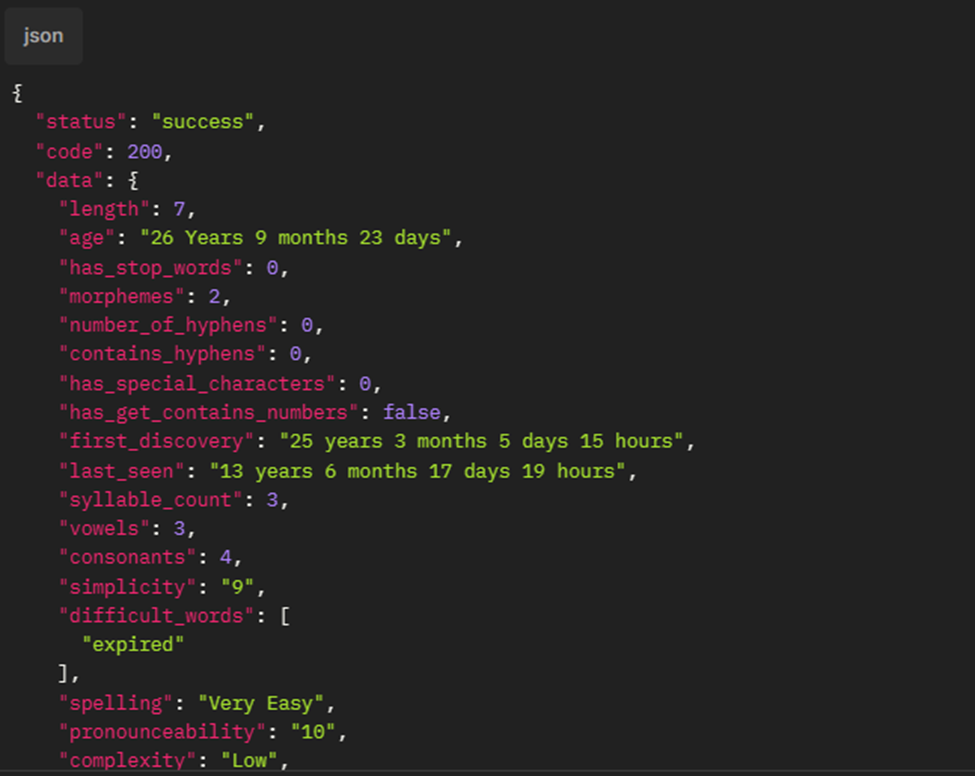
What makes it more useful is its ability to surface relationships between multiple domains. The tool reveals IP history, nameserver changes, and ownership patterns to help identify domain networks, which can be relevant for detecting private blog networks or shared infrastructure.
Domain Tools For Sales Comps and Market Pricing
You can’t price a domain correctly in a vacuum. Comparable sales are the only reliable anchor for what a domain is actually worth in the current market.
Ask yourself: What have comparable domains sold for recently?
Tools to help you with sales comps and market pricing include:
6. NameBio
NameBio offers a database for domain sales comps, covering over 2 million verified historical transactions aggregated from Sedo, GoDaddy Auctions, Flippa, and other platforms.
With this tool, you can uncover what buyers have actually paid for comparable domains by filtering by toplevel domain, keyword structure, word count, and recency. This is more reliable than any automated appraisal for domains in categories with active transaction history.
7. Bishopi Domain Sales History
Bishopi's domain sales history tool combines verified transaction data with real-time market demand signals for investors who need comps and current pricing context in the same workflow rather than switching between multiple tools.
Using this tool, you can uncover valuable domain sales data, including verified current and past pricing, sale dates, and the respective marketplaces in real time.
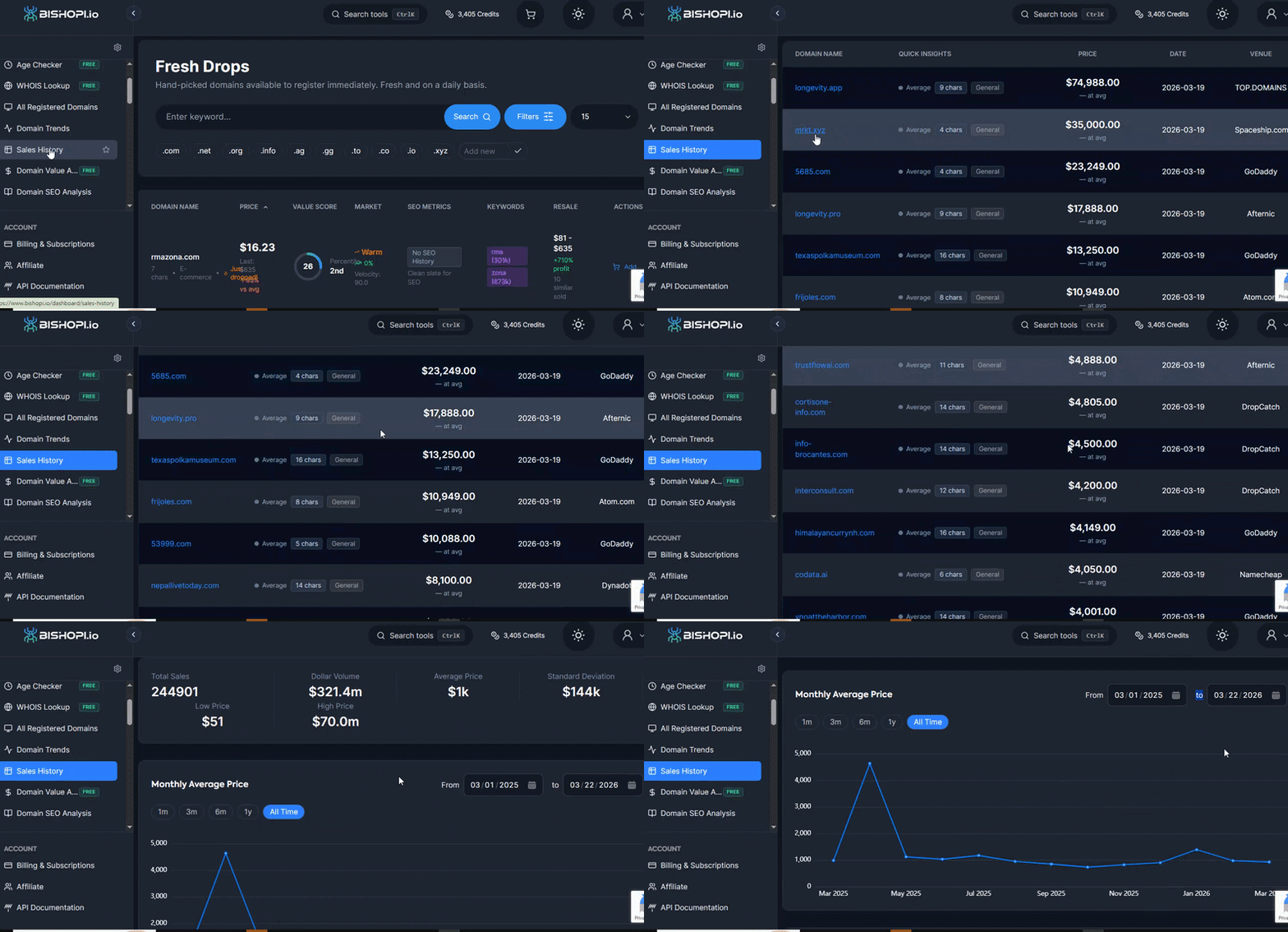
You can compare current market data to historical sales activity, track pricing trends, and market momentum over time. You can also identify high-performing domain categories and niches and benchmark current against past sales performance.
The tool also allows you to filter sales by domain extensions, price range, keyword category, or length to find the exact domain you want to buy.
Here’s a sample of recent domain sales pulled from the Bishopi domain sales history database in the finance category:
Domain Name | Sale Price | Sale Date | Platform |
|---|---|---|---|
bullmarket.ai | $809 -above avg | 2026-03-03 | Namecheap |
cofinance.ai | $824 -above avg | 2026-02-26 | Namecheap |
finconsult.ai | $514 -above avg | 2026-02-23 | Namecheap |
stockalerts.ai | $193 -below avg | 2026-02-22 | Namecheap |
fintrade.ai | $176 -below avg | 2026-02-22 | Namecheap |
Tools For Domain SEO Strength & Backlink Profile
According to a Backlinko study, domains ranking on page 1 of search results have an average of 3.8x more backlinks than those ranking on pages 2 to 10. This means that a strong backlink profile is as important as the domain name for SEO value and domain flipping.
Answer the question: What is the SEO strength — backlinks, authority, existing traffic?
Use these tools to understand the SEO strength and backlink profile of your chosen domain.
8. Bishopi Domain SEO Analysis
The Bishopi domain SEO analysis tool reveals valuable domain insights such as authority score, trust flow, spam score, backlink count, traffic sources(organic vs. referral vs. direct), and search ranking signals in a single view.
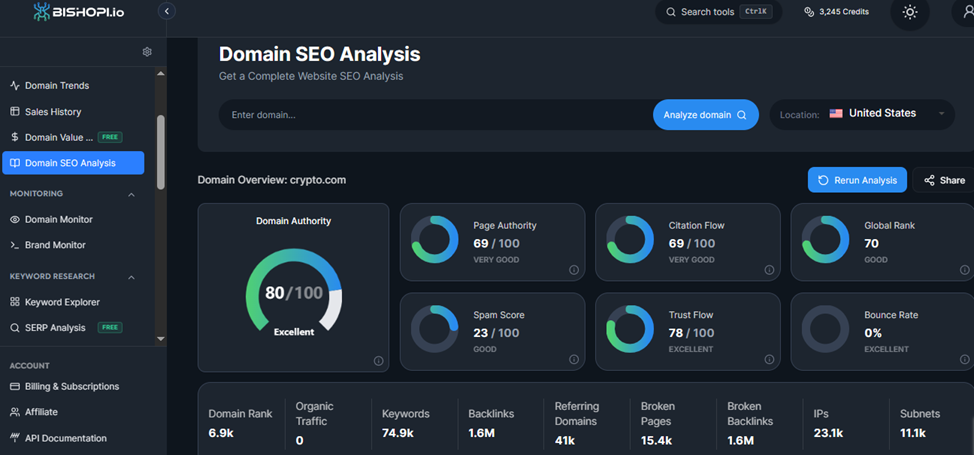
What’s more? You can track a domain’s traffic distribution by country, referring domains, and top competitor domains.
For investors, the traffic source split helps you distinguish domains with genuine organic traffic from those propped up by referral loops or bot-inflated metrics. If you’re evaluating a domain for development potential, use this tool before making an offer.
9. Ahrefs
For deep backlink analysis, Ahrefs remains the most comprehensive database in the market. Its referring domain graph, anchor text distribution, and historical link velocity are still the industry benchmark for serious SEO due diligence.
If you’re a domain investor who wants valuation, history, and sales comps in the same workflow, Bishopi handles all three. Meanwhile, Ahrefs can be helpful if your primary goal is link graph quality at a level that warrants the specialist tool.
This tool can also be costly for investors who only need periodic domain checks rather than ongoing SEO monitoring.
Domain Valuation — Pulling It Together
You need to know how to value domain names to get a good deal. Because the asking price might not correlate with what the domain is actually worth today.
Ask yourself this question: What is the domain actually worth today vs. its current price?
There are three methods you can use to value a domain. Each has its role, and none of them works in isolation.
Using Automated Appraisal Tools
GoDaddy’s free domain appraisal, EstiBot, and HumbleWorth all use machine learning models trained on historical sales data. They’re fast and affordable, which makes them useful as a starting point.
However, their accuracy, in my experience, sits around 75–85% relative to actual market prices, and that variance widens significantly for domain categories with thin transaction history or sudden demand spikes.
You should never rely on a single automated appraisal or use one as your final answer. You need to run two or three, average the outputs, and treat the result as a number to validate against comps, not anchor to.
Comparable Sales Method
The comparable sales method is when you value a domain by analyzing recent sales of similar domain sales, matching factors like keyword, length, extension, and industry relevance.
As an investor, you can see what buyers have already paid for similar domains. This reduces guesswork.
You can use domain tools like the Bishopi, NameBio, or GoDaddy Auctions to identify historical transactions, then adjust for differences (branding strength, traffic, or timing). This grounds valuation in real buyer behavior rather than speculation.
For instance, if a domain like cryptowallet.com recently sold for $120,000 and securewallet.com for $95,000, you could value a domain like digitalwallet.com within that range, adjusting upward or downward based on keyword demand and brand-fit.
3. The Judgment Layer
This is where tools fail. Practically, algorithms don’t understand timing, brand fit, end-user demand, or current news cycles.
Take a look at the example below:
Based on data from NameBio, NamePros, and multiple domain news sources the domain terafab.ai was sold for $174,257 to Elon Musk on 2026-03-22. It was the top domain name sale of that day at Spaceship.com.
Just 1 day before the sale, Elon Musk had unveiled a massive $20–25 billion chip manufacturing facility called TERAFAB that’s tied to Tesla, SpaceX and xAI.
However, if you analyze the domain name through Bishopi's domain value analysis tool you get the following results:
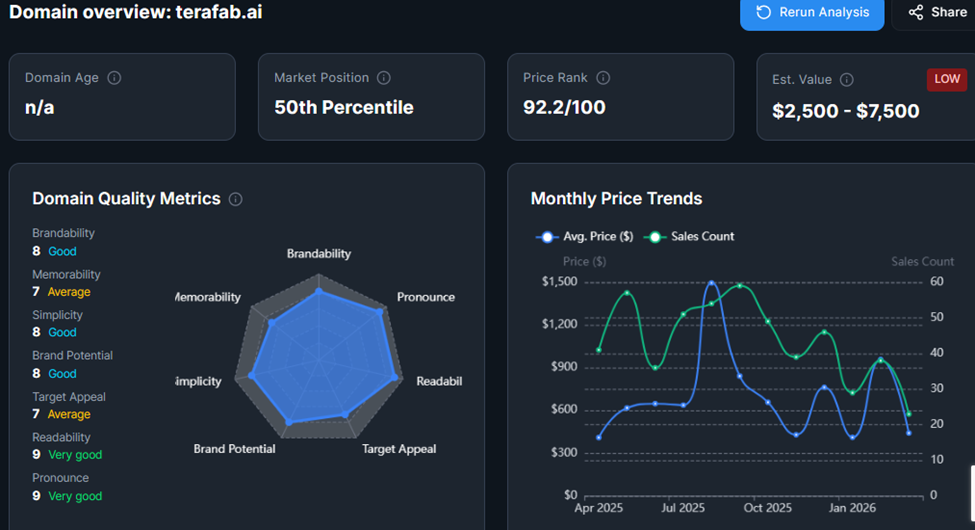
Estimated value ranges between $2,500 – $7,500.
Its monthly price trend is between $442 - $958
Top similar recent domain sales- fabrique.ai - $3,383
The domain’s historical price trends- all-time average price- $1,817
Based on the data from this tool, you can easily think the domain name isn’t valuable or worth investing in.
However, as a smart investor you could predict the real end-user value of the domain and apply your own judgement. Not only because AI domain values have surged but the breaking-news effect, market context and end-user demand override tool estimates.
How to Value a Domain, Step by Step
Now that you know the best domain research tools you can use for your workflow, here is a simple checklist to evaluate a domain from the start to the decision stage, alongside the tool to use:
Use Instant Domain Search or Bishopi Availability lookup tool to check availability and current asking price
Use DomainTools WHOIS History to run WHOIS history. Count ownership changes, flag rapid re-registrations
Pull Wayback Machine snapshots. Scan for spam, adult content, PBN use, and content gaps across ownership periods.
Check domain age and registration timeline using Bishopi domain age checker
Pull backlink profile and DA score. Evaluate link quality, not just count with Bishopi SEO Analysis or Ahrefs
Run a comparable sales search using the same TLD, similar keywords, the last 12 months with NameBio and Bishopi Sales History
Run automated appraisal on 2–3 tools, average the outputs using GoDaddy Appraisal, EstiBot, and HumbleWorth
Apply the judgment layer — who is the end-user? Why is this domain available now? What’s the demand trend?
Set your walk-away price before entering any negotiation.
The Best Domain Research Tools at a Glance
Let’s compare the best domain name research tools:
Tool | What It Does | Free Tier? | Questions Answered | Best For |
|---|---|---|---|---|
Bishopi | Availability, age, SEO, sales history, valuation — all in one tool | Yes | 1, 2, 3, 4, 5 | Domain investors who want full workflow in one tool |
NameBio | Historical domain sales database | Limited | 3 | Pricing comps, market research |
Wayback Machine | Domain content history, archived snapshots | Free | 2 | Due diligence on aged domains |
EstiBot | Automated domain appraisal, bulk valuation | Yes (limited) | 5 | Quick portfolio valuation |
GoDaddy Appraisal | Automated appraisal using ML + sales data | Yes | 5 | Starting point for valuation |
ExpiredDomains.net | Daily expiring domain lists with metrics | Yes | 1 | Hunting expired/dropping domains |
Ahrefs / Moz | Deep backlink analysis, DA scoring | Limited trial | 4 | SEO-focused domain acquisition |
WHOIS (any) | Ownership records, registration history | Yes | 2 | Ownership verification, due diligence |
Instant Domain Search | Real-time availability across 800+ TLDs | Yes | 1 | Fast availability checks, brainstorming |
One Workflow. No Switching Tools.
Most domain research tools solve a single piece of the puzzle. Instant Domain Search helps you brainstorm. Wayback Machine protects you from toxic history. NameBio grounds you in real market comps. Ahrefs goes deep on backlinks. Each is useful but only in isolation.
That’s where most investors lose time and money. You’re forced to jump between tools, stitch together data, and still make judgment calls with gaps in your analysis.
This can create pricing inefficiencies and missed opportunities.
Bishopi flips that model.
Instead of fragmented insights, it gives you a connected workflow: availability, history, SEO strength, and sales comps—all in one place, in real time. You move from discovery to valuation without breaking context or relying on guesswork.
The tool offers convenience and clarity. Plus, you can analyze multiple domains at once in a single view.
Explore how Bishopi domain tools can power your domain research workflows.
Frequently Asked Questions
What is the most reliable way to value a domain name?
The most reliable method is comparable sales analysis. Review recent domain transactions with similar keywords, length, and TLD using domain name tools like Bishopi.
Combine this with multiple automated appraisals for baseline estimates, then apply judgment based on market demand, brandability, and current industry trends.
Are free domain research tools accurate enough for real investment decisions?
Free tools are useful for initial research but not final decisions. They provide insights into availability, basic SEO metrics, and history checks.
However, they often lack depth in sales data and real-time pricing. For serious investments, combine free tools with data sources from premium domain tools for accuracy.
How important is domain history when evaluating a purchase?
Domain history is critical in evaluating risk and long-term value. A domain with a history of spam, penalties, or malicious use can negatively impact online presence and reputation.
Domain history allows you to verify past usage through archived content and ownership records to avoid costly mistakes and ensure clean investment assets.
Originally published at: www.bishopi.io
Stay up to date
Get updated with all the news, update and upcoming features.