Enterprise SEO Competitor Analysis: Find Your Real Search Rivals
Most enterprise SEO teams are benchmarking against the wrong sites. Your real search competitors aren't on your sales team's radar. They're content publishers, SaaS blogs, and comparison sites quietly capturing the search demand you should own. This guide shows you how to identify them using data. We demonstrate how to use SEO APIs to run that analysis at scale.
Who Are Your Real Search Competitors?
Your true search competitors aren’t the companies you already know. The ones competing in your industry. They are sites stealing your traffic through keyword overlap and SERP dominance, not just industry peers.
For instance, a cloud software company may compete with software review sites, SaaS blogs, or marketplaces for search visibility, not just other software companies.
Take a look:
If you search for “Google Sheets for SEO” on Google, you will notice that Search Engine Land shows up for the keyword for a tutorial, even though the site doesn’t sell the software.

Here are the three signals that can reveal your genuine SEO competitors:
Keyword overlap: Domains ranking for the same search terms you’re targeting
Shared SERP features: Sites winning featured snippets, People Also Ask boxes, or top-of-page placements for your highest-value terms
Traffic competition: Sites targeting the same target audience
Backlink intersections: Referring domains linking to competitors that also link to you — a signal of topical authority in the same space
Traditional vs. Data-Driven Competitor Research
For years, enterprise SEO teams have relied on a combination of gut instinct, periodic manual audits, and self-reported industry knowledge to map the competitive landscape.
That approach worked when search landscapes were simpler, and enterprise content creation programs were smaller. Today, it creates dangerous blind spots.
Limitations of Traditional Competitor Research
Traditional competitor research typically involves:
Manual keyword tracking
Guessing competitors based on brand recognition
Reviewing SERPs one query at a time
Isolated competitive analysis using multiple SEO tools
While these approaches may work for small websites, they quickly become inefficient, where hundreds of product lines, thousands of target keywords, and multiple geographies are involved.
Traditional competitor research is limited in the following ways:
Manual keyword tracking cannot keep up with SERP volatility, where rankings can shift daily due to algorithm updates, content changes, and competitive activity. Remember that Google Search changes 13 times per day, on average.
Guessing competitors based on brand recognition misses category disruptors and content publishers with no product offering
Sampling a handful of keywords gives a skewed picture that doesn't reflect the full keyword universe you are competing in
One-off audits become stale quickly — competitive intelligence needs to be continuous, not quarterly
The good news? You can overcome these limitations with data-driven competitor organic search analysis.
What Data-Driven Competitor Analysis Can Change
A data-first competitor research provides a clearer picture of the search landscape. Instead of guessing competitors, you can identify them through measurable signals and quantified evidence.
Technically, a data-driven approach to competitor research enables you to:
Extract SERP data at scale
Identify keyword clusters and ranking patterns
Quantify keyword overlap between domains
Track traffic estimates and ranking trends
Instead of reviewing individual search results, you can generate competitor datasets in minutes and gain insights on how to outrank your competitors.
How to Spot Your Real Competitors Using Data Step by Step
The goal is to build a repeatable process that scales across thousands of keywords.
Identify and Govern Your Keyword Universe
At the enterprise level the challenge is not finding keywords. It’s structuring, prioritizing, and governing a keyword universe that spans hundreds of product lines, multiple markets, and distributed teams.
Here is how to identify your target keywords:
Build a Structured Keyword Taxonomy
Start by mapping your full product and service portfolio into a hierarchical keyword taxonomy. This should reflect how your business scales, not just how individual marketers think about keywords.
Define core categories aligned to business units or product lines
Map primary keyword themes to each category (not just one “seed keyword”)
Expand into subtopics and intent clusters (informational, commercial, transactional)
Standardize naming conventions to ensure consistency across teams and regions
Separate Discovery from Competitive Analysis
During the initial phase of your enterprise SEO competitor analysis, you need to separate keyword discovery from competitor analysis.
The goal at this stage is to build complete market coverage, not validate ideas against competitors. Premature benchmarking can bias your keyword universe toward what others are already doing.
Prioritize at Scale
Once you have defined your keyword universe, prioritize.
Instead of choosing a handful of keywords per product, evaluate opportunities using the following criteria:
Search demand across markets
Business relevance and revenue alignment
Ranking feasibility (based on domain authority and SERP landscape)
Intent alignment with existing or planned content/assets
This allows you to allocate resources strategically across thousands of keywords, rather than optimizing in isolated silos.
Use SEO APIs to Scale Your Keyword Discovery
Using traditional SEO tools at enterprise scale can become a bottleneck for enterprise teams working with extensive keyword sets or scaling SEO insights. UI-based platforms like Semrush are valuable for exploration, but their workflows are inherently limited by rate restrictions and predefined reporting structures.
To build and maintain a scalable keyword system, you need programmatic access to data.
SEO APIs such as those offered by Bishopi enable you to:
Pull keyword suggestions, related terms, and question-based queries in bulk
Enrich your taxonomy with real-time search data across markets
Continuously update and expand your keyword universe
Integrate keyword data directly into internal data warehouses, BI tools, or dashboards
This transforms keyword research from a static task into a dynamic, continuously evolving dataset that supports enterprise-wide SEO strategy.
Pull SERP Data at Scale
This is the step where search competitors differ sharply from business competitors and where manual research breaks down.
Running dozens of manual searches can be slow and unreliable. This is because personalization, localization, and search history all influence what you see in search results. Google confirms that search results are influenced by factors like location and past activity, meaning no two users necessarily see identical SERPs.
Pulling SERP data via APIs can eliminate that noise. You get raw, unmodified results for any keyword, any location, any device type automatically at whatever scale you need.
For example, using a SERP API, you can:
Analyze competitors’ source of organic traffic
Monitor your competitors’ position on SERPs in real time
Uncover your competitors’ SEO strategy, content gaps, and link profile
Automatically pull top-ranking domains for thousands of keywords simultaneously
Identify ranking opportunities your competitors are missing
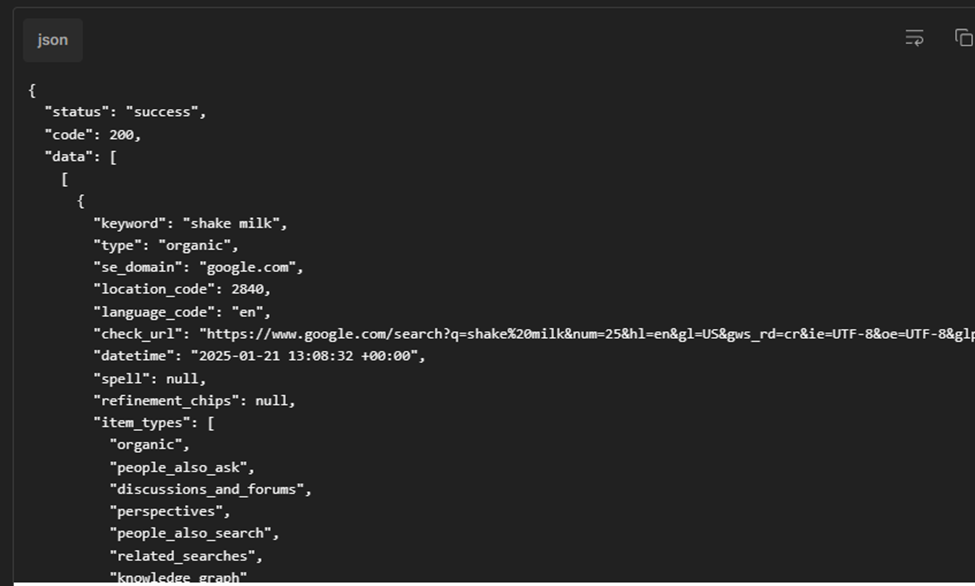
Here’s how to collect SERP data using APIs:
Select a SERP API and define the keyword, location, device type, and search engine you want to analyze.
Use the API to run searches for many keywords at once instead of performing manual searches.
Retrieve results such as top-ranking domains, ranking URLs, SERP features, and position data for each query.
Combine the results across all queries to identify frequently appearing domains and key search competitors.
Analyze Keyword Overlap
Not every domain appearing in search results is your true competitor. Some may rank for only a small subset of keywords.
Keyword overlap analysis tells you the depth of that competition. It reveals which specific terms you share, where the gaps are, and which competitor is strongest on your highest-value keywords.
Using a dedicated tool for analyzing the competition, like the one offered by Bishopi, you can map the intersection between your domain and any rival's keyword portfolio.
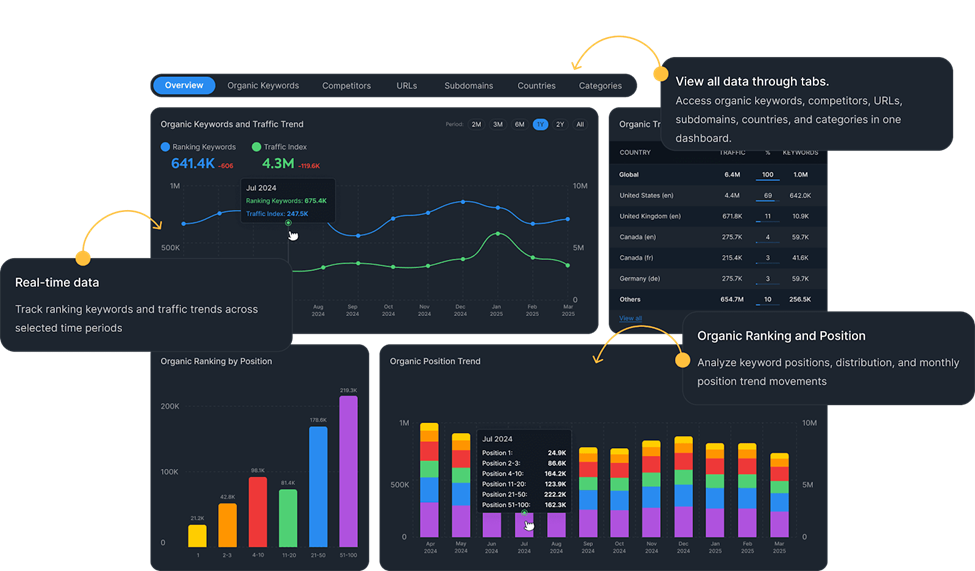
The tool can show you keywords you share with competitors, gap keywords your competitors rank for, but you do not, and terms where you rank higher.
When analyzing keyword overlap, focus on the following:
High-overlap, high-volume keywords
Competitor-only keywords
Your exclusive keywords
How many keywords does each domain share with yours?
Domains with the highest overlap represent your closest SEO competitors.
Analyze Competitor Content Strategy
Once you identify competitors, analyze the content that drives their rankings.
Enterprise SEO isn’t just about keywords but content coverage and search intent alignment.
For each high-priority competitor identified in Step 2, review the top-performing pages for your shared keywords. Look at:
Content formats ranking in SERPs
Topic clusters competitors dominate
Content depth and structure
SERP features competitors capture
Search intent alignment
Freshness signals
Collectively, these insights can help you understand the content search engines reward for specific queries. You can then integrate SEO APIs into your content strategy to automate topic research and content planning.
Analyze Their Domain Rating and Backlink Profiles
Content alone rarely explains why a domain ranks in search results. Authority signals, especially backlinks, are strongly correlated with higher search visibility.
According to a Backlinko study, pages ranking on page 1 of search results have an average of 3.8x more backlinks than those ranking in page 2 to 10.
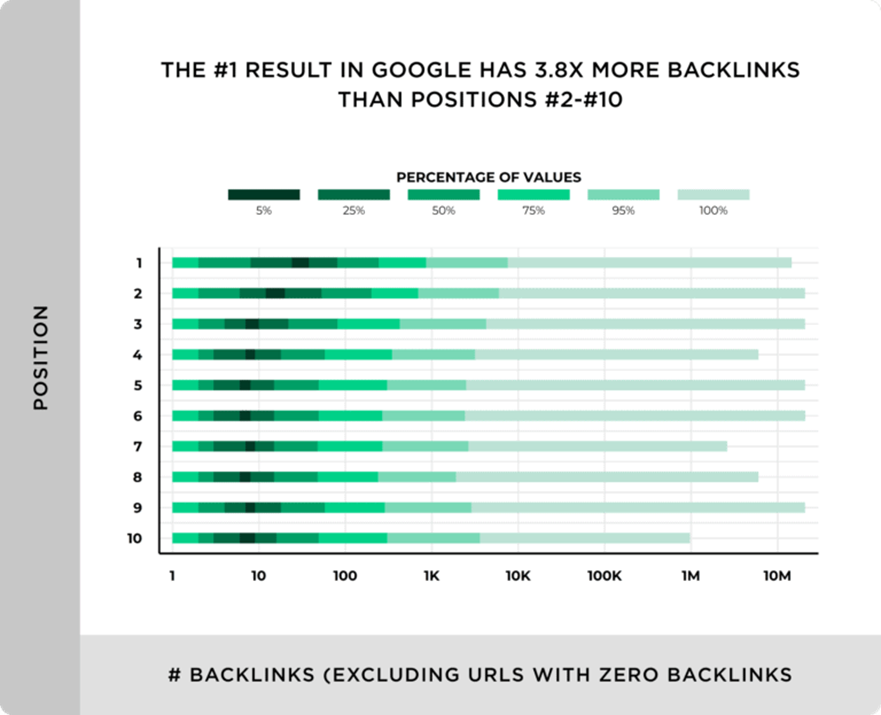
The same study also shows that higher Domain Ratings and Authority correlate with high rankings on Google’s first page.
You need to analyze your competitors’ domain strength and backlink profiles to understand how difficult it will be to compete for certain keywords.
Start with a domain-level view using an SEO domain analysis tool to compare overall domain authority, organic website traffic estimates, and ranking strength across your competitor set.
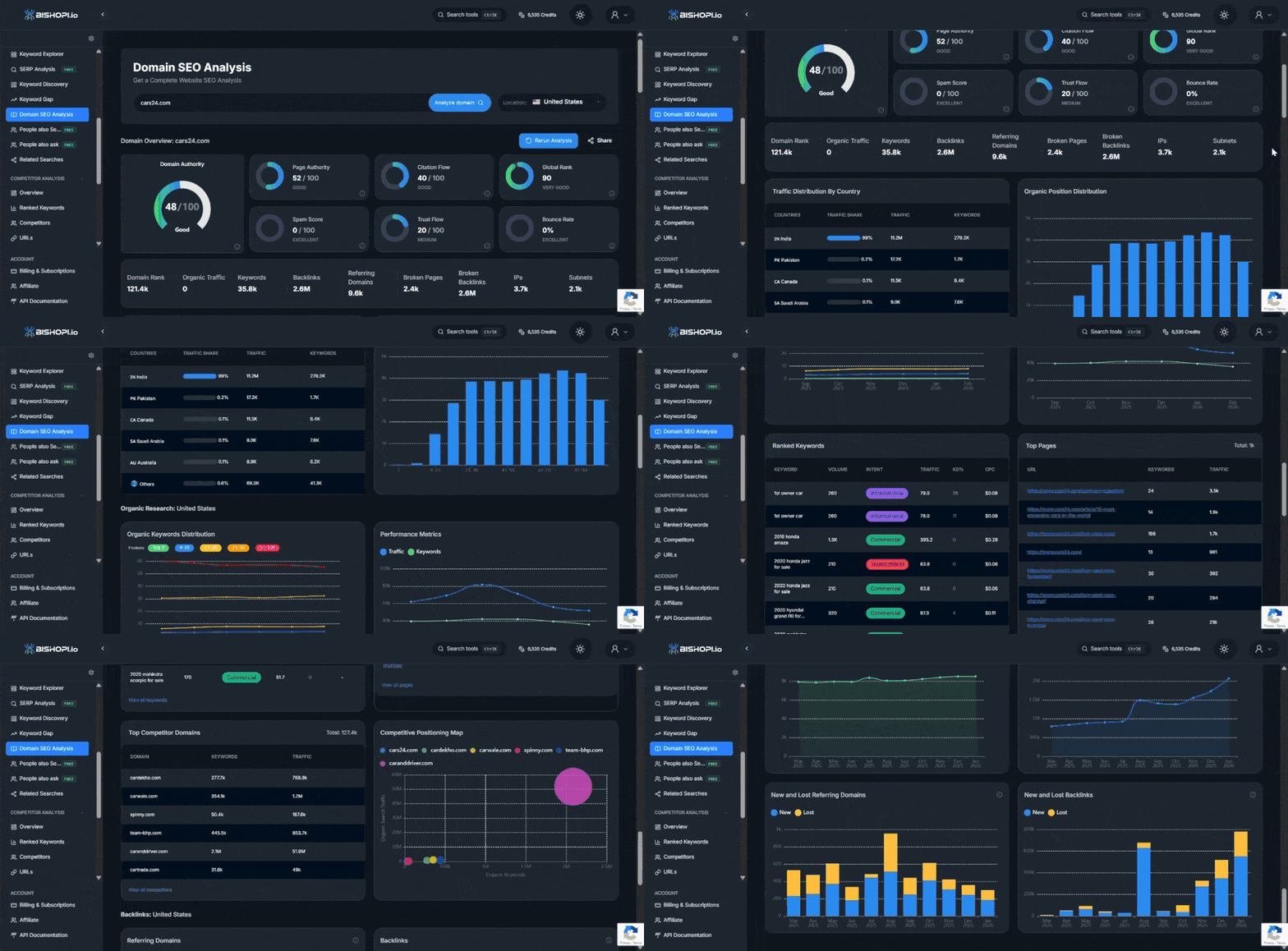
This will give you a quick read on which competitors have structural authority advantages that content alone cannot overcome.
Then go deeper with a backlink analytics tool to examine the specific referring domain profiles of your top competitors.
Look for high-authority sites in your industry that link to multiple competitors but not to you. These are your best link-building targets because they have already demonstrated relevance to your topic space.
Here are the metrics to track at this stage:
Metric | What to analyze | Why it matters |
|---|---|---|
Unique referring domains | Number of different websites linking to each competitor’s site | Reveals how widely competitors are trusted and how diverse their backlink profiles are compared to yours |
Anchor text distribution | Types of anchor text used in competitor backlinks (branded, keyword-rich, generic, etc.) | Shows how competitors optimize anchor text and helps identify safe patterns for your own strategy |
Backlink growth trends | How quickly competitors are gaining new backlinks over time | Indicates whether competitors are actively building links and how aggressive their SEO strategy is |
Domain Rating (DR) / Domain Authority (DA) | Competitors’ authority scores relative to your site | Helps benchmark your site’s authority and estimate how difficult it will be to outrank them |
Backlink sources | The websites linking to competitors | Identifies potential link-building opportunities and high-value sites that may also link to you |
Prioritize Real Search Competitors
At this stage of your enterprise SEO competitor analysis process, you likely have dozens of potential search competitors. You now need to prioritize the real ones, because not every domain competing in your SERPs deserves the same strategic attention.
Evaluate competitors across four dimensions:
Keyword overlap depth: Percentage of your target keywords where they rank in the top 10
Domain authority gap: Relative strength compared to your domain
Content quality score: Standardized evaluation of ranking page strength
Search intent alignment: Coverage across your full intent spectrum
Use a simple 1–5 scoring rubric across four factors:
Content depth: Comprehensiveness, structure, and topical coverage
SERP feature capture: Use of featured snippets, FAQs, schema, and rich results
Recency: Frequency and relevance of updates
Intent alignment: Precision in matching user intent
Average the four scores to generate a composite content quality score per competitor. Then pay attention to sites scoring consistently high across all dimensions. These are your primary competitors.
Meanwhile, domains with high keyword overlap but weaker authority or low content scores indicate near-term opportunities.
How SEO APIs Make Enterprise Analysis Smarter
On a small scale, some of this workflow can be done manually. At enterprise scale, where you need to analyze thousands of keywords, domains, and ranking changes continuously, the process can be slow and incomplete.
SEO APIs can solve this by enabling automated, continuous, and programmatic competitive intelligence that integrates with your existing data infrastructure.
A well-configured API setup can:
Automate SERP data collection
Track keyword rankings at scale
Deliver real-time ranking alerts
Integrate data for quick decision-making
Platforms like Bishopi provide a suite of APIs designed for scalable data extraction and analysis, making it easier to integrate search insights directly into enterprise workflows.
Whether you are pulling SERP data for competitive discovery, running bulk keyword analysis, or tracking domain-level metrics, the APIs are designed to handle enterprise-scale data volumes efficiently.
Your Real Search Competitors Are in the Data
Are you analyzing it?
Enterprise SEO performance is determined by how accurately you analyze the competitive landscape and how quickly you act on the data.
The most impactful competitors are rarely the ones on your internal lists. They are the domains consistently capturing your highest-value search demand across products, markets, and intent types. Identifying them requires structured data, not assumptions.
The good news? You can run this analysis on your own domain and uncover who is actually competing for your search visibility. Use Bishopi’s competitor analysis tool to benchmark your keyword overlap, evaluate competitive gaps, and surface immediate opportunities.
Frequently Asked Questions
1. What is enterprise SEO competitor analysis?
It is the process of identifying and evaluating the websites that compete with you in search engine results across large keyword sets.
Instead of focusing only on direct business rivals, it analyzes domains that rank for the same keywords, capture similar search intent, or dominate SERP features that attract your target audience.
This analysis helps enterprise teams uncover hidden competitors, prioritize SEO opportunities, and build strategies based on measurable search data rather than assumptions.
2. Why are search competitors different from business competitors?
These are websites that compete with you for visibility in search engine results, even if they don’t sell the same products or services.
For example, blogs, comparison sites, directories, and SaaS platforms may rank for the same informational or transactional keywords your business targets. Because search engines prioritize relevance and search intent, these content-driven sites can capture organic traffic that would otherwise go to your brand.
3. How do you identify your real SEO competitors?
Start by analyzing data signals such as keyword overlap, shared SERP features, organic traffic competition, and backlink intersections.
By examining which domains frequently appear in the top search results for your target keywords, you can determine who is competing for the same search audience.
SEO APIs can automate this process by pulling large-scale SERP data and highlighting domains with the strongest overlap across thousands of keywords.
4. Why is traditional competitor research ineffective for enterprise SEO?
Traditional competitor research often relies on manual keyword tracking, brand recognition, and reviewing a limited number of search results.
At enterprise scale, this approach fails because organizations may target thousands of keywords across multiple markets and product lines.
Without automated data analysis, teams risk missing emerging competitors, misjudging the competitive landscape, and making strategic decisions based on incomplete information.
5. How do SEO APIs improve enterprise competitor analysis?
SEO APIs enable automated, large-scale data collection from search engine results.
Instead of running manual searches or exporting limited reports, teams can programmatically retrieve SERP data, keyword rankings, and competitor domain metrics across thousands of queries.
This allows businesses to monitor ranking changes in real time, uncover keyword gaps, and integrate search insights directly into dashboards, databases, or internal SEO workflows.
Originally published at: bishopi.io
Stay up to date
Get updated with all the news, update and upcoming features.