Competitor Keyword Research: How to Find, Analyze & Prioritize (2026 Guide)
Keyword research tools are very good at producing ideas.
Type a seed phrase like “project management”, and you’ll get hundreds or thousands of suggestions in seconds.
The harder question comes after the export.
⮕ Which of those keywords are actually worth building content around?
Most of them won’t be.
Some are too competitive to realistically target. Others bring the wrong audience. Many simply don’t justify the time and effort required to rank.
That’s why experienced SEOs rarely rely on keyword lists alone.
They look at what already works in search.
Competitor keyword analysis does exactly that. You check what’s working for your competitors and double down on it.
What Is Competitor Keyword Analysis?
Competitor keyword analysis is the process of examining the search queries your competitors' websites rank for in Google and how those rankings translate into organic visibility. It answers which queries already earn traffic in your niche and which pages capture it, so you can target proven demand instead of guessing.
In practice, you’re answering two simple questions:
What queries already bring traffic in this niche?
Which pages capture that traffic?
Instead of starting with hypothetical keyword research and ideas, the analysis begins with inspecting trending keywords that work for your competitors.
When you examine competitor rankings, you start to see patterns - how Google organizes a topic, how queries cluster around certain pages, and those pages accumulate visibility across related searches.
Most sites don’t spread rankings evenly across every page. Traffic usually concentrates around a small number of URLs.
A typical keyword dataset includes information such as:
keyword
ranking position
ranking URL
search volume
CPC (cost per click)
keyword difficulty
Individually those numbers don’t mean much. But when you stack the data, you see how competing sites capture traffic within a topic.
How Competitor Keyword Analysis Matters For Your SEO Strategy
When you build a keyword list from scratch, you’re guessing what people might search for. When you build it from competitor data, you’re looking at what people are already searching and what already earns traffic.
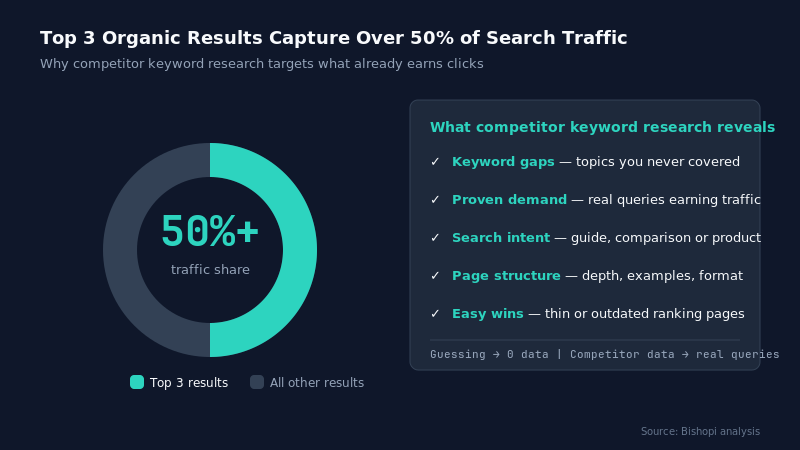
Competitor keyword research helps in a few plain ways:
Find keyword gaps: Topics competitors rank for that your site never covered. Each gap is a question your audience asked, and someone else answered first.
See proven search demand: Real queries that already bring traffic, not just keywords that look good in an SEO tool. Remember, the top 3 organic results get more than 50% traffic share.
Understand search intent: The pages ranking for a keyword show whether users expect a guide, a comparison, or a product page.
Learn how ranking pages are built: Your competitors’ pages reveal what a successful result usually includes - structure, examples, and depth.
Spot easier opportunities: Sometimes competitors rank with thin or outdated pages. When the authority gap isn't too large, a clearer and more complete page can take its place.
Step-by-Step Process for Competitor Keyword Analysis
The step-by-step process for competitor keyword analysis has four stages: identify your true SERP competitors, extract the keywords behind their rankings, clean and segment that data by topic and intent, then run a keyword gap analysis to find and prioritize what to target. Each step below builds on the last.
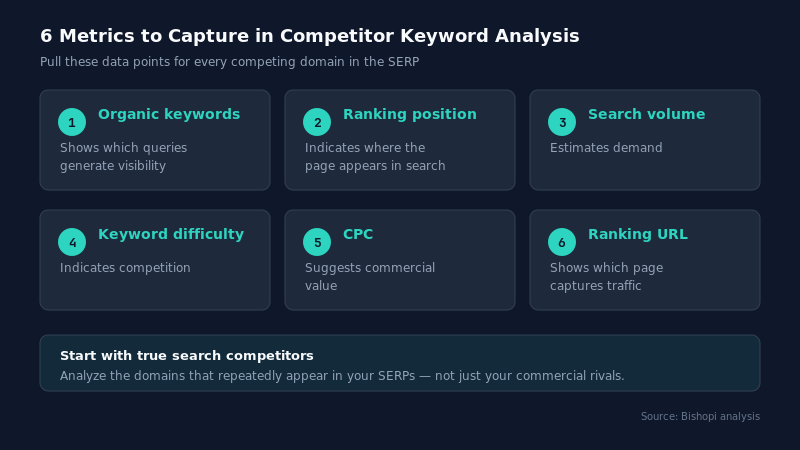
Step 1: Identify Your True SEO Competitors
Competitor keyword analysis only works if you analyze the right competitors.
Many teams begin by listing companies they compete with commercially. That’s a reasonable starting point, but it rarely reflects the real search landscape.
Search competition is defined by who consistently appears in the SERPs for your target topics.
When you review results across a meaningful set of queries, the same domains usually appear repeatedly. Those sites effectively define the competitive environment for organic search.
Market Competitors vs Search Competitors
Your sales team's competitor list and your SEO competitor list are usually different documents.
A SaaS project management tool might compete commercially with Asana and Monday.com.
But the queries your target audience searches - project management templates, sprint planning checklist, agile workflow guide -are often dominated by content publishers, template libraries, and consulting blogs.
Those sites are your real search competitors, even if they don't charge a subscription fee.
This distinction matters because analyzing the wrong competitors produces the wrong insights.
How to Find Your SERP Competitors Quickly
The most basic method is manual SERP analysis.
Search 10–15 of your most important target queries and note which domains appear repeatedly. Sites that show up across multiple queries are competing for the same audience.
From there, look for overlapping ranking domains—sites whose keyword footprint significantly intersects yours.
At scale, using a keyword API to detect domain overlaps is faster and more thorough than manual reviews.
Bishopi's Competitor Analysis tool surfaces competing domains directly from your keyword footprint, ranked by overlap and estimated traffic.
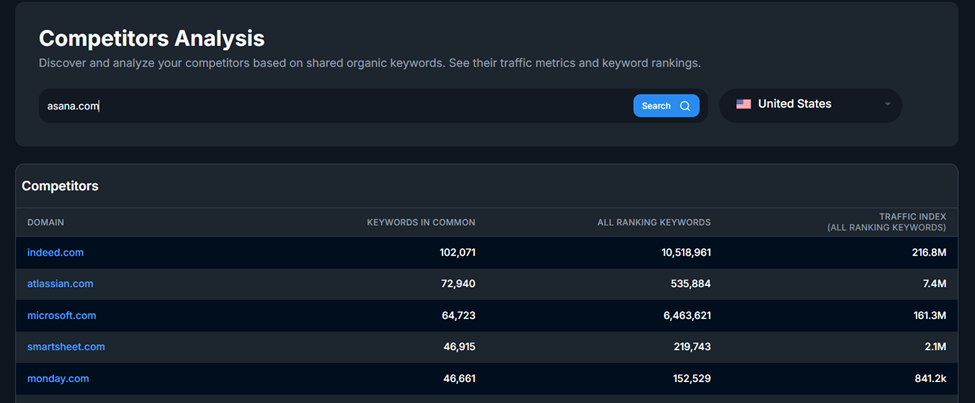
[Image via Bishopi Competitor Analysis]
Step 2: Extract Competitor Keywords
Once you know which domains compete with you in search, the next step is straightforward: pull the keywords behind their rankings.
When you export a competitor’s keyword dataset, one pattern usually appears quickly. A large portion of their visibility tends to come from a relatively small group of pages.
These pages typically cover the core topics in the niche.
Looking at real ranking data gives you a perspective that keyword tools alone rarely provide. Instead of seeing isolated keyword suggestions, you start to see how search queries connect to specific pages.
Often, dozens of related searches point to the same URL. When multiple variations rank on a single page, it usually means the page covers the topic comprehensively enough to capture an entire search cluster.
Understanding that structure makes it much easier to reverse-engineer what competitors are doing well.
Data Points That Matter
When exporting competitor keyword data, several metrics help explain how rankings translate into traffic.
Metric | Why it matters |
Organic keywords | Shows which queries generate visibility |
Ranking position | Indicates where the page appears in search |
Search volume | Estimates demand |
Keyword difficulty | Indicates competition |
CPC | Suggests commercial value |
Ranking URL | Shows which page captures traffic |
Looking at these metrics together helps explain how competitors structure their content and which pages drive the majority of their organic reach.
For example:
Keywords with meaningful search volume and difficulty close to your site’s authority often represent realistic entry points.
Multiple related keywords tied to the same URL usually indicate a strong topic cluster built around that page.
High CPC keywords often reveal queries with clear commercial intent.
Tools like Bishopi’s Ranked Keywords tab surface this dataset directly, returning every keyword a competitor ranks for alongside position, volume, difficulty, CPC, and the specific ranking URL.
Reviewing this data makes it easier to identify which pages drive the most visibility and where realistic opportunities exist.
[Image via Bishopi]
Step 3: Clean and Segment the Keyword Data
Cleaning and segmenting the keyword data means stripping the noise from a raw export, then grouping the survivors into topic clusters and tagging each by search intent. A raw competitor export routinely runs into the thousands of rows, and most of them won't matter to you. Three passes turn that noise into a shortlist you can act on: filter, cluster, and tag.
A Worked Example: Filtering a Raw Export
Below is a small, illustrative sample — not a live competitor export — to show the actual decisions you make on each row. Assume you pulled eight keywords from an email-marketing competitor and your own site targets US commercial traffic.
Keyword | Volume | Decision |
email deliverability best practices | 2,400 | Keep — core informational |
how to improve email deliverability | 1,900 | Keep — same cluster |
SPF record setup | 1,100 | Keep — subtopic |
DKIM authentication | 880 | Keep — subtopic |
best email marketing software | 14,000 | Keep — commercial intent |
mailchimp pricing | 9,900 | Drop — branded/navigational |
email deliverability australia | 210 | Drop — wrong geography |
what is an email | 6,600 | Drop — too low intent |
Three of the eight rows come off the list immediately: the branded query, the Australian variant, and the definition-level term. That leaves five keywords worth analyzing.
Remove Irrelevant Keywords
Start by filtering out keywords that don't support your goals.
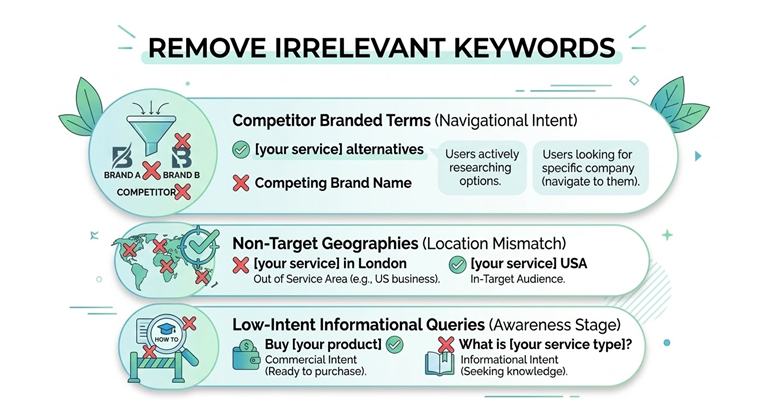
Focus on removing:
Branded terms: Searches that include a competitor's brand name, like mailchimp pricing above. Someone searching for a company directly is usually navigating to that site, not evaluating alternatives.
Irrelevant geographies: If your audience is primarily in the US, traffic driven by UK or Australian queries can distort the picture.
Low-intent informational queries: If your priority is commercial traffic, purely educational searches like what is an email may not belong on your immediate target list.
Cleaning the dataset first makes the patterns easier to spot.
Group Keywords by Topic Clusters
Once the list is trimmed down, group the remaining keywords into topic clusters. A cluster is a set of queries that share the same underlying intent and are typically captured by a single page. From the filtered example, four of the five survivors form one cluster:
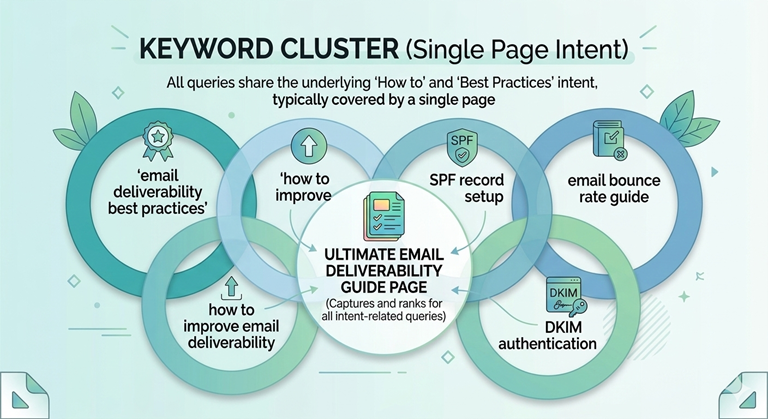
email deliverability best practices
how to improve email deliverability
SPF record setup
DKIM authentication
These queries look different on the surface, but they all point to the same topic. One well-structured page can capture visibility across the entire cluster — which is exactly how the competitor is ranking for all four. The fifth survivor, best email marketing software, sits in its own commercial cluster and needs a different page type. This is the logic behind building topic clusters rather than one thin page per keyword.
Segment Keywords by Search Intent & Traffic
With clusters formed, tag each one by search intent.
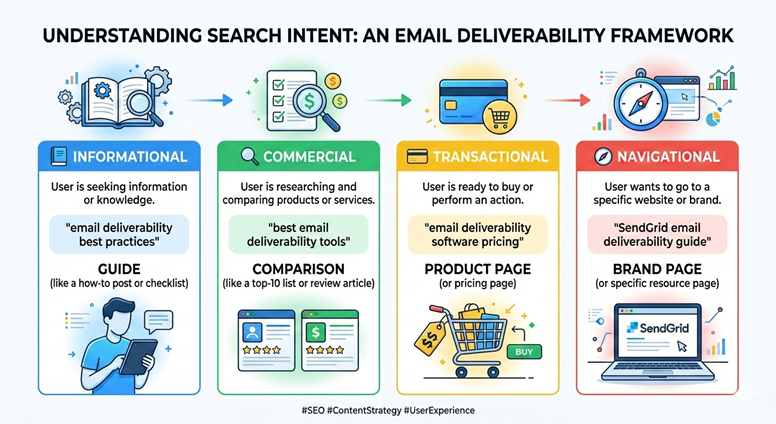
Most queries fall into a few common categories:
Informational: Users looking for knowledge or guidance — how to improve email deliverability (guides, tutorials, definitions)
Commercial investigation: Users comparing options — best email marketing software (best tools, alternatives, reviews)
Transactional: Users ready to take action (pricing, buy, sign up)
Navigational: Brand or website searches, which are usually not useful for competitive targeting
Understanding intent determines what type of content should target each cluster. Guides tend to perform best for informational searches, while product pages or comparisons work better for commercial and transactional queries.
Looking at intent also reveals how competitors attract traffic across the funnel. Some sites generate large volumes of informational traffic through guides, while others focus more on high-intent commercial or transactional queries.
In Bishopi’s Competitor Analysis Report, traffic is broken down by search intent. This makes it easier to see whether a competitor’s visibility comes mostly from educational content, comparison pages, or high-conversion product queries. Those patterns can help you decide which type of content to prioritize in your own strategy.

Image via Bishopi
Step 4: Run a Keyword Gap Analysis
With competitor keywords organized, the next step is comparing them with your own rankings.
This comparison usually highlights two things:
Topics competitors rank for that you don’t cover
Keywords where competitors rank higher
Both point to opportunities.
Keywords You Don’t Rank For
If a competitor ranks for 2,500 keywords and your site ranks for 800, the difference represents potential reach you haven’t captured.
Not all of those keywords matter. But filtering by search volume and relevance often reveals useful topics.
For example, an email marketing blog might notice competitors ranking for:
email deliverability best practices
SMTP configuration guide
SPF record setup
Those queries expand the topic into technical areas that may not yet exist on the site.
Keywords Where Competitors Rank Higher
Sometimes, both sites target the same keyword.
The difference lies in ranking position.
A competitor might rank #4 for “content marketing strategy” while your page sits around #24.
Comparing the pages often reveals why.
Look at the structure, depth, examples, and internal links. In many cases, the higher-ranking page simply answers the query more clearly.
Step 5: Evaluate Keyword Metrics in Context
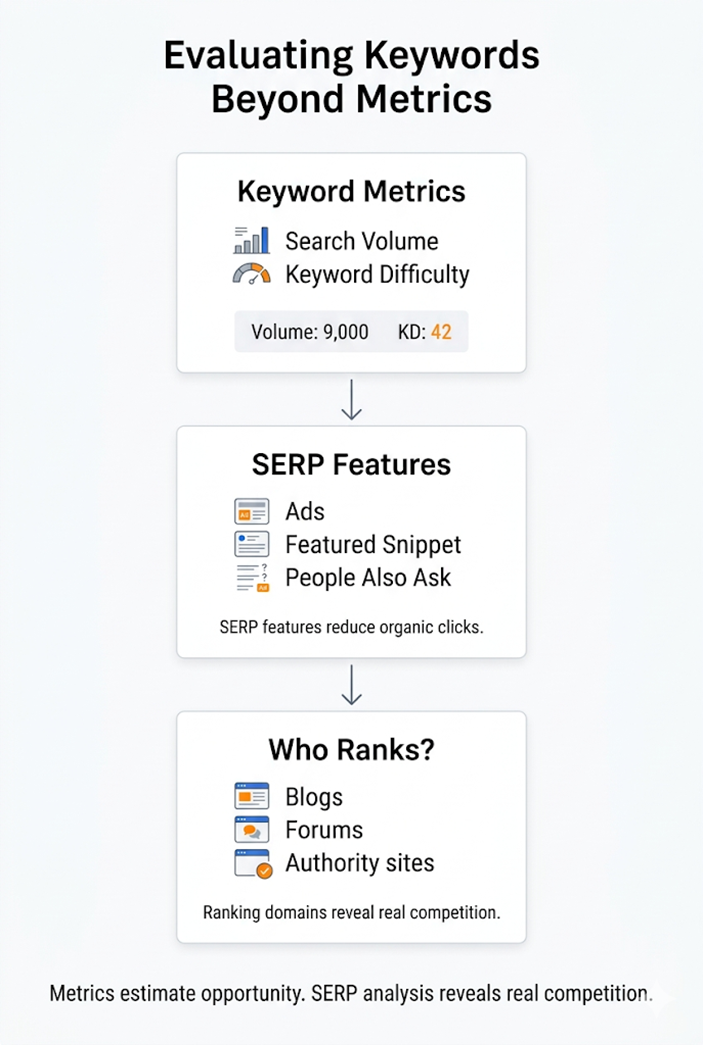
Metrics are useful. They give you numbers to sort and columns to filter. But numbers alone don’t tell you how a keyword behaves in the wild.
To understand that, you have to look at the search results.
Search Volume vs Traffic Potential
Search volume tells you how often a query is typed into Google. It doesn’t tell you how many of those searches turn into clicks.
Take two keywords with the same volume. One might show 10,000 searches a month, but the results page is crowded with ads, a featured snippet, and a People Also Ask box. Half the questions get answered before anyone reaches the organic listings.
Another keyword might show the same 10,000 searches, but the results page is quiet. Ten blue links and very little competition for attention.
⮕On paper, those keywords look identical. In practice, one sends visitors, and the other sends very little.
Keyword Difficulty
Difficulty scores aim to estimate competition by considering factors such as backlinks and authority. They’re useful for getting a rough sense of the field.
But the real story appears when you check the page's ranking.
Sometimes a keyword marked “KD 65” is held together by thin blog posts and forgotten tutorials. Other times, a keyword labeled “KD 30” is filled with large sites that have been collecting authority for a decade.
That’s why experienced SEOs don’t stop at the metric. They open the search results and look at the pages themselves. The truth about a keyword usually sits right there in the rankings.
Step 6: Prioritize Opportunities
Competitor analysis often produces a long list of potential keywords. But if you want results, prioritization matters.
Some keywords offer quick wins. Others support long-term authority.
A common approach is to group keywords into tiers.
Quick wins - Moderate volume, manageable competition, and weak competitor content.
Strategic targets - Keywords that strengthen important topic clusters.
Long-term keywords - Highly competitive terms that define authority within the niche.
Balancing these categories helps maintain steady growth.
How to Turn Competitor Keyword Insights into Content Strategy
Competitor keyword data is only useful if it changes what you publish. Otherwise, it’s just a spreadsheet with ambitions.
Once you see what competitors rank for, the next question is simple: what should your pages do better?
1. Create content that’s clearly better
Start by looking at the pages already ranking for your target queries. Read them like a skeptical reader.
Where are they thin?
Where do they dodge the real question?
Where do they bury the useful part halfway down the page?
Sometimes the fix is simple. Add clearer examples. Update statistics. Break long paragraphs into sections people can actually read. A table or visual often explains what three paragraphs cannot.
Occasionally, it helps to add structured elements like “FAQ” or “HowTo” schema so the page appears more clearly in search results.
⮕ The aim is not to copy a competitor’s page. The aim is to make the reader glad they found yours instead.
It also helps to notice where competitors get their traffic. Some sites pull most of their visibility through blog articles and guides. Others rely on product pages or documentation.
Looking at traffic by subdomain often reveals this structure.
In many cases, the pattern is simple: blogs attract informational searches. Product pages capture commercial ones. Documentation serves users already using the tool.
Once you see that pattern, you start to understand what role each section of a site plays in the search journey.
2) Build topical authority clusters
Successful sites rarely rely on a single article to carry a topic. They build a small neighborhood of pages around it.
One page acts as the pillar, covering the topic broadly. Supporting pages handle the details.
A guide on email marketing, for example, might link to deeper pages on deliverability, segmentation, and automation workflows. Each article answers a different question, but together they form a complete map of the topic.
Those internal links quietly tell search engines something useful: this site knows its way around the subject.
3) Optimize existing pages first
Many people rush to publish something new when a better move is to fix what already exists.
A page might be ranking on page two simply because it is missing a section that competitors included.
Sometimes it ignores a related keyword. Sometimes the structure is confusing enough to make readers give up.
Adding depth, clarifying the structure, or aligning the page with the search intent can move it several positions upward without writing an entirely new article.
In fact, case studies show that content updates can increase organic traffic by ~30% to 100%+, depending on the topic and timing.
It is often the quickest win in SEO.
Common Mistakes to Avoid in Competitor Keyword Analysis
Competitor keyword analysis is straightforward in theory, but a few common mistakes can limit the value of the insights.
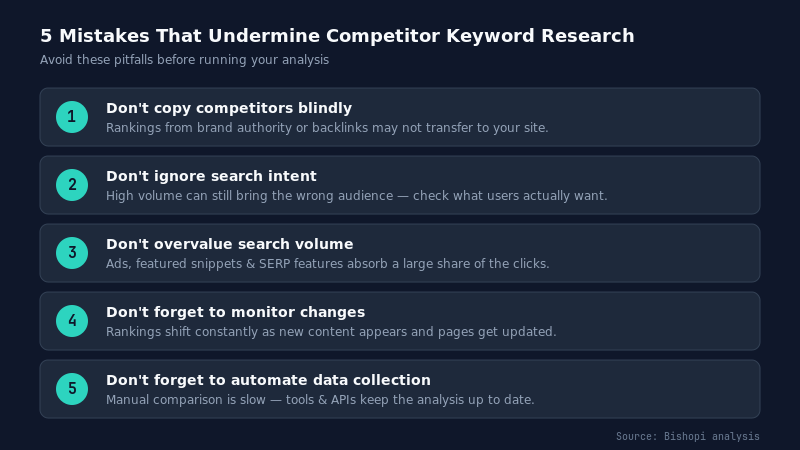
Keeping these in mind before you start with it:
Don’t copy competitors blindly: It’s easy to treat competitor keywords like a checklist. But not every keyword they rank for is worth pursuing. Some rankings come from brand authority or backlinks that may not apply to your site.
Don’t ignore search intent: A keyword can have strong search volume and still bring the wrong audience. Always check what users are actually looking for before creating content.
Don’t overvalue search volume: High volume looks attractive, but it doesn’t always mean real traffic. Ads, featured snippets, and other SERP features often absorb a large share of clicks.
Don’t forget to monitor changes: Competitor analysis isn’t something you run once and forget. Rankings shift constantly as new content appears and existing pages get updated.
Don’t forget to automate data collection: Comparing large keyword lists manually becomes slow very quickly. Tools and APIs make it much easier to track competitors and update the analysis regularly.
Over time, competitor keyword analysis becomes less about finding keywords and more about understanding the structure of search demand in your niche.
How to Automate Competitor Keyword Research at Scale
What if your competitor analysis updated itself every week, across every client, without anyone touching a spreadsheet?
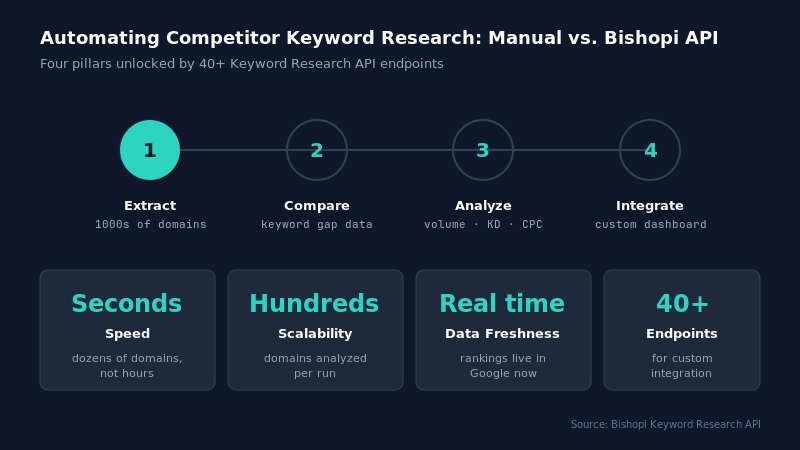
At some point, doing this manually just stops making sense.
If you're an agency, you're re-pulling the same data for every client every month. If you're building a SaaS product, you can't hardcode competitor insights into a UI that needs to stay current.
And if you're running an internal dashboard, stale data defeats the whole point.
That's where Bishopi's Keyword Research API comes in.
You programmatically extract, compare, and analyze competitor keywords across thousands of domains in real time - search volume by country, keyword difficulty, CPC, keyword gap data, all across 40+ endpoints.
In practice, this gives you:
Speed - keyword data for dozens of domains in seconds, not hours
Scalability - run analysis across hundreds of domains
Data freshness - rankings that reflect what's live in Google now
Custom dashboard integration - competitive intelligence inside your own tools
Start Your Free Competitor Analysis
Which Are the Best Tools for Competitor Analysis?
Before running competitor keyword analysis, it helps to have the right tools in place. SEO platforms can show which keywords competitors rank for, which pages drive their traffic, and how those rankings change over time.
Here are a few widely used tools for competitor keyword analysis and domain research.
Best Tools for Competitor Keyword Analysis
Tool | USP | Pricing |
Bishopi | Combines SEO analysis with domain intelligence. Useful for competitor keyword analysis alongside domain history, domain valuation, sales history, and broader domain insights. | API-based / subscription |
Ahrefs | Strong backlink analysis combined with competitor keyword research. Useful for identifying which pages drive traffic and understanding the link profiles behind rankings. | Starts around $129/month |
Semrush | All-in-one SEO and marketing platform with keyword gap analysis, domain comparison, and broad competitive research features. | Starts around $129/month |
Final Checklist: Competitor Keyword Analysis Workflow
If you’re ready to put this into practice, start with a simple, repeatable process.
Here’s the complete workflow for competitor keyword analysis:
Identify real SEO competitors from SERP data, not your commercial rival list
Extract ranked keywords with position, volume, KD, CPC, ranking URL
Clean and segment your keywords to remove branded terms, irrelevant geos, navigational queries; group into topic clusters
Run keyword gap analysis; flag positions 6-15 as priority targets
Evaluate metrics in context: check actual SERPs, weight CPC alongside volume
Score and prioritise: quick wins, strategic targets, long-term plays
Build content strategy: map gaps to new pages or existing page updates
Monitor continuously: rankings shift, new gaps open, competitor content changes
Take the Next Step!
The steps in this guide are fairly straightforward. The difference comes from actually applying them to real competitors in your niche.
Once you start reviewing their keyword data, the landscape becomes easier to read. You’ll see which pages carry most of their visibility, which topics they’ve invested in, and where their coverage is thin.
That perspective tends to change how you approach content planning. Instead of chasing keywords, you’ll start thinking about which pages deserve to exist on the site.
And over time, that shift is what leads to stronger rankings and more consistent organic traffic.
Try Competitor Analysis For Free with Bishopi
FAQs
1. How do you analyze competitors’ keywords?
Start by exporting the keywords competitors rank for and look at which pages bring them the most visibility. Then identify topics they cover that you don’t and keywords where their pages rank higher than yours.
2. Can ChatGPT do competitor analysis?
ChatGPT can help you interpret keyword data and spot patterns, but it does not pull ranking data on its own. You still need an SEO tool to collect competitor keywords and traffic metrics.
3. Which are the best tools for competitor analysis?
You can use tools like Bishopi, Ahrefs, or Semrush for competitor analysis. They show which keywords competitors rank for, which pages drive their traffic, and where the biggest gaps exist.
4. What's the difference between keyword research and competitor keyword research?
Regular keyword research starts with your ideas - you pick topics and look for volume. Competitor keyword research starts with proof - you look at what's already driving traffic to other sites and work backward.
5. How often should I run a competitor keyword analysis?
Monthly is the practical baseline for most teams. But if you're in a competitive niche like SaaS, finance, or health, it’s a good idea to check more often.
Originally published at: www.bishopi.io
Stay up to date
Get updated with all the news, update and upcoming features.