The Best SERP APIs Ranked by Speed, Pricing, and Use Cases
Comparing SERP APIs based on their feature list cannot help you pick the best one for your specific use cases.
With nearly 60% of Google searches now ending without a click to an external website, SERP APIs are increasingly becoming useful tools for tracking appearances on "People Also Ask", featured snippets, and Google’s AI Overviews.
The tricky bit is in knowing which API to choose.
Before you evaluate any API, get clear on four decision variables: cost per query, whether you need real-time or async delivery, engine coverage, and SEO metric depth.
This article skips the feature checklist approach. Instead, it matches each tool to a specific use case, so by the time you finish reading, you'll know which API fits your use case, not just which ones exist.
What Is a SERP API and Who Actually Needs One?
A Search Engine Result Page API is an interface that allows applications and AI agents to programmatically query search results, including organic listings, SERP features, rich results, ads, and maps.
Results are then retrieved in a structured, machine-readable format, such as JSON, instead of an HTML page designed for human browsing.
Like this:
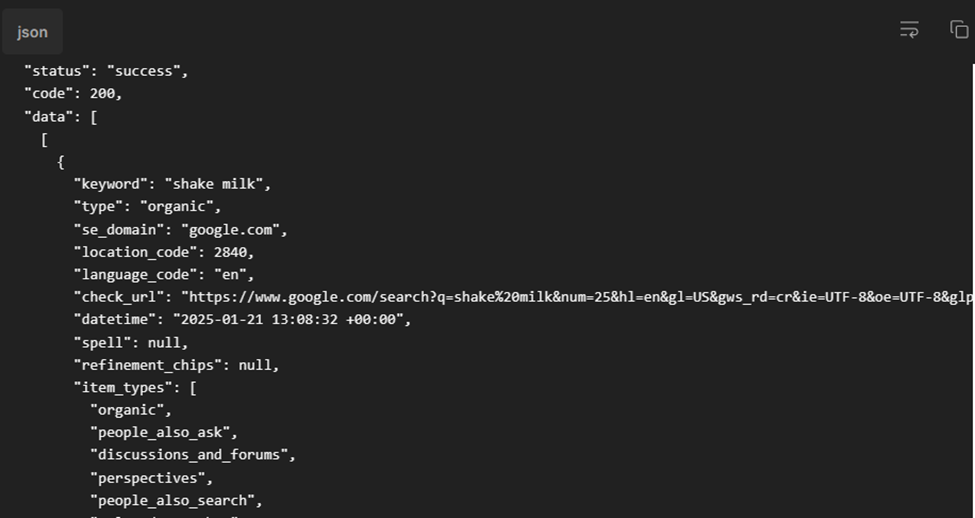
Unlike full SEO platforms such as Semrush or Ahrefs, SERP APIs don’t come bundled with a UI, pre-built dashboards, or opinionated workflows. You get the raw, semi-processed search data. What you build with it is entirely up to you.
Here are the three main use cases of these APIs:
Rank tracking tools: You want to monitor how websites rank for specific keywords across different locations and devices in real time to make adjustments based on actionable data.
Real-time SEO dashboards: If you want APIs to feed live search data into dashboards so you can see up-to-date rankings, competitors, and trends in one place.
Custom SEO platforms: You’re a developer who wants to build tailored SEO tools with features like keyword tracking, competitor analysis, and SERP feature monitoring.
What to Look for in a SERP API Before You Commit
Here are the key aspects to guide you in choosing an API for your specific use case:
Pricing model
According to a 2023 Postman State of the API report, pricing is among the top considerations for 47% of respondents when deciding whether to integrate APIs into their stack.
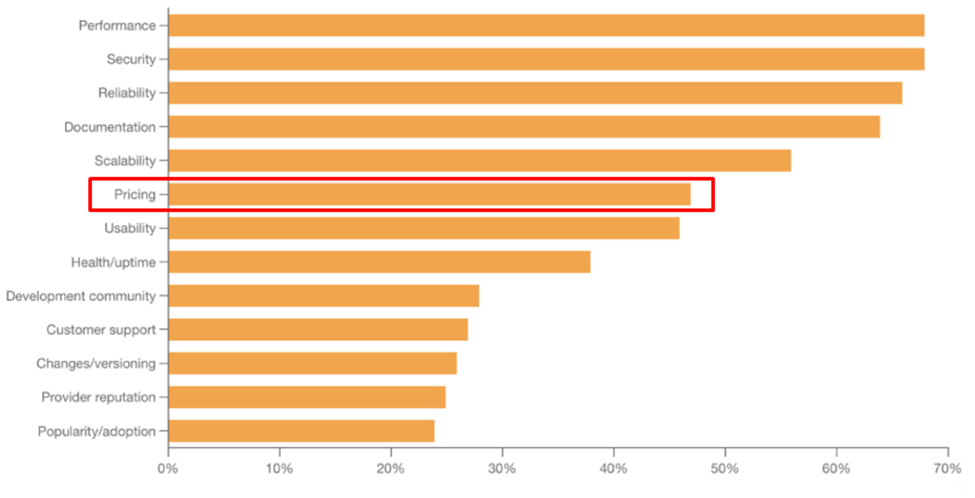
If your usage is predictable, for example, tracking 5,000 keywords daily, a subscription plan can work. Meanwhile, choose a pay-as-you-go model if you want to scale your operations. This model allows for maximum flexibility, where you pay only for the requests you make.
For instance, API platforms like Bishopi offer a flexible, credit-based pricing model that blends pay-as-you-go with subscription options. This offers users high flexibility, allowing you to choose between purchasing credits on demand or as part of a recurring plan.
Speed
Speed affects both user experience and infrastructure design.
Synchronous (live) APIs: Return results in seconds, ideal for real-time dashboards or user-triggered queries.
Asynchronous APIs: Deliver results in batches (5–45 minutes), typically at a lower cost.
If you want results retrieved in a few seconds, choose APIs that use live (synchronous) mode, though these can be costly. But if you want to send requests in batches and wait for around 5-45 minutes at a lower cost, choose APIs that use standard async mode. Your choice will entirely depend on how you want results retrieved.
Coverage
Not all SERP APIs are equal in coverage, but more isn’t always better.
Some APIs support multiple search engines, but for most SEO tool developers, 90+ of queries happen on Google.
Bing, Amazon, and YouTube endpoints are genuinely useful for specific use cases such as shopping insights and video rank tracking. If you’re not actively using multiple engines, paying a premium for coverage you won't use is a waste.
Documentation and developer experience
Poor documentation creates hidden costs, especially in engineering time. A tool you can integrate in an afternoon is worth more than the cheapest SERP API that takes a week to set up correctly, sends you digging through a forum, and breaks on edge cases your tests didn't cover.
Always check if the provider has an interactive playground, code examples in your language, and a responsive support channel before committing.
Data depth
Some APIs give you raw SERP data. Others enrich results with keyword difficulty, traffic estimates, backlinks, or domain-level insights.
If you only need rankings, raw data is fine. But if you’re building anything involving analysis, reporting, or recommendations, enriched data can save you from stitching together multiple APIs later.
The Best SERP APIs in 2026 — Matched to Use Case
Here are the best APIs for tracking SERP data. Each tool below is mapped to what it’s actually best at and where it falls short.
1. Bishopi SERP API — Best for SEO Platform Builders
If you’re building a serious SEO platform, think rank trackers, competitor monitoring dashboards, or an internal analytics tool, Bishopi SERP API stands out. The API offers structured Google SERP data with minimal integration friction and a pricing model that scales with your usage.
What’s more? It goes deeper than most APIs in terms of structure and insight.
Using the API, you can:
Track real-time ranking positions across all search result types, including organic, paid, and local listings, with precise position data that refreshes as rankings change.
Capture the full SERP feature landscape, including knowledge panels, People Also Ask sections, image packs, video carousels, and featured snippets.
Monitor PAA sections systematically to surface user intent signals and identify content opportunities directly from Google's suggested query structure.
Run historical SERP comparisons to benchmark before-and-after performance across algorithm updates, identify seasonal rank patterns, and produce the kind of time-series trend data that clients actually care about.
Identify competitor SERP feature dominance at scale. For instance, which domains consistently capture featured snippets, local packs, and other premium positions and quantify competitive threat by feature type rather than just overall keyword ranking.
Beyond raw data, Bishopi integrates domain-level intelligence, including domain authority scores, backlinks, traffic estimates, and valuation signals into one ecosystem.
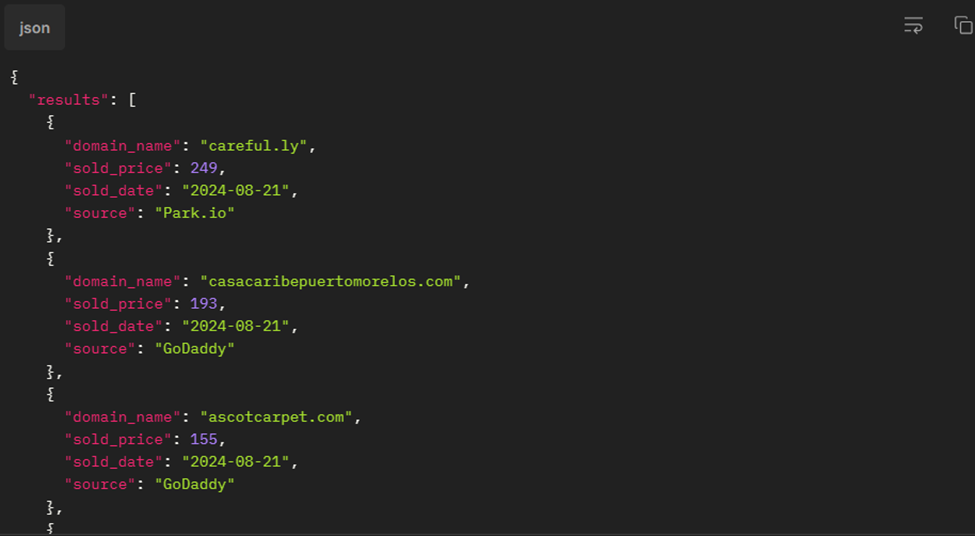
You don’t need to add a second API provider to your stack.
Best for:
Developers building rank tracking tools or competitor monitoring dashboards
Technical SEO teams that need enriched metrics alongside SERP data
Agency teams automating SERP analysis at scale.
Who it’s NOT for:
The API is currently Google-focused. If you need multi-engine coverage, this might not be the platform for you.
Limitations
Currently Google-focused. If your use case requires multi-engine support( think Bing, YouTube, Amazon, or other coverage) out of the box, you will need to add a second API provider.
The credit-based model requires upfront estimation of monthly usage. Teams with highly unpredictable or spiky query volumes may find it harder to forecast costs than with a strict pay-as-you-go model.
Pricing: Bishopi offers a pay-as-you-go credit model across three tiers. Starting price is $39/month with 5,000 credits. You also get a 7-day unlimited free trial with no credit card required.
2. SerpAPI — Best for Multi-Engine Coverage
Choose SerpAPI if your workflows depend on multiple search environments, not just Google’s main SERP.
For example, with this API, you can:
Pull product data from Google Shopping or Amazon
Extract local business listings from Google Maps
Monitor YouTube rankings alongside web results
Track Google organic rankings
It’s also fully synchronous, which makes it useful for real-time applications where users expect immediate responses.
Best for:
Multi-engine SEO or data products
Teams building tools that combine web, local, and ecommerce search
Applications that require real-time responses across different platforms
Who it’s NOT for:
If you’re focused purely on Google SERP insights at scale, SerpAPI can become unnecessarily expensive. You’re paying for breadth you may not use. In this case, you need a SerpAPI alternative like Bishopi.
Limitations
The API’S subscription model means unused monthly searches expire — a significant cost penalty for variable-volume workflows.
At $75/month for just 5,000 searches, the effective cost per query is among the highest in the market.
There's no native SEO metric enrichment, so you get raw SERP results only.
The fixed plans also create budget unpredictability for early-stage products where query volume fluctuates significantly month-to-month.
Pricing:
SerpAPI offers a free trial with 250 searches per month. Pricing starts at around $25 up to 1,000 searches per month.
3. DataForSEO — Best for High-Volume Builds Where Cost is Paramount
The DataForSEO SERP API is built for teams that care about cost per request at scale. It’s not the easiest API to work with, but it’s one of the most flexible.
The API offers a massive set of endpoints, covering everything from SERPs to keyword data to backlinks. But its real strength is its async processing model, which allows it to deliver extremely low costs for bulk operations.
If you’re running:
Millions of keyword checks per month
Large-scale rank tracking across multiple regions
Background jobs where latency doesn’t matter
This can be an economical option for you.
You also get full control over how data is requested and structured.
Best for
Developers running bulk SERP processing jobs where turnaround time is flexible
SEO platforms that need deep modular data access, such as keyword difficulty, backlinks, domain metrics, alongside raw SERP data
Teams with mature engineering capacity to build around an API-first workflow
Who it’s NOT for
If you want fast integration, clean abstraction, or real-time data out of the box, DataForSEO will feel heavy for your use case. You may want to consider other DataForSEO alternatives.
Limitations
Steep integration learning curve due to complex API structure
The task-based architecture adds meaningful setup complexity compared to synchronous APIs like Bishopi
The API does not return enriched domain intelligence (valuations, trust signals) alongside SERP data
Its documentation is extensive but dense
Pricing
DataForSEO uses pay-as-you-go pricing with no monthly fee and no expiring credits. The standard async queue (results in ~5 minutes) costs approximately $0.60 per 1,000 SERP requests. The live synchronous endpoint costs more. You need a minimum $50 deposit to activate the account. Verify current rates at the official website before committing.
4. Bright Data — Best for Enterprise Proxy Infrastructure
Bright Data isn’t a typical Google SERP API. It's primarily an enterprise web data platform that happens to offer a SERP API on top of its proxy network. The SERP API returns results in JSON or raw HTML across different search engines, with CAPTCHA handling and IP rotation built in.
You can use this platform if you want to:
Launch highly customized scraping workflows
Bypass rate limits or geo-restrictions
Perform large-scale data extraction across multiple sources
Best for
Enterprises with strict compliance or data requirements
Teams building fully custom scraping systems
Use cases beyond SEO, including market intelligence, pricing data, etc.
Who it’s NOT for
If your goal is a rank tracking API, SERP feature monitoring, or competitor analysis, this is overkill.
Limitations
Requires significant engineering effort to implement and maintain
No built-in SEO enrichment or analysis layer
Higher cost and complexity compared to developer-focused APIs like Bishopi
Not a cost-effective option for developers building SEO products at a startup scale
Pricing
Pricing is available upon request.
5. Zenserp — Best for Fast Prototyping and Light Volume
Zenserp is the fastest path to a working SERP integration. The API offers clean documentation, a real-time request builder that generates production-ready code snippets in CURL, Python, Node.js, and PHP, so you can start using it fast and easily. It covers multiple search engines, including Google, Bing, YouTube, and others.
If you’re a developer validating whether a SERP-dependent feature is worth building before investing in a production-grade API, this can be an ideal solution for you.
Best for
Developers who want to prototype quickly or validate a SERP-dependent idea before committing to a paid API
Also works for internal tools with light monthly query volume
Limitations
The subscription pricing ($49.99/month for entry-level paid plans) gets expensive relative to query volume at scale
It doesn't include any SEO metric enrichment, so you're limited to raw SERP results
Response times average 5–7 seconds, making it one of the slower options in this comparison
Pricing
Zenserp offers a free tier with 50 searches per month. Paid plans start at $49.99/month with 25,000 searches.
Best SERP API Comparison
Let’s see how the APIs compare against each other
API | Pricing Model | Starting Price | Live/Async | Engine Coverage | SEO Metric Depth | Free Trial | Best For |
Bishopi | Pay-as-you-go | $39/mo | Live + Async | Google-focused | High SEO-enriched | 7 days | Developers, SEO tool builders, Agency teams |
SerpAPI | Subscription | $25 | Live only | Multi-engines | Raw SERP only | Free tier | Multi-ending support |
DataForSEO | Pay-as-you-go | Minimum $50 | Standard async | Multi-engines | Deep (modular) | Sandbox($1 credit) | High-volume builds |
Bright Data | Usage-based | Request | Live | Multi-engine | Raw SERP | Yes | Enterprise proxy infrastructure |
Zenserp | Subscription | $49.99/mo | Live | Multi-engines | Basic | Free tier | Prototyping |
How to Choose The Best SERP API
Stop comparing feature lists. Start with what you're building and work backwards to the API that fits.
Building a rank tracking tool at scale (10K+ keywords/day)? Your main constraint is cost per query. DataForSEO is the lowest-cost option for batch workflows. If you need the same cost efficiency with cleaner onboarding and enriched SEO metrics out of the box, Bishopi is the stronger platform choice.
Building a real-time SEO dashboard where users expect live data? If your dashboard is Google organic-focused, Bishopi’s live endpoint can deliver synchronous results alongside enriched domain intelligence, with no second API needed.
Meanwhile, if your dashboard also needs Google Maps, Shopping, or YouTube data alongside organic results, you can consider SerpAPI.Need Google Maps, Shopping, YouTube, or Amazon SERP data specifically? SerpAPI's multi-engine breadth is unmatched in this comparison.
Operating under enterprise compliance requirements with a dedicated proxy infrastructure? Use Bright Data.
Prototyping or validating an idea with low query volume? Zenserp's free tier gets you into production in an afternoon with no billing conversation required.
For most developers building SEO-focused products, think rank trackers, competitor monitoring tools, SERP analysis dashboards, Bishopi SERP API hits the best combination of data quality, pricing transparency, and documentation clarity.
The pay-as-you-go credit model scales with your product, and the 7-day free trial gives you enough runway to validate the integration before spending anything. Start your free trial here!
Frequently Asked Questions
What's the difference between a SERP API and an SEO API?
A SERP API returns raw search engine results data (organic rankings, ads, rich results, and SERP features) for a given query. An SEO API goes further by adding keyword metrics, backlinks, domain authority, and traffic estimates alongside raw SERP data.
For instance, Bishopi offers a robust SEO API for developers that combines both, which reduces the need to stitch multiple APIs together in your stack.
How much does a SERP API cost per month?
It depends on usage. Entry-level plans start around $25–$75/month, but costs scale with query volume. Pay-as-you-go models are often more efficient for developers because they eliminate unused capacity and adapt to fluctuating workloads.
Is SerpAPI the same as DataForSEO?
No. While both provide APIs to scrape search engine results pages (SERPs) in real-time, they differ in focus, with SerpApi generally prioritizing ease of use for rapid data extraction, while DataForSEO offers a broader range of specialized SEO data, such as deep keyword research and backlink analysis.
Which SERP API has the best documentation?
SerpAPI and Zenserp offer interactive playgrounds, auto-generated code snippets, and a clean endpoint reference. Bishopi's documentation has a clear structure and practical examples that work well for teams integrating across multiple API types. Meanwhile, DataForSEO's documentation is extensive but dense.
Can I use a SERP API to build a commercial SaaS product?
Yes, in most cases, but check each provider's terms of service before shipping. The primary consideration is whether the provider permits commercial redistribution of API data. Most major providers allow this; some require higher-tier plans or separate commercial licensing for resale use cases.
The Best SERP API Depends on What You’re Building
There is no single best SERP API for everyone. The best API depends on what you’re building.
If you need multi-engine breadth, SerpAPI can be your right choice. If you're running millions of async queries on a lean budget, DataForSEO's Standard queue wins on price.
If you need enterprise proxy infrastructure with managed anti-bot compliance, Bright Data is in a category by itself. And if you're prototyping with minimal commitment, Zenserp's free tier gets you moving fast.
But for developers building SEO-focused products, tools where data quality, predictable pricing, and the ability to layer in domain intelligence without a second vendor all matter, Bishopi SERP API is the strongest fit.
The pay-as-you-go model tracks your actual usage, the 7-day trial is genuinely risk-free, and the combination of live SERP data with enriched SEO metrics in one platform reduces the integration complexity that slows most product builds.
Ready to pull real-time SERP data into your stack? Start your 7-day free trial with Bishopi — no credit card required. |
Originally published at: www.bishopi.io
Stay up to date
Get updated with all the news, update and upcoming features.