Evaluating Exact Match Domain Value for Startups
In the early 2010s, owning an exact match domain was a shortcut to ranking on Google. Then came Google’s 2012 update, which reduced the ranking power of low-quality keyword domains.
Since then, the landscape has shifted. AI-generated answers, think Google's AI Overviews, ChatGPT, Perplexity, and Claude synthesise brand recognition, authority signals, and cited sources rather than matching keywords in URLs.
A keyword-stuffed domain doesn't help you surface in an AI-generated answer. What does help is entity authority: being a recognisable, cited, trusted source in your category. But that doesn’t mean EMDs are worthless.
Some startups still pay big for them with good reason. In April 2025, the AI.com domain was sold for approximately $70 million. This is an ultra-short, exact category domain that directly matches the entire AI keyword.
So where does that leave a founder considering whether to spend $5,000 or $50,000 on a keyword-matched domain before launch?
This article breaks down key exact match domain valuation factors. By the end, you will have a solid formula for evaluating EMDs before you commit.
What Makes an Exact Match Domain Valuable?
An exact match domain is a domain name that precisely matches a common search query, for example, austinseoagency.com for “Austin SEO agency.” This differs from partial match domains (PMDs), which include only part of a keyword, or brandable domains, which are unique, non-keyword names.
Here are the key domain value factors that influence an EMD:
Search volume of the matched keyword: A matched keyword with higher monthly searches signals more potential organic traffic and greater demand.
Keyword CPC: Cost-per-click of the keyword is often a stronger indicator of commercial value, since it reflects how much advertisers are willing to pay for that traffic.
Top-level domain TLD plays a major role: .com extension commands a higher exact match domain valuation than .io or .co since it’s the most popular and trusted TLD.
Domain length: The EMD length impacts memorability and usability. Shorter domains are generally easy to remember, hence more valuable.
Industry vertical: The industry significantly affects pricing. EMDs in sectors like finance, insurance, health, and legal command premium valuations due to high CPC and commercial competition.
Existing backlinks and domain history: Aged aftermarket EMDs with a clean established backlink profile carry additional value.
Comparable sales: Looking at past sales of similar exact match domains can help you establish a realistic market value. For instance, if domains with the same keyword structure, industry, search volume, or CPC have sold for high sale prices, you can get an idea of what buyers may be willing to pay.
These factors drive pricing because EMDs combine scarcity, strong commercial intent, and brand potential.
Do EMDs Still Affect SEO in 2026?
The answer to this question is nuanced.
Here is why:
EMDs were a powerful ranking factor. Before 2012, including an exact keyword in a domain name was often enough to rank for that term, regardless of content quality.
That changed when Matt Cutts announced Google’s 2012 EMD update, targeting low-quality sites using keyword-heavy domains.
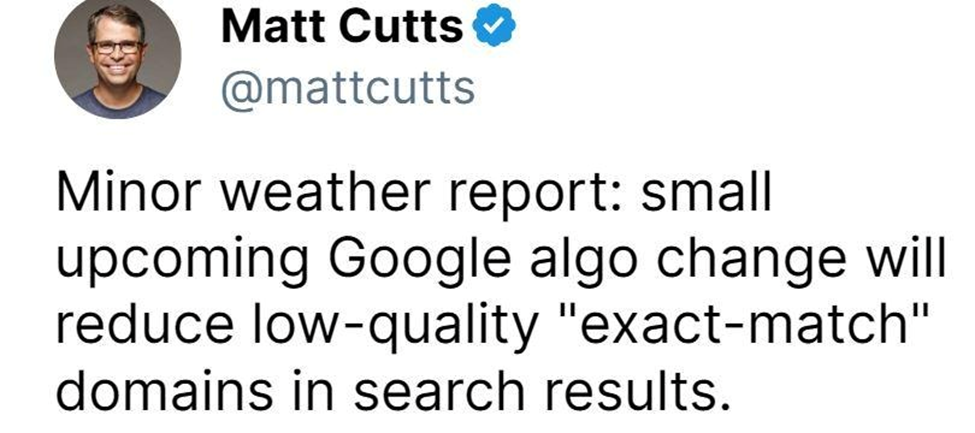
After the update, Moz documented significant traffic drops for thin EMD sites in the weeks that followed. The domain's role shifted from a primary ranking signal to a minor contextual one. However, EMDs still offer an advantage.
Here is the proof:
A March 2025 study by SEOExamples.com, examining 500 individual search results, found concrete evidence that EMDs retain a structural advantage:
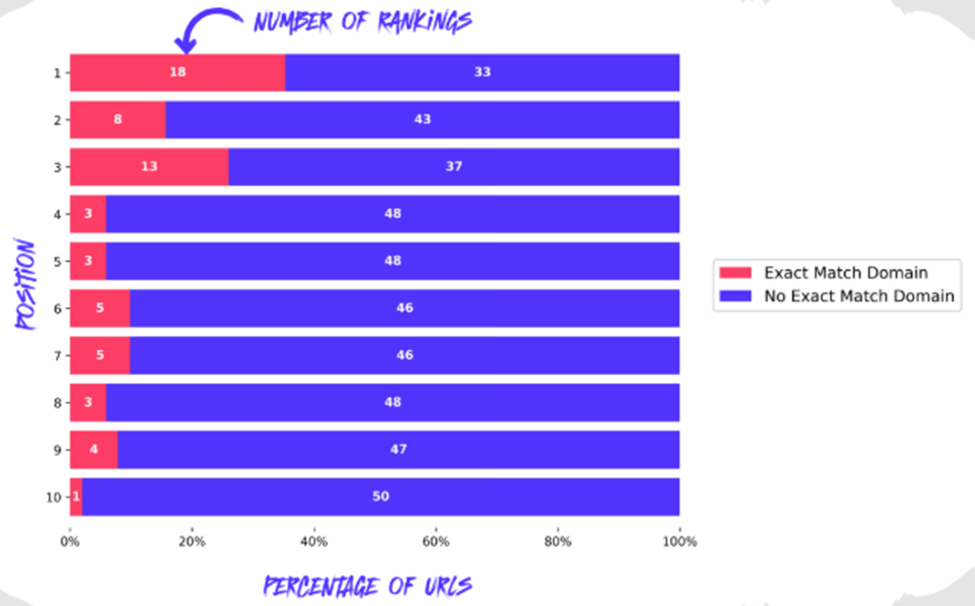
EMDs ranked in the top 10 with a Domain Rating of just 7.7 for local keywords, versus 30.9 for non-EMDs. For generic keywords: DR 20.6 vs. 43.6. EMDs require roughly 60% less domain authority to achieve the same ranking position.
EMDs appear disproportionately often in Google's top-3 results, approximately 25% of those positions, despite representing a small fraction of all registered domains.
There is a catch, though: 70% of EMDs rank only for their exact-match keyword. This is a critical limitation for startups that need to capture adjacent topics and grow their traffic over time.
The EMD Domain SEO Advantage:
EMDs no longer provide a direct ranking boost. As John Mueller stated, including specific keywords in domains will not help to boost rankings.
Instead, their value is indirect:
EMDs can improve click-through rates compared to non-matching domains for the same ranking position because the domain visually confirms relevance before the user clicks.
When other sites link to an exact match domain, the anchor text naturally carries the keyword, which creates legitimate relevance signals without any over-optimization risk.
In an AI-first search environment, this distinction matters even more. Large language models synthesize brand recognition, authority signals, and cited sources, not just keyword matches in URLs. Brandable domains have a growing structural advantage in AI Overviews and Google's AI Mode precisely because brand equity is something you build, not something a domain string delivers.
Here’s the verdict: An EMD can help you rank faster in a specific niche with less authority, but the benefit is narrow, keyword-specific, and will not scale broadly with your brand.
If you’re asking:
Does domain name help SEO? The answer is: slightly, through relevance and CTR
What’s the best domain name for SEO? It’s one that aligns with your long-term content strategy
The Real Cost of an Exact Match Domain — and What You're Giving Up
Let’s talk about the trade-offs.
New .com registrations can cost $10–$15 per year.
Premium aftermarket EMDs are a different universe entirely.
Take a look at the numbers:
In late 2024, OpenAI acquired Chat.com for more than $15.5 million to redirect it to ChatGPT.
Gold.com changed hands for $8.5 million in 2024.
In 2025, Icon CEO Kennan purchased Icon.com for $12 million for their artificial intelligence-based startup.
Even mid-tier EMDs in competitive verticals routinely list for $10,000–$500,000.
Let’s take a look at the opportunity cost. A $20,000 EMD budget, redirected toward content production, link building, and technical SEO, compounds over time in a way that a domain name simply cannot.
Content generates traffic across hundreds of keywords. Links build authority that raises every page on your site. An EMD only raises your ranking ceiling for one keyword cluster.
The brandability trap
Modern startups increasingly prioritize flexible branding. Here are a few recent examples:
Xreal originally launched as Nreal.ai, an EMD-adjacent tech domain. Following a legal dispute with Epic Games over 'Nreal' and 'Unreal' similarities in 2023, the company rebranded entirely to Xreal and secured Xreal.com. The original domain constrained the brand narrative and required an expensive pivot.
Moniepoint wasinitially launched as TeamApt in 2015 before rebranding in 2023 to its flagship product name, Moniepoint. The rebrand meant securing Moniepoint.com and rebuilding brand equity from scratch.
The spam-perception risk is also a concern. Overly generic EMDs, think cheapcarinsurancequotes.com, can read as low-trust to modern users who have learned to associate keyword-stuffed domains with affiliate spam.
This can actively hurt CTR and brand perception rather than help it.
Finally, do not overlook renewal cost traps.
Are premium domains worth it when the annual renewal fee erodes your runway? A .ai EMD runs $70–$160/year in renewals, depending on your registrar.
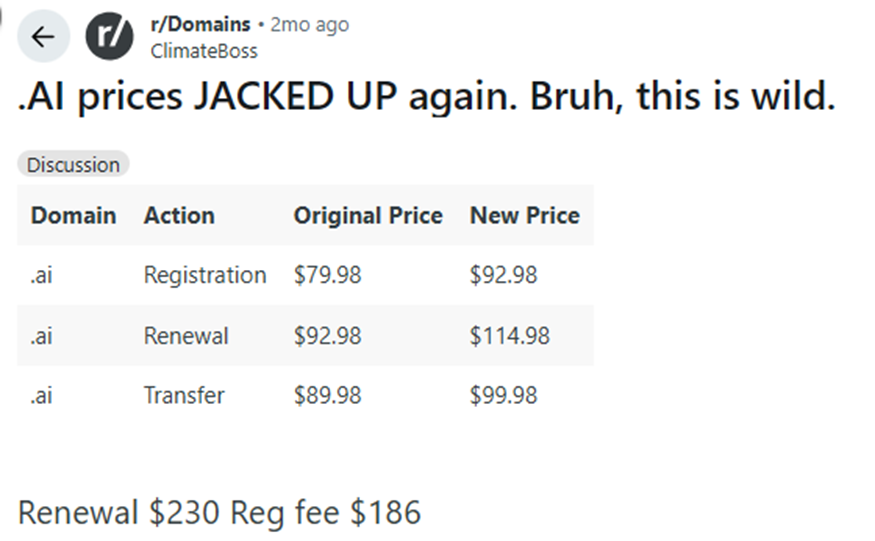
These are small numbers individually, but they signal that premium TLD infrastructure costs are not fixed.
EMD vs. Brandable Domain: Which Is Right for Your Startup?
The decision between EMDs vs brandable domains can be a tricky one, especially when looking for startup domains.
Let’s take a look at the key differences:
Aspect | EMD | Brandable Domains | Partial Match Domains (PMD) |
SEO quick win | High but niche-based | Low initially | Medium |
Brand scalability | Low (boxed into keyword) | High | Medium–High |
Aftermarket cost | High ($1K–$500K+) | Low–Medium | Low–Medium |
User trust signal | Mixed (can look spammy) | High if executed well | Medium |
Anchor text benefit | Strong — natural keyword match | Brand-only | Partial keyword benefit |
AI/LLM visibility | Low — not brand-recognized | High as brand grows | Medium |
Best use case | Local/niche, affiliate, MVP testing | Long-term brand build, fundraising | Startups wanting SEO plus brand balance |
Here is the domain to use based on your specific startup stage:
Pre-revenue / MVP stage: Use a brandable .io or .co. Do not invest in an EMD premium before product-market fit. Startups domains at this stage should minimize switching costs.
Post product-market fit: Evaluate an EMD only if the keyword is demonstrably your core acquisition channel long-term, and only if the cost does not crowd out content and link investment. Run the domain through multi-signal domain appraisal tools first.
Scale-up / fundraising stage: Use a premium .com, whether brandable or EMD. It signals credibility to domain investors. At this stage, the domain is part of your brand equity story, and the cost is more justifiable.
When Are EMDs Useful?
Exact match domains are still relevant, but not in most cases. Here are instances when EMDs are useful:
Local and geo-service businesses
MVP validation plays
Niche affiliate and informational sites
When the EMD is also a genuinely great brand
For many startups, partial match domains offer a balance because they retain some keyword relevance and allow brand flexibility.
How to Value an Exact Match Domain Before You Buy
There is no one-size-fits-all formula for evaluating EMDs. However, the last mistake you can make in EMD valuation is using a single-metric free tool and treating the output as your price ceiling.
Free domain valuation tools can provide quick estimates, but often miss critical signals like:
Keyword CPC
True search demand
Comparable domain sales
Backlink quality
You risk undervaluing a strong commercial EMD by 10X or overvaluing a vanity domain with zero commercial intent.
That’s where multi-signal analysis becomes important. Instead of relying on a generic domain value checker, you can use tools like Bishopi’s domain value analysis to evaluate domains.
The tool evaluates EMDs based on multiple data points, including search volume, CPC, comparable sales, SEO, and domain authority signals, so you’re not making a five-figure decision based on guesswork.
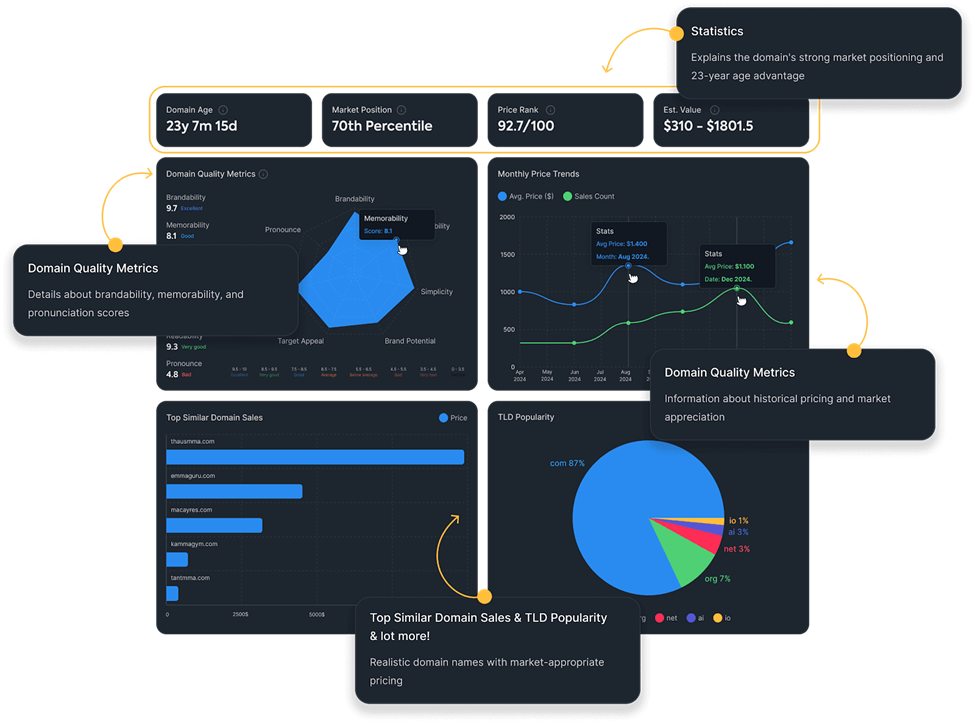
You must also look at past sales for similar EMDs so you don’t undervalue or overvalue the domain. Tools like NameBio provide a searchable database with historical sales data for comparing pricing, but don’t surface sufficient data for solid decision-making.
You will need to use it alongside another tool, but this means managing two subscriptions and accounts.
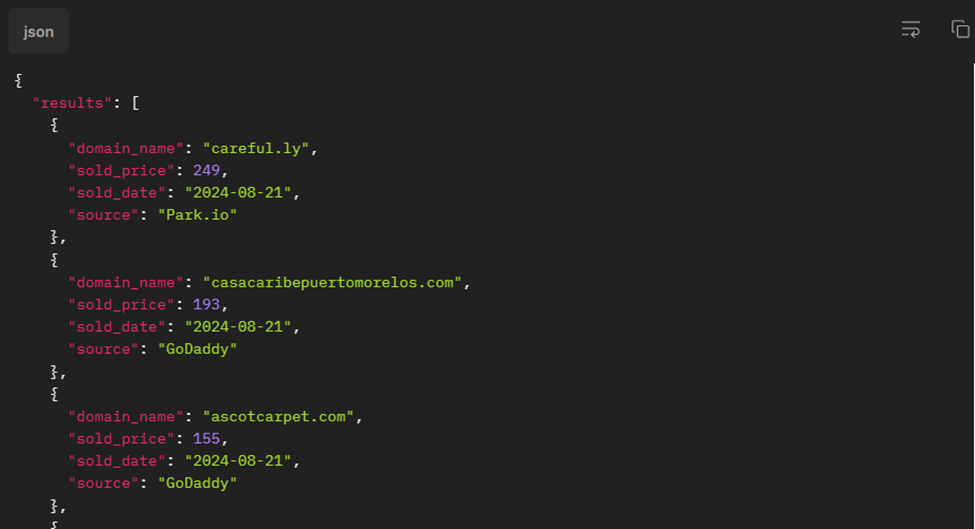
A domain name sales history tool like the one offered by Bishopi combines verified transaction data with real-time market demand signals in one single view.
Using this tool, you can view verified current and past pricing of similar EMDs, sales dates, and their respective marketplaces in real time.
You can also uncover high-performing EMD categories and niches to benchmark current against past sales performance.
If you’re evaluating EMDs programmatically at scale, a domain analysis API can help you with bulk research without manual lookup.
A practical rule of thumb: An EMD is priced fairly if its annual keyword CPC value (search volume × CPC × 12 months) exceeds the asking price within 2–3 years. Above that, you are paying for speculation, not a commercial signal.
Final Verdict
An exact match domain is worth paying for if, and only if, it meets these three conditions simultaneously:
The exact keyword is demonstrably your primary long-term acquisition channel
The cost does not crowd out content, link building, and technical SEO investment
The domain does not box you into a niche you will outgrow.
For most pre-revenue startups, a strong brandable domain paired with excellent content and a disciplined SEO strategy can beat a premium EMD every time. This is because the compounding returns on content and authority investment far exceed the one-keyword advantage an EMD delivers, and they do not constrain your brand as the business evolves.
For the right use cases, local SEO, niche affiliate sites, MVP validation, well-funded growth-stage companies with a proven acquisition channel, an EMD reduces the authority needed to rank and delivers a measurable CTR advantage.
Before you pay a premium for any domain, run it through Bishopi domain analysis to validate the commercial signal against real keyword data and comparable sales.
Explore how Bishopi domain tools can power your EMD valuation workflows.
Frequently Asked Questions
What is an exact match domain (EMD)?
An exact match domain is a domain name that exactly matches specific search terms or keywords. These domains are designed to signal relevance to search engines and users. Historically, EMDs helped rankings, but today their impact depends more on content quality, authority, and overall user experience.
Do exact match domains still help SEO in 2026?
Exact match domains can still provide a slight relevance signal, but they no longer guarantee higher rankings. Modern SEO prioritizes high-quality content, backlinks, user intent, and site performance. An EMD may improve click-through rates if it matches search intent, but without strong content and authority, it offers minimal ranking advantage.
Are premium domains worth it for startups?
Premium domains can be valuable for startups if they enhance brand credibility, memorability, and trust. A short, keyword-rich, or highly brandable domain may improve marketing and direct traffic. However, you should balance cost with budget priorities, as investing in product development and marketing often delivers greater long-term returns.
How do I determine the value of an exact match domain?
The value of an EMD depends on various domain name valuation factors like keyword search volume, commercial intent, competition, length, and brandability. High-value EMDs usually target profitable industries and have strong demand. Additional factors include domain history, backlink profile, and comparable sales data from domain marketplaces to estimate realistic pricing.
Originally published at: www.bishopi.io
Stay up to date
Get updated with all the news, update and upcoming features.