How to Buy Premium Domains: A Practical Buyer’s Guide
The difference between a $50,000 domain and a $97,000 one usually isn’t obvious at first glance.
Both can look clean, brandable, and “premium.”
Recent domain sales make this obvious:
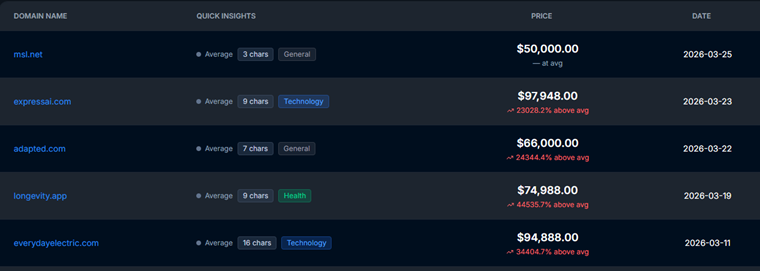
On the listing, you see a name, a price, and a “premium” label. But it doesn’t show how the seller reached that price tag.
“Premium” isn’t a standard. It’s a label applied across very different assets.
So the real question is: what’s the right price to pay for valuable domains?
The difference comes down to the data you check before making an offer. This guide walks through how to find, evaluate, and buy premium domains.
What Makes a Domain Premium?
The term “premium domain” refers to two fundamentally different products, and confusing them leads buyers to make bad decisions.
Here is a quick breakdown:
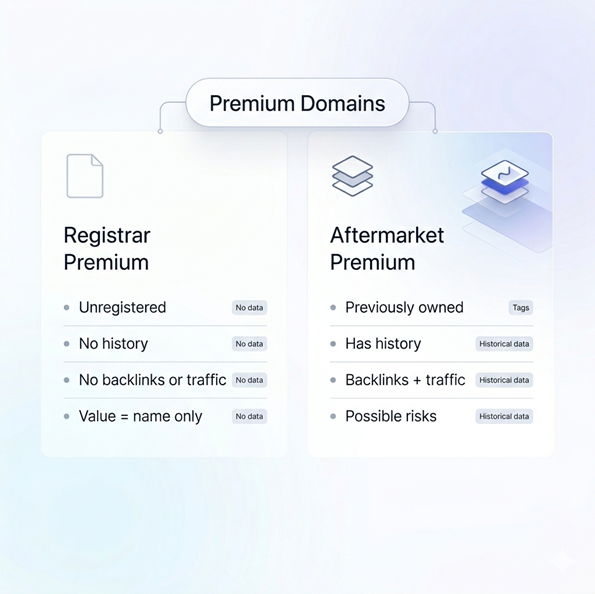
Registrar-Premium Domains: They are unregistered names priced above standard registration by the registry itself. There is no previous owner, backlinks, or traffic history. Basically, you're paying for the domain name and nothing else.
Aftermarket-Premium Domains: These domain names are previously owned and are listed for resale. These domains carry a full history: prior rankings, backlinks, traffic patterns, and sometimes penalties.
That history is either the most valuable thing you're buying or the biggest liability.
In most cases, you’ll be evaluating the second category.
That’s where the work is.
You need to check the domain reputation and whether the underlying signals justify the price. That means checking demand, links, traffic, and comparable sales before you make an offer.
Factors That Affect the Prices of Domain Names
There isn’t a fixed formula for coming up with the final asking price, but a few trust signals consistently shape the final domain value.
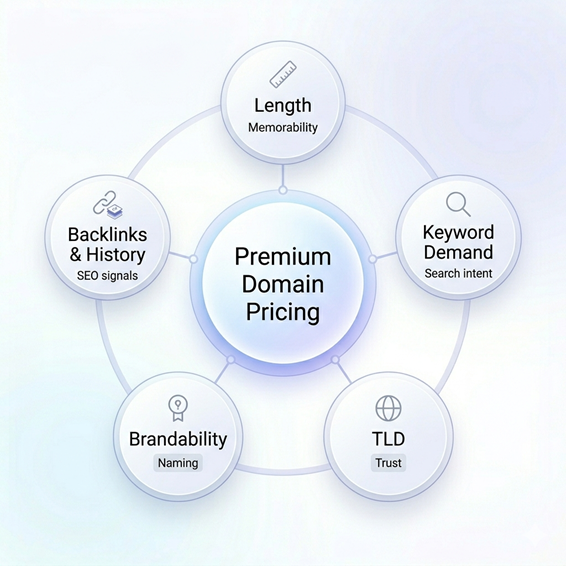
When you look at the price of any premium domain, check these five signals:
Length: Shorter domains are easier to use and remember, which is why they’re often priced higher. But length is usually a proxy, not a driver. A longer domain with real demand or strong history will often outperform a shorter one without it.
Keyword demand: This is the most reliable anchor. A domain tied to a keyword with measurable search demand and commercial intent carries a built-in opportunity. Without that, pricing becomes speculative.
TLD: .com tends to hold value because it’s easier to trust and resell. Other TLDs can work well in specific markets, but their pricing depends more on context than consistency.
Brandability: Some domains function well as names, not because of search demand but from how easily they can be adopted as a brand. This makes the pricing less predictable.
Backlinks and history: For aftermarket domains, history can shift pricing significantly. A clean, relevant backlink profile can support the price. A weak or unclear one can limit it, regardless of how strong the name looks.
However, pricing isn’t driven by any one factor in isolation. It’s the mix that determines whether the number holds up.
Where to Find Premium Domains for Sale
Now you know what to look for in a premium domain.
The next question is where to find them.
Most buyers start with marketplaces, then move into expired domains or social channels where pricing is less fixed, and deals show up earlier.
A) Dedicated Marketplaces
Most people start here to find premium domains for sale. Remember, while they’re a great starting point, the pricing won’t always make sense.
Marketplace | What It Is | What to Know | When to Use |
Sedo | Largest global marketplace with a wide range of premium domain names. | Inventory ranges from low four-figure names to headline sales. The highest sale price in 2024 was $ 500,000, but the median was under $549 - most deals happen well below visible top-end listings. | Useful for getting a feel for the market and understanding pricing ranges. |
Afternic | Distribution network behind many “buy now” premium listings on registrars. | Many listings seen on GoDaddy or Namecheap originate here. Strong on .com inventory. Transfers are typically smooth once your payment clears. | Good for sourcing .com domains and completing straightforward purchases. |
Atom (Formerly Squadhelp) | Curated marketplace for brandable domains with built-in branding. | Domains come packaged with logo, positioning, and brand identity. Part of the price reflects presentation, not just the domain itself. | Useful if you want a ready-to-use brand. Less suited for pure domain evaluation. |
Flippa | Marketplace for domains listed by owners. | Seller-driven inventory with mixed quality. Pricing often includes traffic or revenue. | Useful for negotiated deals and access to less visible listings, including domains bundled with traffic or projects. |
B) Expired Domains
Platforms like GoDaddy Auctions, SnapNames, and DropCatch surface domains as they move through the expiration cycle, which is where aged inventory starts to re-enter the market.
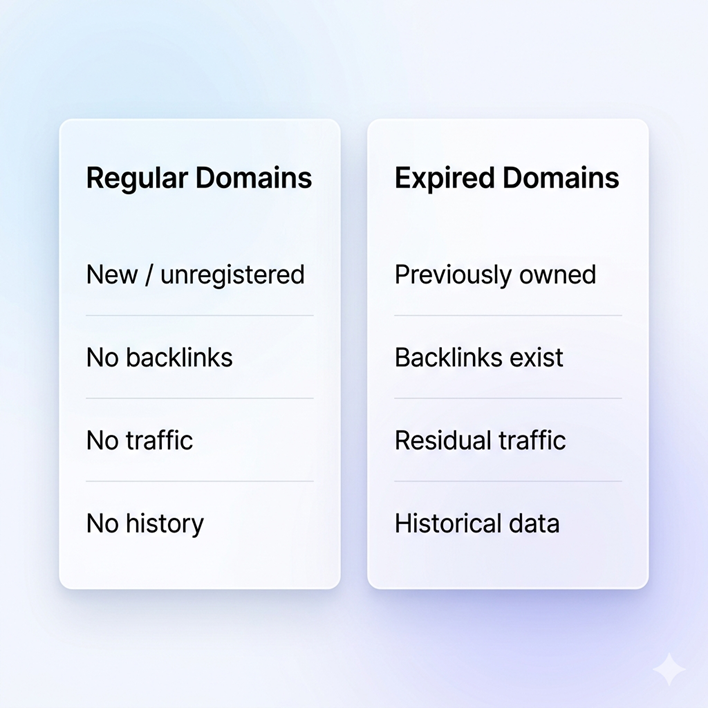
You’ll come across domains with existing backlink profiles, and sometimes residual traffic. That’s where real opportunities can show up, including names priced below what their underlying signals would suggest.
At the same time, you’re inheriting everything that came before.
Some of these domains were legitimate businesses with clean histories. Others were built for short-term SEO and carry link profiles that don’t hold up. The listing won’t tell you which is which.
Key Insight: Vet all expired domains thoroughly. It determines whether you’re buying something with built-in value or something you’ll have to work around.
C) Social and Community Channels
Domains are also often shared outside formal marketplaces on social media platforms. That changes how they’re priced and how deals come together.
There are no listing commissions, and you’re usually dealing directly with the owner. As a result, pricing tends to be more flexible, and conversations are less structured.
If you’re looking for premium domains on social media, here’s a quicker starter guide:
Channel | What It Is | What to Know | When to Use |
Reddit r/domainselling / r/Entrepreneur | Peer-to-peer listings from individual sellers. | Mix of serious sellers and casual posts. Limited structure, so credibility depends on signals like post history and account age. | Useful for early-stage deal discovery, but requires careful vetting. |
X | Active domainer community with real-time listings. | Listings often appear before they reach marketplaces. | Best for sourcing early deals and reaching owners directly. |
Facebook Groups | Informal marketplaces with varying quality. | Some groups are well-moderated with established sellers; others are not. | Useful for deal hunting, but only with strict due diligence. |
Targeted sourcing through professional networks. | Owners of niche or industry-specific domains are often easier to identify here than on marketplaces. | Best when looking for a specific domain tied to an industry. | |
NamePros | Core domain investor community and marketplace. | Includes reputation scores based on transaction history. | Useful for both sourcing domains and understanding realistic pricing before negotiating. |
How to Evaluate Whether a Premium Price Is Justified
Most premium domains look expensive. The tricky part is figuring out if they’re actually worth it.
The asking price is just the seller’s side of the story. Until you break it down, you don’t really know what you’re paying for.
Here is a quick framework you can use to evaluate any premium domain:
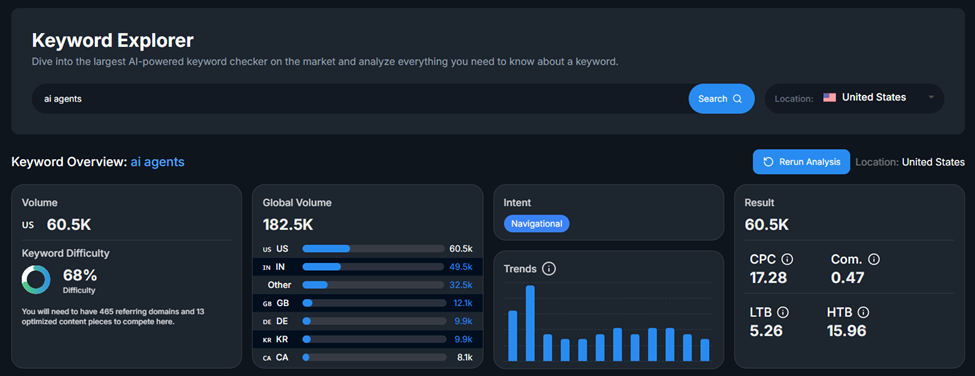
Step 1: Validate Keyword Search Demand
A keyword-rich domain only carries SEO value if people are actually searching for that keyword with commercial intent.
High search volume alone isn't enough - you want volume plus high CPC, which signals that advertisers are paying to reach people searching that term.
To find out these metrics, log in to Bishopi's Keyword Research tool. You’ll easily be able to compare two competing domains with CPC, difficulty, and volume.
Screenshot via Bishopi
Step 2: Audit the Backlink Profile
When you’re buying an aftermarket domain, you’re not just buying the name. You’re buying its backlink profile and the reputation that comes with it.
If the profile is strong, you’re inheriting authority that’s already been built. If it’s weak or manipulated, you’re inheriting a problem that doesn’t go away when ownership changes.
To get a clear idea of what you’re getting, run the domain through Bishopi’s Backlink Analysis tool and look at a few things closely - total referring domains, their authority, how relevant they are to the niche, the anchor text distribution, and any signs of spam.
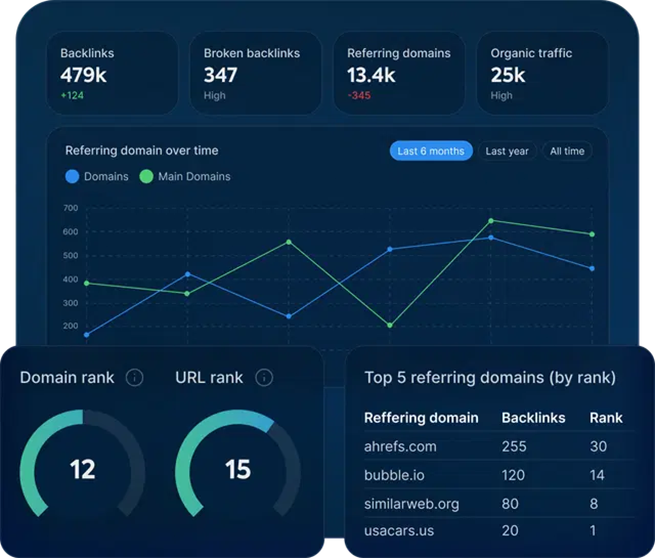
The difference here is usually clear.
Fifty referring domains from authoritative, relevant sites means you’re inheriting trust that has already been established.
That’s time and effort you don’t have to rebuild.
But 300 links from low-quality directories and unrelated foreign-language sites means you're inheriting a liability.
Step 3: Check Historical Traffic
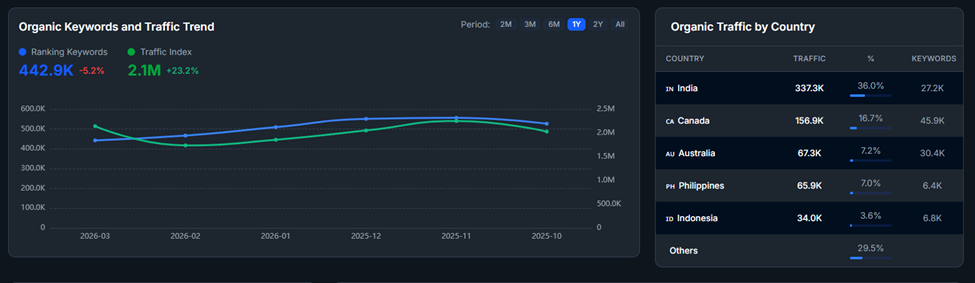
A domain that once ranked and drove consistent organic traffic has demonstrated real-world SEO potential. A domain that sat parked for a decade has theoretical value only - the seller is pricing the name, not the performance.
Use Bishopi's Competitor Analysis tool to check the domain's traffic history.
[Screenshot via Bishopi]
A sharp drop to zero in a domain that previously had steady traffic often signals a manual penalty or a significant algorithm hit.
Flat or nonexistent history against a high asking price means the price is based on what the domain could be worth, not what it has been worth.
Step 4: Pull Comparable Sales
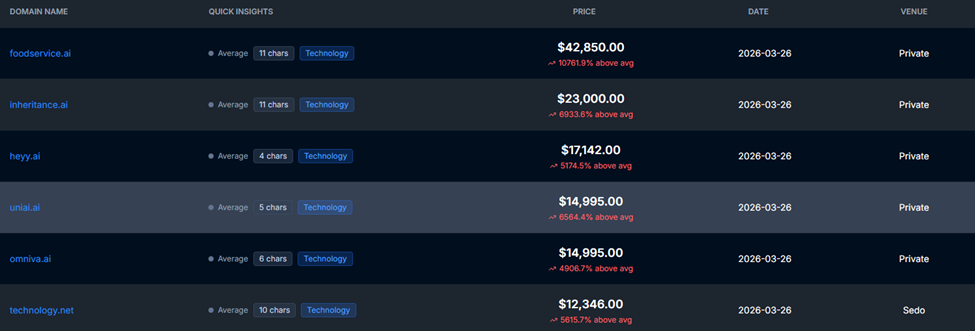
You can also sanity-check pricing by looking at what similar domains have actually sold for.
That gives you a real reference point, not just the seller’s asking price, and helps you negotiate with more confidence.
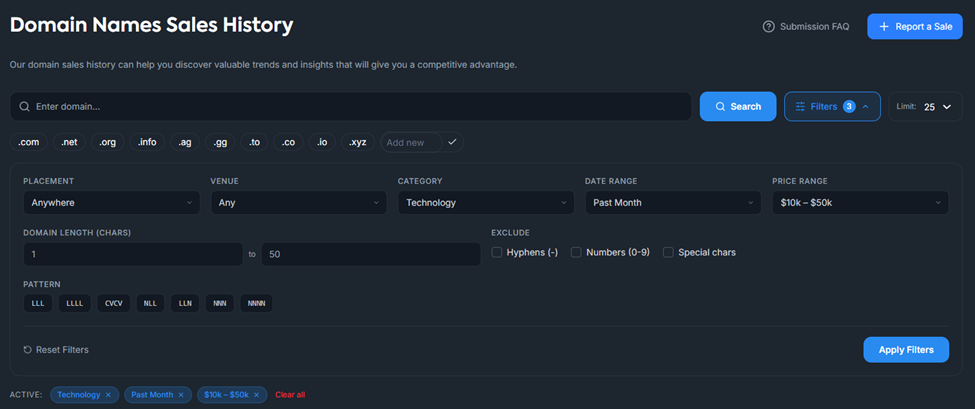
With Bishopi’s Sales History tool, you can filter by category, TLD, and date range to find comps that actually match your domain, so you’re not guessing what it should be worth.
[Screenshot via Bishopi]
With just a few clicks, you can pull up a list of premium domains along with their actual selling prices. That gives you a grounded view of what buyers are really paying, not just what sellers are asking.
[Screenshot via Bishopi]
Step 5: Check Domain History and Previous Use
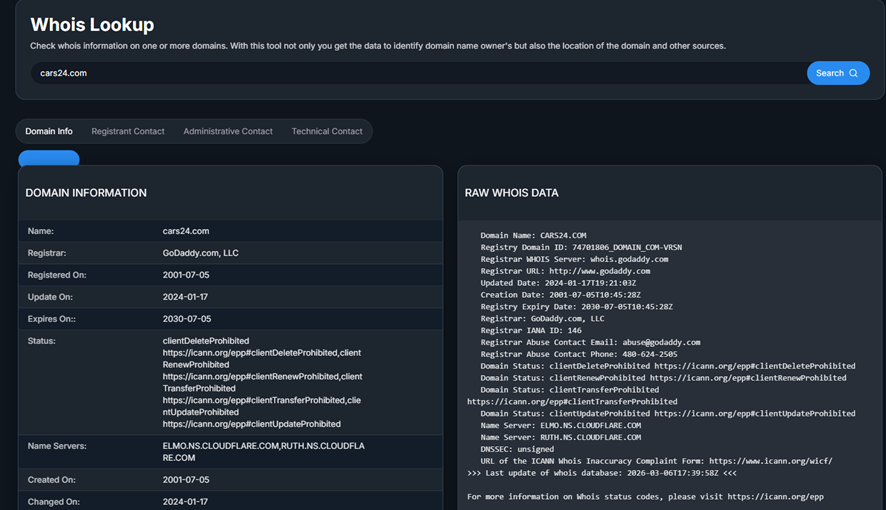
Run the domain through Bishopi’s WHOIS Lookup tool to see what the site actually looked like under previous ownership. Was it a real business, a content site, a link farm, or a parked page?
Cross-reference with WHOIS history to identify ownership changes and registration gaps.
[Screenshot via Bishopi]
Domain-level penalties can survive ownership changes. If the previous owner ran a link scheme or hosted content that triggered a manual action, that history doesn't disappear when you buy the domain.
A clean chain of ownership with consistent, legitimate use is a positive signal.
Once you've run all five checks, the question is straightforward: does the data support the price?
If it doesn't, the asking price is a starting position, not a conclusion.
How to Negotiate the Right Price for a Premium Domain
Once you’ve worked out what the domain is worth, negotiation becomes a data exercise. You’re not trying to “win.” You’re trying to stay anchored to what the domain supports
Step #1: Set Your Starting Position
In domain deals, there is no fixed floor for an opening offer. Starting at 20–40% of the asking price is common and rarely offensive, particularly when you can back the number with data.
What matters is the reasoning, not the percentage.
Base your range on what you’ve found:
Search volume (e.g. 0 vs 1,000+ monthly searches)
Backlink strength (e.g. 20 relevant domains vs 300 low-quality links)
Traffic history (none vs consistent organic traffic)
Comparable sales range
Move lower if the domain has clear issues, and closer to that range if the data is clean and comparable sales support it.
What matters here is the reasoning.
An offer backed by specific points gets taken seriously. A round number without context looks like a low offer.
Step #2: Anchor to Comparable Sales
Look at domains with the same TLD, similar structure, and within the same category over the past 12 to 24 months.
When you bring comparable sales into the conversation, you’re no longer negotiating based on opinion. You’re referencing what the market has already accepted. That gives you an upper hand.
Step #3: Cite Specific Domain Issues
It helps to be specific about what you’re seeing in the domain itself.
If the backlink profile is thin, say so. If most links come from low-authority directories, that’s relevant. If there’s no evidence of organic traffic or past rankings, that matters too.
On the other hand, if the domain has strong, relevant backlinks or a history of performance, that supports the price and changes how you approach the deal.
Step #4: Propose Escrow
Once there’s some alignment on price, the structure of the deal becomes the next step.
Bringing up Escrow.com early tends to keep things straightforward. It is the most widely used service for domain transactions - both buyer and seller are protected, and the transfer only completes once funds are confirmed.
It signals that you understand how domain transactions work and removes uncertainty from the process.
If the gap is small but still there, structure can often solve it. Many sellers are open to instalment payments or split deals, especially at higher price points. In those cases, the total price isn’t always the issue. It’s how it’s paid.
Step #5: Go Through a Broker for High-Value Targets
For higher-value domains, particularly those that aren’t publicly listed, it can also make sense to involve a broker.
Not because the process is complicated, but because it changes how the conversation starts. Keeping your identity and budget out of the initial exchange gives you more control over how the negotiation develops.
5 Mistakes You Should Avoid While Buying Premium Domains
Most mistakes happen before the offer. They come from relying on the listing instead of checking what actually supports the price.
These are the ones that tend to cost the most.
Overpaying for weak demand: A domain can look great but still have no real search demand behind it. If people aren’t actively searching with intent, you’re buying a name, not something that drives value.
Not vetting the quality of backlinks: Not all history helps. A messy or irrelevant link profile can hold you back, while a clean one can justify the price. You need to look before you buy.
Confusing age with value: An old domain isn’t automatically a strong one. What matters is how it’s been used. No real content or links usually means domain age alone isn’t doing much.
Choosing the wrong TLD: Extensions shape trust more than people expect. If your audience leans toward .com, going with something else can make adoption and resale harder.
Skipping escrow in direct deals: There’s no safe middle ground without structure. Escrow exists for a reason. It keeps both sides protected while the transfer actually happens.
With premium domains, you’re paying more, so small mistakes cost more. The good ones usually make sense across demand, history, and usability.
The Final Decision Comes Down to Data
When you check a listing for any premium domain, it is best to begin with a simple question: Does this price actually make sense?
You won’t get that answer from the listing itself. It comes from looking at demand, backlinks, traffic, and comparable sales together.
It also doesn’t really matter where you found the domain. The same check applies every time.
If you run that process before making an offer, it becomes much clearer whether the price holds up or starts to fall apart.
Originally published at: www.bishopi.io
Stay up to date
Get updated with all the news, update and upcoming features.